
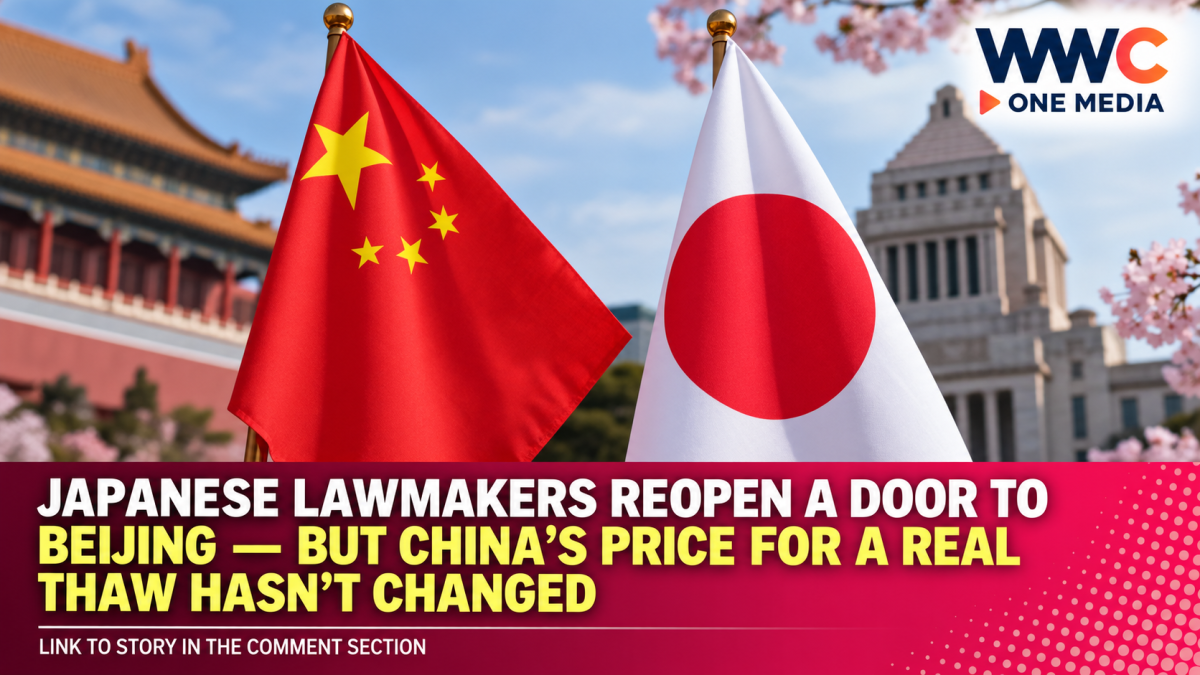
BEIJING — After months in which official Japan-China political contact nearly disappeared, eight Japanese lawmakers have walked through a door that both governments have struggled to reopen.
A cross-party delegation from the Japan-China Friendship Parliamentarians’ Union arrived in Beijing on September 13 for a three-day visit aimed at restoring communication between Asia’s two biggest economies.
Led by Liberal Democratic Party lawmaker and former State Minister of Justice Masahiro Komura, the delegation includes politicians from five ruling and opposition parties. It is the friendship league’s first China mission since relations deteriorated dramatically after Prime Minister Sanae Takaichi’s remarks about a potential Taiwan conflict in November 2025.
On Monday, Komura and his colleagues held a roughly two-hour meeting with Chinese Assistant Foreign Minister Liu Bin.
The Japanese side stressed the importance of keeping communication open and raised concerns about Japanese nationals detained in China.
Afterward, Komura called the fact that the two sides had been able to meet face to face a significant step.
Later in the day, the delegation met Yang Wanming, president of the Chinese People’s Association for Friendship with Foreign Countries, a state-backed organization involved in China’s overseas people-to-people diplomacy.
Yet beneath the handshakes lies a much more uncomfortable reality.
Neither Tokyo nor Beijing has publicly moved on the disagreement that caused their relationship to collapse.
And that disagreement is Taiwan.
One sentence helped plunge relations into crisis
The current dispute can be traced to remarks Takaichi made in parliament in November 2025.
She said a Chinese military attack or blockade involving Taiwan could, depending on the circumstances, constitute a “survival-threatening situation” for Japan.
That phrase carries specific significance under Japanese security legislation. Such a determination could allow Japan to exercise limited collective self-defense if an attack on a country closely connected to Japan threatened Japan’s survival.
Beijing interpreted Takaichi’s statement as suggesting Japan could become militarily involved in a Taiwan conflict and reacted furiously.
China claims democratically governed Taiwan as part of its territory and has not renounced the use of force to bring the island under its control.
Japan, meanwhile, says its fundamental position on Taiwan has not changed.
Tokyo points to the 1972 Japan-China Joint Communiqué, under which Japan recognized the People’s Republic of China as the sole legal government of China and said it “fully understands and respects” Beijing’s position regarding Taiwan.
Foreign Minister Toshimitsu Motegi has repeatedly said Japan’s basic Taiwan policy remains exactly as set out in that communiqué.
But Takaichi has not withdrawn the remarks that triggered the crisis.
And Beijing has made clear that this matters.
China already told another Japanese delegation: Change your Taiwan position first
The latest mission comes only weeks after another, smaller group of Japanese lawmakers traveled to Beijing in late August.
That visit demonstrated both the usefulness — and the limits — of parliamentary diplomacy.
Chinese Communist Party official Lu Kang told that delegation that bilateral relations were facing “serious difficulties” and that Beijing’s position would not change unless Japan changed its approach to Taiwan.
Delegation leader Shinichi Isa described the meeting as difficult, with sharp exchanges, but argued that simply reopening contact was itself progress after months of almost no political dialogue.
That makes the latest visit notable.
China is allowing political exchanges to restart.
But so far it has shown no indication that reopening communication means softening its fundamental demands.
In other words, Beijing appears willing to talk without yet being willing to compromise.
Tokyo appears to be taking the same approach
Japan is also trying to separate dialogue from concessions.
Its official position remains that China is an important neighboring country with which Tokyo seeks a “constructive and stable” relationship, while Japan simultaneously raises concerns about Beijing’s military activities, the East China Sea, economic coercion and the Taiwan Strait.
Motegi has repeatedly said that precisely because serious disputes exist, communication between the two sides is necessary.
That helps explain why lawmakers are doing what diplomats have struggled to do.
Parliamentary groups provide a semi-official channel through which messages can be exchanged without requiring either government to announce a major political concession.
Japan and China have used such channels during previous downturns in relations.
This time, however, the gap appears unusually wide.
The diplomatic fight has already become an economic one
The biggest reason neither country can easily ignore the relationship is money.
According to JETRO, bilateral trade rebounded 6.2% in 2025 to approximately $343.25 billion after three consecutive years of decline.
Japanese exports to China totaled roughly $165 billion, while imports from China reached about $178.3 billion.
China accounted for 20.3% of Japan’s total trade, making it Japan’s largest trading partner overall. It supplied 23.6% of Japanese imports.
Those numbers make the political freeze economically dangerous.
Japanese companies depend on Chinese factories, customers and raw materials.
China, meanwhile, benefits from Japanese investment, machinery and technology.
Yet since the Taiwan dispute erupted, economics has increasingly become part of the confrontation.
And nowhere is that clearer than rare earths.
Four critical materials: zero exports to Japan in June
China dominates the processing of many critical minerals used in everything from electric vehicles and semiconductors to aircraft engines and defense equipment.
Beijing had already introduced export controls covering certain heavy rare earths before the latest Japan-China political dispute.
But it tightened measures specifically affecting Japan in early 2026, according to Reuters.
The result became stark in June.
Chinese customs data showed no gallium, dysprosium, terbium or yttrium exports to Japan that month.
That matters because Japan possesses the largest rare-earth magnet industry outside China but still depends heavily on Chinese supplies for key inputs.
Japanese manufacturers have warned that shortages could increasingly affect the broader economy.
Yttrium offers a particularly telling example.
It is little known outside industry, yet it is used in heat-resistant coatings protecting turbine blades in aircraft engines and power-generation equipment.
Reuters reported this week that restrictions on yttrium have turned the obscure element into a geopolitical pressure point involving China, Japan and the United States.
That makes the lawmakers’ Beijing trip about considerably more than diplomatic symbolism.
Japanese industry has something tangible at stake.
Detained citizens are another pressure point
Komura’s delegation also raised the safety and detention of Japanese nationals during its talks with Chinese officials.
The issue has been a source of anxiety among Japanese businesses for years.
A Japanese employee of Astellas Pharma was detained in Beijing in 2023 and later sentenced to three and a half years in prison on espionage-related charges. Japan called the ruling deeply regrettable, while Beijing said its judicial authorities handled the case according to law.
More recently, China detained two additional Japanese nationals in May 2026 over allegations that they attempted to smuggle prohibited goods.
China said the detentions were conducted according to its laws and urged Japanese citizens and companies operating there to comply with Chinese regulations. Japanese authorities have sought information and consular access.
For Japanese companies deciding whether to send executives and engineers to China, these cases have become part of the wider risk calculation.
The split between economics and security is getting harder to manage
Japan’s dilemma can be reduced to an uncomfortable contradiction.
Economically, China is indispensable.
Strategically, Tokyo increasingly views Beijing as its most consequential long-term security challenge.
Under Takaichi, Japan is pursuing a major defense expansion and strengthening military capabilities across its southwestern islands, some of which sit close to Taiwan.
Tokyo says the buildup is defensive and necessary because of China’s military expansion, North Korea’s weapons programs and a deteriorating regional security environment.
China portrays Japan’s defense changes very differently, accusing Tokyo of moving toward remilitarization.
The dispute is therefore bigger than one controversial parliamentary answer.
It reflects fundamentally different visions of the regional security order.
Japan wants the ability to help deter or respond to a Taiwan crisis that could directly affect its territory and U.S. bases in Japan.
China wants Tokyo to stay out of what Beijing regards as an internal matter.
Neither position is easily reconciled.
Even the lawmakers began their trip by looking at AI and robots
There was an interesting economic element to the delegation’s itinerary before the serious diplomacy began.
After reaching Beijing, the eight lawmakers visited the China International Fair for Trade in Services, where they looked at Japanese small-business exhibits as well as Chinese AI and robotics demonstrations.
Japanese television footage showed delegation members receiving briefings on technology already being deployed commercially in service industries.
It was a small but revealing reminder of how tightly rivalry and commerce now overlap.
Japan and China are competing in artificial intelligence, robotics, electric vehicles, semiconductors and advanced manufacturing.
Yet companies on each side remain deeply connected to the other’s market.
Even during a diplomatic crisis, economic disengagement is far easier to discuss than to execute.
More Japanese delegations are lining up behind this one
The latest trip may also be part of a broader attempt to rebuild connections from the bottom up rather than wait for a leaders’ summit.
Former Foreign Minister Takeshi Iwaya is expected to lead a trade-promotion delegation to China later this month.
The visit is being organized through the Japan Association for the Promotion of International Trade and is expected to focus heavily on economic ties.
Japanese business delegations are also preparing additional China visits later in the year.
Hiroshi Moriyama, president of the Japan-China Friendship Parliamentarians’ Union and a former LDP secretary-general, has said he also hopes to travel to China at an early opportunity.
Viewed together, the pattern is clear.
Tokyo’s political and business establishment appears to be trying to rebuild multiple channels at once:
lawmakers, trade organizations and business groups — even while formal government relations remain deeply strained.
This has happened before — but Taiwan makes this crisis different
Japan and China have endured numerous diplomatic crises since normalizing ties in 1972.
The two sides have clashed over history, the disputed Senkaku/Diaoyu Islands, visits by Japanese politicians to Yasukuni Shrine, Chinese maritime activity, Fukushima wastewater and trade.
Eventually, some form of dialogue has usually resumed.
Parliamentary diplomacy has often helped.
In 2024 and early 2025, senior lawmakers and political-party officials moved regularly between the two countries, supplementing government-level talks. China’s Communist Party openly encouraged such exchanges.
But Taiwan touches a more fundamental red line for Beijing than most previous disputes.
That means simply restoring meetings does not guarantee restoration of relations.
The biggest achievement may be that they are talking at all
Komura’s description of Monday’s meeting as a major step might sound modest.
There was no summit announcement.
No rare-earth breakthrough.
No release of detainees.
No settlement over Taiwan.
But several weeks ago, Japanese politicians were describing official channels as virtually severed.
Now, two separate parliamentary delegations have reached Beijing within three weeks.
An economic delegation is expected to follow.
That is movement.
It just should not be confused with reconciliation.
China has reopened the door to Japanese visitors while continuing to insist that Tokyo address the Taiwan issue.
Japan has resumed outreach while continuing to say its security policies and Taiwan position will be determined according to its own laws and longstanding diplomatic framework.
Both sides appear to want to stop relations from deteriorating further.
Neither appears ready to pay the political price the other is demanding for a full reset.
And that is why the latest Beijing visit matters.
Eight Japanese lawmakers have managed to restart a conversation. The real test is whether that conversation can survive the one subject neither Tokyo nor Beijing is prepared to surrender: Taiwan.




Leave a Reply