
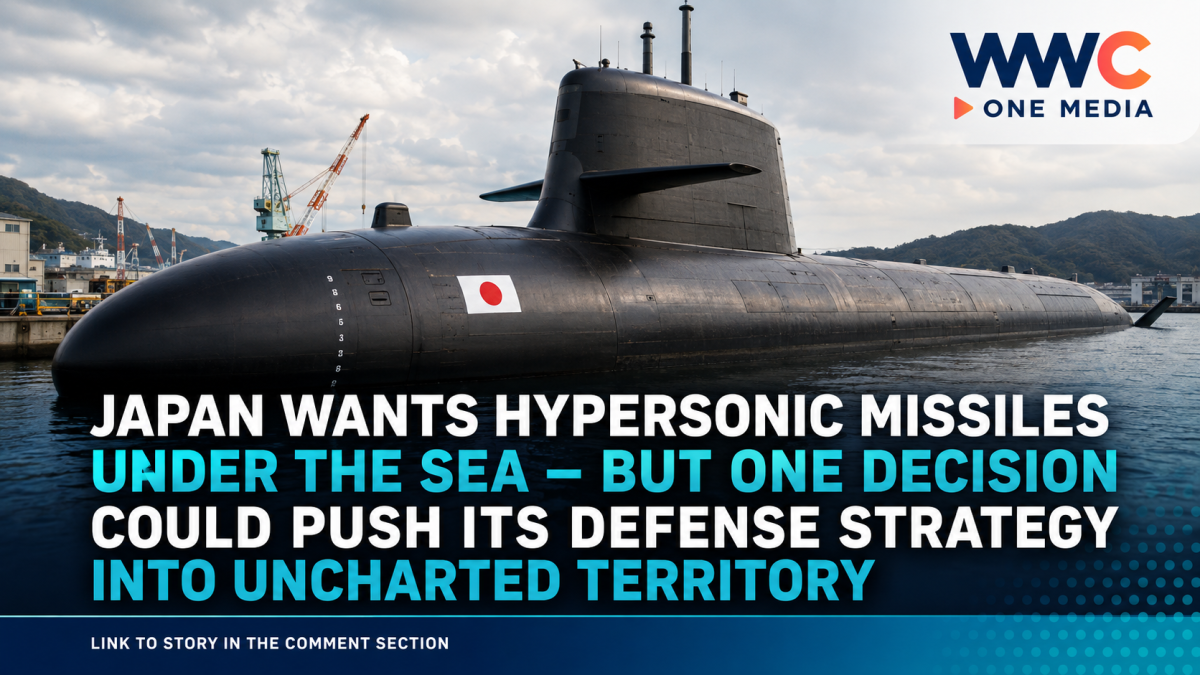
TOKYO — Japan is preparing to take one of its biggest military technology leaps in decades: putting hypersonic strike weapons beneath the waves.
But behind the futuristic missiles, submarines and unmanned underwater vehicles lies a much bigger question — one that reaches far beyond Japan’s rivalry with China.
How close could these new capabilities eventually bring Japan to possessing the building blocks of a sea-based nuclear deterrent?
For now, the answer requires an important distinction.
Japan has not announced plans to arm its submarines with nuclear weapons, and the government officially continues to uphold its long-standing non-nuclear policy. What Tokyo is doing, however, is building several pieces of military infrastructure that could dramatically strengthen its ability to launch long-range conventional strikes from difficult-to-detect underwater platforms.
That alone could reshape the balance of power in the Western Pacific.
Japan puts underwater hypersonic weapons on the budget agenda
Japan’s Ministry of Defense included development of an underwater-launched hypersonic guided missile in its fiscal 2027 defense budget request, part of a record ¥8.9 trillion, or roughly $55 billion-plus, spending proposal.
Janes reported that the ministry intends to develop an underwater-launched derivative connected to Japan’s Hyper Velocity Gliding Projectile program. The weapon would form part of Tokyo’s expanding stand-off strike capability — weapons designed to attack targets from outside an opponent’s immediate defensive range.
USNI News separately reported that the hypersonic project was submitted as an unpriced funding request, while Japan continues research into an underwater vertical launch system and pursues a separate long-range submarine-launched missile program.
That distinction matters.
The Ministry of Defense itself uses the broader term “underwater platform”, rather than saying the hypersonic weapon will definitely be carried by a crewed submarine. Janes notes that this leaves open several possibilities, including conventional submarines, large unmanned underwater vehicles, or potentially both.
In other words, Japan is not simply designing a bigger submarine missile.
It appears to be developing an entire undersea strike ecosystem.
Japan is already building the submarine side of the equation
Japan’s plans did not begin with the latest budget request.
An official Ministry of Defense assessment describes research into the design of a next-generation submarine equipped with a Vertical Launch System, or VLS. The study examines how missile-launch tubes and other systems could be integrated while preserving the submarine’s stealth and maneuverability.
The government document says research is scheduled to run through fiscal 2029 and explicitly connects submarine VLS technology with Japan’s broader stand-off defense strategy.
Naval News reports that Tokyo is also seeking ¥16.3 billion to acquire a separate Mitsubishi Heavy Industries-developed submarine-launched guided missile capable of attacking ships and land targets from stand-off distances.
That weapon is expected to be deployed on Japan’s newer Taigei-class diesel-electric submarines, which use lithium-ion batteries rather than nuclear propulsion.
So Japan’s underwater strike transformation is happening in layers: torpedo-tube-launched long-range missiles today, VLS research for future submarines, unmanned underwater missile-launch modules and now development of a hypersonic weapon designed to be fired from beneath the sea.
Why China will be watching closely
Tokyo says its military buildup comes in response to what it describes as its most severe security environment since World War II.
Chinese naval activity in the Pacific is a major concern.
According to Japan’s defense ministry, Chinese aircraft carriers operated on Japan’s Pacific side five times in 2025, up from twice in 2022. Tokyo is also responding to joint Chinese-Russian bomber operations and expanding Chinese naval access into the Western Pacific.
A submarine carrying long-range missiles creates a different problem for an adversary than land-based launchers or surface ships.
Land-based missile batteries can potentially be detected and targeted. Air bases can be attacked. Surface warships can be tracked.
A quiet submarine operating somewhere across thousands of square kilometers of ocean is much harder to locate.
Add a weapon traveling above Mach 5, and the defender’s reaction time becomes considerably shorter.
South China Morning Post has reported that Japan’s expanding hypersonic and underwater weapons programs are already attracting attention in China, particularly as Tokyo moves toward longer-range strike capabilities.
But calling them “nuclear submarines” goes too far — for now
This is where the debate becomes more complicated.
Japan currently operates conventionally powered submarines. Its Taigei class relies on advanced lithium-ion battery technology.
There is, however, an increasingly serious political discussion over whether future Japanese submarines should instead use nuclear propulsion.
The Japan Innovation Party, the junior partner in the governing coalition, called in June for Japan to introduce nuclear-powered submarines as quickly as possible.
The party argued that nuclear propulsion would provide the endurance needed for future VLS-equipped submarines to remain submerged for longer periods and operate much farther from Japan.
It also called for discussion of “nuclear sharing” and a review of part of Japan’s Three Non-Nuclear Principles.
But those are party proposals, not an adopted Japanese government program.
The dominant Liberal Democratic Party did not include equivalent nuclear-submarine or nuclear-sharing proposals in its own recommendations, according to The Japan Times.
That difference is crucial.
Nuclear propulsion is also not the same as nuclear weapons
A nuclear-powered submarine and a nuclear-armed submarine are two very different things.
Nuclear propulsion simply means a reactor supplies the vessel’s energy. Australia, for example, is pursuing nuclear-powered submarines through AUKUS while remaining a non-nuclear-weapons state.
A submarine becomes part of a nuclear deterrent only if it carries nuclear weapons.
Japan has announced no such plan.
Tokyo remains a non-nuclear-weapon state under the Nuclear Non-Proliferation Treaty, and Japan’s Foreign Ministry says the country adheres to its Three Non-Nuclear Principles: not possessing, not producing and not permitting the introduction of nuclear weapons into Japanese territory.
The government was still publicly reaffirming that policy after a nuclear-weapons controversy in late 2025.
So why is the “nuclear latency” argument gaining attention?
Because weapons infrastructure can matter even when the weapons themselves remain conventional.
Asia Times argues that a combination of highly survivable submarines, vertical missile launchers and long-range hypersonic weapons could eventually provide part of the delivery architecture required for a future sea-based nuclear deterrent — if a future Japanese government ever made the political decision to pursue one.
That is a scenario, not current Japanese policy.
Still, Japan possesses an exceptionally advanced civilian nuclear industry and maintains substantial stocks of separated civilian plutonium under international safeguards.
Japan’s Atomic Energy Commission projected its plutonium holdings at roughly 44.5 tonnes for fiscal 2025, much of it stored overseas and intended for civilian nuclear-energy purposes.
That plutonium stockpile should not be confused with a nuclear-weapons stockpile. Japan’s civilian nuclear material is subject to safeguards, and possessing civilian plutonium does not mean Japan has decided to weaponize it.
But Japan’s combination of nuclear expertise, advanced aerospace technology and an increasingly sophisticated missile industry is why defense analysts have long described the country as having significant technological “nuclear latency” — the theoretical ability to move faster than many countries if its political strategy ever fundamentally changed.
Japan’s nuclear debate is becoming harder to ignore
That political barrier remains enormous.
Japan is the only nation to have suffered atomic bombings in war, and Hiroshima and Nagasaki continue to shape public attitudes toward nuclear weapons.
Yet the debate over nuclear deterrence has become noticeably more visible.
Prime Minister Sanae Takaichi has said the government currently maintains the Three Non-Nuclear Principles, but questions have persisted about whether all of their wording — particularly the prohibition on allowing nuclear weapons to enter Japanese territory — will remain untouched as Tokyo revises its major national-security documents.
At Hiroshima in August, Takaichi said Japan was “upholding” the principles but avoided prejudging how they might appear in the revised security documents.
At the same time, Japan remains protected by the United States’ extended nuclear deterrent.
That creates an increasingly difficult strategic question for Tokyo: how far can Japan strengthen conventional deterrence without changing the nuclear rules that have defined its postwar security identity?
The bigger story is not one missile
Japan’s underwater hypersonic program therefore matters for reasons far beyond speed.
Combined with VLS-equipped future submarines, long-range conventional missiles, Tomahawks, improved Type 12 missiles, unmanned underwater vehicles and stronger intelligence capabilities, it points toward a Japanese military increasingly designed to strike farther from home and survive an adversary’s first attack.
Japan’s fiscal 2027 request also seeks funding for AI-supported command systems, drones, missile defenses and an expanded Pacific surveillance network, demonstrating how broadly Tokyo’s defense strategy is changing.
None of that means Japan is secretly building nuclear weapons.
But it does mean the technical distance between Japan’s traditional self-defense posture and a highly survivable long-range strike force is getting smaller.
And that could leave Tokyo facing a decision much bigger than whether to put hypersonic missiles on submarines.
The real question may eventually be what Japan chooses to do with the military architecture it is now building — and whether a rapidly changing Indo-Pacific security environment pushes one of the world’s most firmly non-nuclear nations toward choices that once appeared politically impossible.
WWC ONE MEDIA MJE

Leave a Reply