
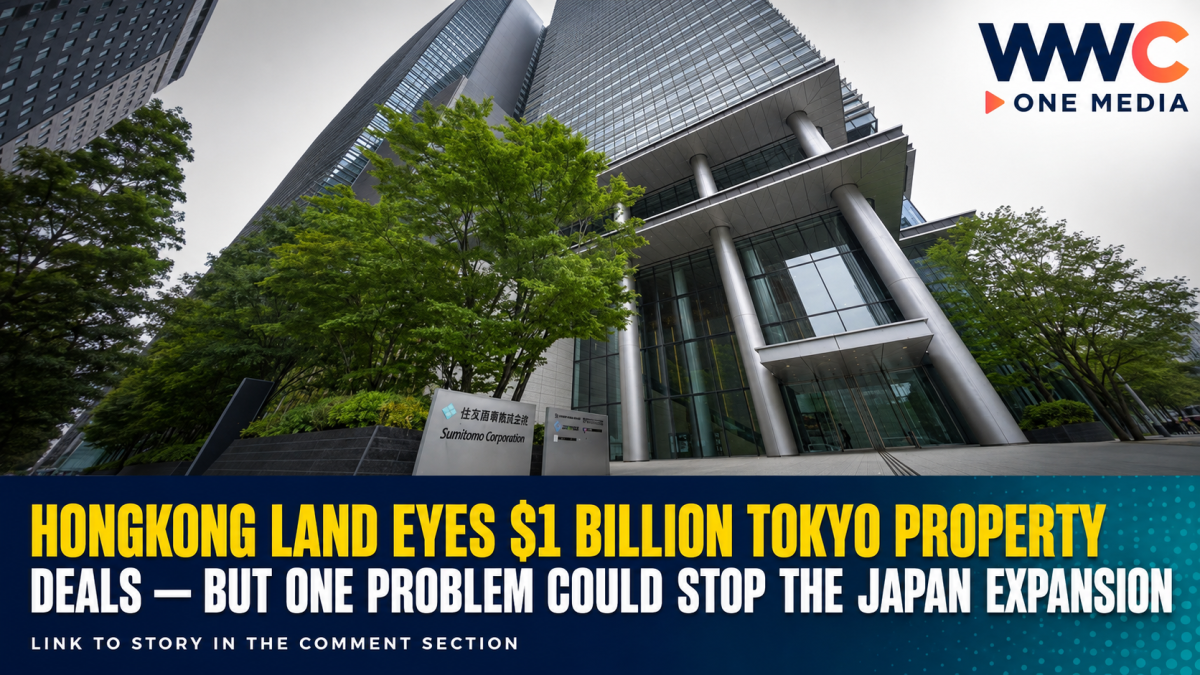
Hongkong Land is setting its sights on Japan’s booming commercial property market, exploring potential deals worth more than US$1 billion as its parent company, Jardine Matheson, accelerates a broader transformation into a more investment-focused group.
The Hong Kong-based property giant is looking at major mixed-use developments in prime Tokyo locations, with potential targets combining premium offices, retail and hospitality space, according to people familiar with the discussions. The talks were reported by Bloomberg and published by The Japan Times on September 3.
Among the properties reportedly approached are Tokyo Garden Terrace Kioicho, associated with Blackstone, and Otemachi Place, in which Hulic has a stake. Both are major developments in central Tokyo and carry multibillion-dollar valuations.
But there is a major catch: Hongkong Land has yet to secure either the right asset or a suitable investment partner.
The discussions are still preliminary, and there is no guarantee that they will lead to a transaction or partnership. Hongkong Land and Blackstone declined to comment, while Hulic did not respond to a request for comment, according to the reports.
Why Japan is suddenly back on the radar
Japan has become one of Asia’s hottest commercial real estate markets, attracting substantial domestic and international capital.
CBRE reported that Japanese commercial real estate investment reached ¥1.121 trillion in the second quarter of 2026, a 17% increase from a year earlier. It was the first second quarter since 2008 in which investment exceeded ¥1 trillion.
JLL likewise reported that Japan attracted US$10.6 billion in real estate investment during the second quarter, up 39% year over year. First-half investment reached US$23.8 billion, representing a 12% increase from the same period last year. Office properties were among the leading sectors.
Tokyo’s office market is particularly attractive because available space remains tight. CBRE said Tokyo’s overall office vacancy rate fell to 1.4% in the second quarter, while Grade A rents increased 4.3% quarter over quarter.
That combination — strong leasing demand, rising rents and limited prime supply — helps explain why institutional investors continue to chase high-quality Tokyo assets.
But investors are paying a premium
The resurgence comes with an important warning.
CBRE’s latest Japan investment data shows that expected yields for prime Tokyo office properties fell to 3.10% in the second quarter, a record low in its survey. Expected yields for prime Tokyo hotels also fell to a record-low 4.15%.
In other words, Japan’s most desirable properties are becoming increasingly expensive relative to the income they generate.
That creates a difficult equation for Hongkong Land: finding a trophy asset is one challenge, but finding one at a price that can still deliver attractive returns may be considerably harder.
The company also faces the prospect of higher Japanese interest rates, which could increase financing costs and place further pressure on property valuations and investment returns.
A previous Tokyo opportunity already slipped away
Hongkong Land’s Japan push is not entirely new.
Earlier in 2026, the company reportedly considered participating in the sale of Singapore sovereign wealth fund GIC’s stake in Pacific Century Place Marunouchi, a major Tokyo office tower.
However, Hongkong Land reportedly did not proceed after failing to find suitable partners. GIC ultimately agreed to work with Kenedix in a transaction valued at about US$1.4 billion, according to people familiar with the deal.
That episode highlights the challenge facing Hongkong Land as it searches for a foothold in Japan: the company has substantial capital available, but large transactions increasingly require partners capable of sharing both the financial commitment and the risk.
Hongkong Land has room to make a major move
Financially, the company is in a much stronger position than it was several years ago.
According to the Bloomberg-syndicated report, Hongkong Land has generated approximately US$3.7 billion from asset disposals since 2024, representing more than 90% of its capital-recycling target through the end of 2027.
Its leverage had fallen to about 11%, while cash and equivalents rose 141% year over year to US$2.7 billion at the end of June.
That gives the company considerable flexibility to pursue large investments without relying entirely on additional borrowing.
For Jardine Matheson, meanwhile, the potential Japan expansion fits into a much larger strategic shift.
The 194-year-old conglomerate has been selling assets and pursuing acquisitions as it attempts to evolve from a traditional diversified group into a more returns-focused investment organization. The group has targeted more than US$10 billion in asset sales and mergers and acquisitions over the past year, according to the report.
Japan’s property boom may be entering a more complicated phase
The opportunity is clear, but so are the risks.
Japan’s property market is benefiting from strong demand, limited availability in prime locations and continued interest from overseas investors. JLL has described Japan and Australia as leading sources of liquidity in Asia-Pacific real estate, while CBRE has reported continued overseas participation in major Japanese transactions.
Yet rising interest rates could eventually change the investment equation.
With prime Tokyo yields already at historically low levels, buyers such as Hongkong Land have less room for error. A multibillion-dollar trophy property may look attractive from a strategic perspective, but paying too much at the top of the market could undermine the returns Jardine is seeking from its new investment strategy.
For now, Hongkong Land’s reported approach to Blackstone and Hulic should be viewed as an indication of interest rather than a completed Japanese expansion.
The bigger question is whether Hongkong Land can secure a landmark Tokyo property before prices, financing costs and competition make the numbers too difficult to justify.
WWC ONE MEDIA MJE




Leave a Reply