
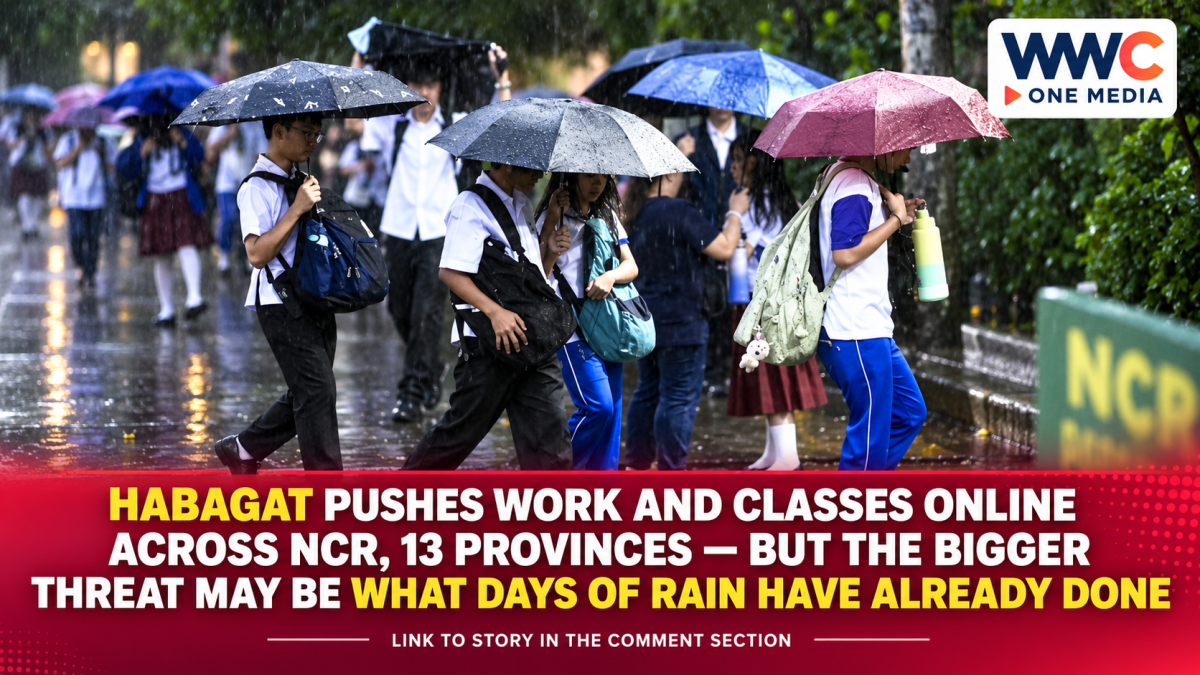
MANILA, Philippines — Days of relentless monsoon rain have pushed the government to change how millions of Filipinos work and study, with Malacañang ordering alternative work arrangements for government offices and alternative learning modes for schools across Metro Manila and 13 provinces on Thursday, September 10.
The directive comes as the Southwest Monsoon, or Habagat, continues to soak large parts of Luzon, raising concerns over flooding, saturated communities and the cumulative impact of prolonged rainfall.
Executive Secretary Ralph Recto, acting by authority of President Ferdinand Marcos Jr., issued Memorandum Circular No. 135 following a recommendation from the National Disaster Risk Reduction and Management Council.
The order covers the National Capital Region, La Union, Pangasinan, Benguet, Bataan, Bulacan, Pampanga, Zambales, Batangas, Cavite, Laguna, Rizal, Occidental Mindoro and Oriental Mindoro.
Schools shift away from face-to-face classes
Under the Palace directive, schools at all levels in both the public and private sectors in the affected areas are expected to use alternative learning arrangements, unless their respective local chief executives issue different instructions.
That can mean synchronous or asynchronous classes and other remote-learning arrangements rather than students physically reporting to campuses. Quezon City, for example, announced the suspension of face-to-face classes at all levels and said synchronous and asynchronous learning modes would be used instead.
The distinction matters: the Palace directive does not simply declare a conventional “walang pasok” across every covered locality. Instead, it seeks to keep lessons going while reducing the need for students, teachers and other personnel to travel through areas vulnerable to heavy rain and flooding.
Local chief executives retain the authority to issue additional localized suspensions where conditions warrant.
Government offices move to alternative work arrangements
Government offices in the covered areas were likewise directed to adopt appropriate alternative work arrangements.
However, agencies responsible for health services, disaster preparedness and response, basic public services and other vital functions must continue operating.
The circular also provides that Contract of Service and Job Order workers placed under alternative work arrangements should still receive their corresponding wages or salaries, subject to existing government rules.
For private companies, Malacañang left decisions on work suspension or remote and alternative arrangements to management.
Why the government acted now
The directive follows several days of disruptive rain.
On Wednesday, a number of local governments in Metro Manila and Luzon had already suspended face-to-face classes or shifted to alternative delivery modes as streets flooded and rainfall warnings remained in place. The Philippine Star reported that several Metro Manila cities moved classes online amid strong monsoon rains, with flooding affecting parts of the capital.
By early Thursday, PAGASA said the Habagat would continue to bring significant rainfall to Luzon and parts of the Visayas.
Zambales was forecast to experience monsoon rains, while Metro Manila, the rest of Central Luzon, Pangasinan, La Union, Benguet, Isabela, Nueva Vizcaya, Quirino, Rizal, Cavite, Batangas and both Occidental and Oriental Mindoro were expected to see occasional rains.
The Visayas, the rest of Luzon, Zamboanga Peninsula and Northern Mindanao were also expected to experience cloudy skies with scattered rain showers and thunderstorms.
Flood threat remains even without a tropical cyclone
One of the most important details is that the dangerous rainfall is not necessarily being driven by a tropical cyclone near the country.
As of 2 a.m. Thursday, PAGASA said it was not monitoring any low-pressure area for possible tropical cyclone formation. The rain was instead being generated primarily by the Southwest Monsoon.
That does not mean the threat is minor.
PAGASA placed Zambales and portions of Bataan under a yellow rainfall warning during the early hours of Thursday, signaling the possibility of flooding in vulnerable areas. Light to moderate rains, with occasional heavy downpours, were also expected in portions of Pampanga, Bulacan, Tarlac, Nueva Ecija and nearby provinces.
The government specifically cited not only continued rainfall but also its “cumulative effects” — an important concern because soil, drainage systems and waterways can become increasingly overwhelmed after repeated days of rain even when individual downpours are not record-breaking.
Habagat disruption is becoming a recurring problem
The September 10 directive is not the first time the Marcos administration has had to adjust work and school schedules because of the monsoon this rainy season.
On August 28, Malacañang suspended government work and classes across Metro Manila and 16 provinces as the Habagat intensified. Earlier in August, similar alternative work and learning arrangements were implemented as persistent rain affected large portions of Luzon.
That recurring disruption highlights the larger challenge facing densely populated urban and flood-prone areas: prolonged monsoon episodes can affect transportation, schools, offices and emergency services even without a typhoon making landfall.
For Thursday, authorities are urging residents to keep monitoring PAGASA, NDRRMC and local-government advisories, particularly in areas where rivers, roads and drainage systems are already under pressure.
For millions of workers and students, the immediate message is straightforward: the day may continue, but increasingly from home rather than on the road.
And with the ground already saturated after days of rain, authorities are watching not only how hard the Habagat falls next — but how much more affected communities can safely absorb.




Leave a Reply