
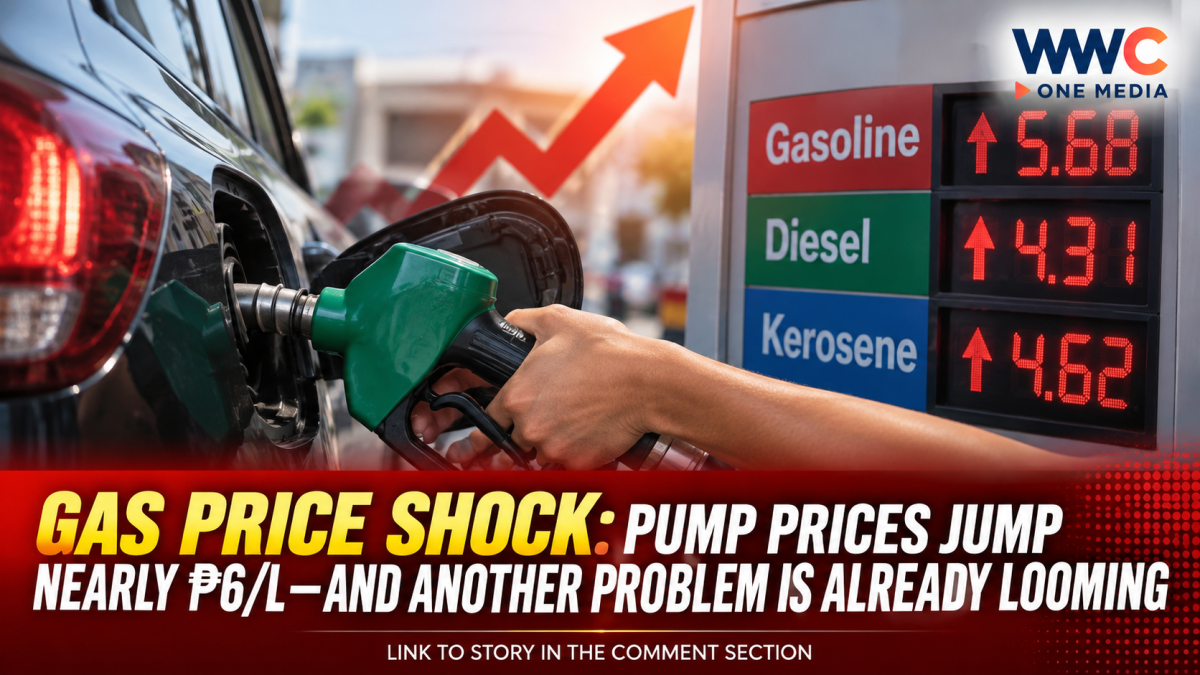
MANILA, Philippines — Filipino motorists are facing another painful hit at the pump as gasoline prices surged by ₱5.68 per liter, while diesel and kerosene prices also climbed sharply beginning Tuesday, September 15.
The latest adjustment means motorists are paying significantly more for fuel just weeks into a series of steep increases, raising fresh concerns over transportation costs, delivery expenses and the prices of basic goods.
According to the Department of Energy (DOE), the latest adjustments are:
- Gasoline: +₱5.68 per liter
- Diesel: +₱4.31 per liter
- Kerosene: +₱4.62 per liter
The increases took effect at 6 a.m. on September 15 and will apply through the September 21 pricing period.
TWO WEEKS, ANOTHER ₱10+ PER LITER
The latest increase becomes even more significant when combined with the previous week’s adjustment.
Fuel prices had already risen by ₱4.69 per liter for gasoline, ₱5.18 for diesel and ₱5.58 for kerosene during the September 8–14 period.
That means that over just two weeks, the cumulative increase has reached:
Gasoline: +₱10.37/L
Diesel: +₱9.49/L
Kerosene: +₱10.20/L
Philstar reported that some gasoline and diesel products in Metro Manila could move above the ₱100-per-liter level, depending on the station and location.
WHY ARE FUEL PRICES SOARING?
The latest increases are being driven largely by continuing turmoil in the Middle East, which has disrupted global oil markets and heightened concerns over fuel supplies.
The regional benchmark Dubai crude surged beyond $100 per barrel and reached around $116 last week, according to the DOE figures cited by Philstar. For the 30-day period ending September 11, the average Dubai crude price stood at $99.41 per barrel.
GMA News had earlier reported that the anticipated increase was being driven by movements in global oil prices, tight supplies and disruptions affecting Middle Eastern and Russian exports.
The continued pressure on international oil markets has now translated into another major increase for Filipino consumers.
THE PESO IS MAKING THE PROBLEM WORSE
It isn’t only the price of crude oil that’s hurting Philippine motorists.
The peso’s weakness against the US dollar is also adding pressure because the Philippines imports much of its petroleum requirements and international oil transactions are dollar-denominated.
BusinessMirror reported that the peso fell to around ₱62.86 against the dollar on Monday, with Energy Secretary Sharon Garin identifying peso depreciation as one of the major factors behind elevated pump prices.
That combination—expensive global oil plus a weaker peso—creates a particularly difficult environment for Philippine consumers.
FUEL TAX SUSPENSION NOW IN THE SPOTLIGHT
There is, however, another major development that could determine how much consumers ultimately pay at the pump.
The DOE has informed the Department of Finance (DOF) that the average Dubai crude price has breached the threshold under Philippine law that allows the government to consider suspending or reducing fuel excise taxes.
Under Republic Act No. 12316, the President may suspend or reduce fuel excise taxes when the average Dubai crude price exceeds $80 per barrel for a month.
Energy Secretary Sharon Garin said the DOF will determine whether the tax suspension should be total, partial or not implemented.
That decision could become crucial for motorists already struggling with rapidly rising fuel costs.
INDUSTRY GROUP PUSHES FOR BIGGER RELIEF
Calls are also growing for the government to suspend excise taxes on gasoline and diesel.
Regasco president Arnel Ty has urged the DOE to recommend suspending excise taxes not only on LPG but also on gasoline and diesel.
According to Philstar, such a suspension could potentially reduce gasoline prices by ₱10 per liter and diesel prices by ₱6 per liter, while LPG could decline by ₱3 per kilogram.
For consumers, that could provide substantially more relief than simply absorbing another round of higher pump prices.
TRANSPORT GROUPS ARE ALREADY FEELING THE PRESSURE
The fuel shock is also spilling into the transportation sector.
Transport group Manibela has been holding a two-day nationwide strike amid demands for government action on rising fuel prices, including calls for tax relief and assistance for public utility vehicle operators.
Higher diesel and gasoline prices can quickly translate into increased operating expenses for jeepneys, buses, taxis, delivery vehicles, trucks and other transport services.
And eventually, those higher costs can filter into the prices consumers pay for food and other goods.
THE BIGGER CONCERN: INFLATION
Economists are watching the fuel shock closely because sustained oil prices above $100 could create a much wider inflation problem.
The Bangko Sentral ng Pilipinas (BSP) has warned that if Dubai crude remains around $100 per barrel, Philippine inflation could reach 6.6% in 2027. Under a scenario where oil averages $110 per barrel, inflation could rise to 7%.
That means the latest fuel increase isn’t simply a problem for motorists.
It could eventually affect transport fares, food prices, logistics, electricity-related costs and household budgets.
WHAT HAPPENS NEXT?
For now, motorists have little choice but to absorb the latest increase.
But the bigger question is whether the government will act on the breached Dubai crude threshold and provide tax relief—or whether consumers will have to brace for another round of expensive fuel.
With international oil prices still elevated and geopolitical tensions continuing, the September 15 increase may not be the end of the story.
For Filipino motorists, commuters and businesses, the next question is no longer simply how high will fuel prices go?
It is how much more expensive everyday life could become if global oil prices stay above $100.



Leave a Reply