WASHINGTON — A once-niche policy idea has moved from political essays and think-tank discussions into the center of America’s debate over housing, energy, government efficiency and economic growth.
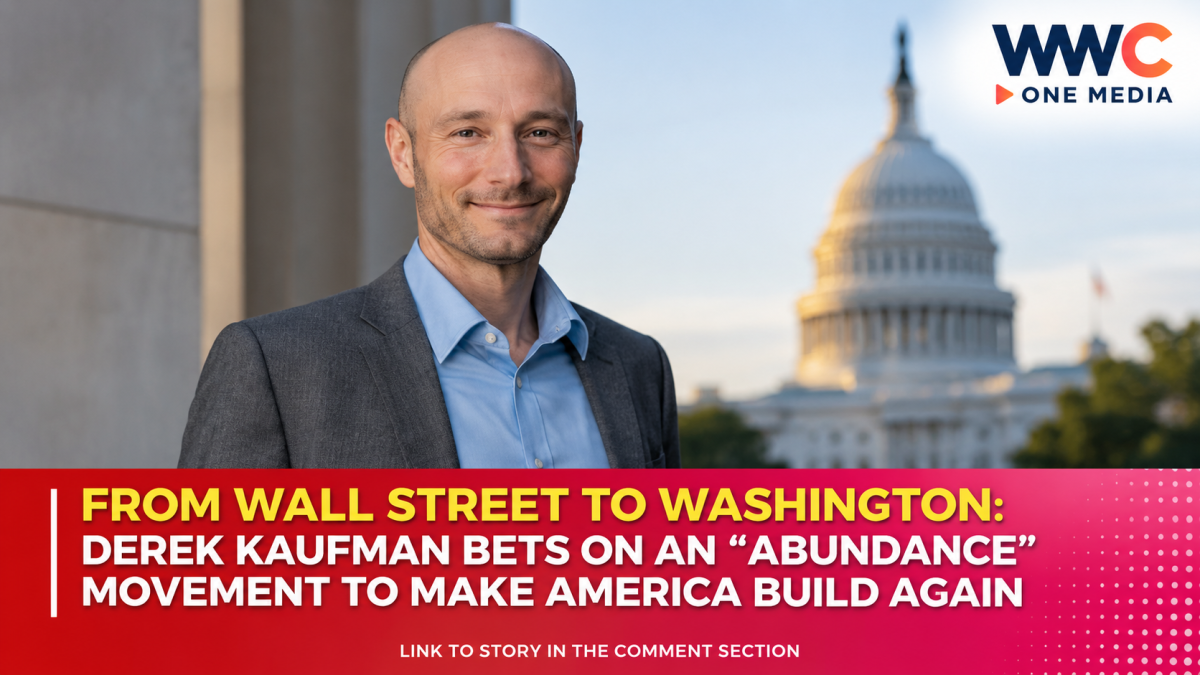
At the heart of that effort is Derek Kaufman, a former Wall Street executive who now leads the Inclusive Abundance Initiative, a nonprofit working to turn the concept of “abundance” into a broader policy agenda.
The movement’s central argument is straightforward: some of America’s shortages are not simply the result of limited resources. Supporters contend that government regulations, permitting delays, restrictive land-use rules, inadequate infrastructure and political gridlock can make it unnecessarily difficult to build more of what people need.
Kaufman has increasingly put that theory into practice, helping advocate for policies aimed at increasing housing supply and reducing barriers to development. Bloomberg reported that he worked behind the scenes on the 21st Century ROAD to Housing Act, major federal housing legislation that became law in July 2026.
But the rise of abundance is also creating a political argument of its own: How much regulation can be removed in the name of building more—and where should the line be drawn?
What exactly is the “abundance” movement?
The modern abundance movement was popularized nationally by journalists Ezra Klein and Derek Thompson, whose 2025 book Abundance argued that governments should become better at producing tangible results, particularly in areas such as housing, clean energy and infrastructure.
The concept has since expanded into a broader policy framework.
The Inclusive Abundance Initiative describes abundance as an approach focused on identifying and removing “self-imposed scarcity” while combining public investment with regulatory reform. Its stated areas of interest include housing, energy, science and technology, and government effectiveness.
At Stanford University’s 2025 policy forum on the subject, Kaufman described abundance as the opposite of scarcity and argued that some shortages are created or intensified by policy decisions, incentives and administrative barriers.
Housing has become one of the clearest examples.
Supporters argue that if communities need more homes, governments should make it easier and faster to approve and construct them rather than relying primarily on subsidies for an existing, limited supply.
The same logic can be applied to energy, manufacturing, transportation, health care and other sectors.
Kaufman’s unusual path into the movement
Kaufman’s background is different from that of many of the writers and activists associated with abundance.
According to Inclusive Abundance, he previously served as global head of fixed income at Citadel and as global head of fixed income in JPMorgan Chase’s proprietary positioning business. He also served on the Treasury Borrowing Advisory Committee and the Federal Reserve Bank of New York’s Investor Advisory Committee on Financial Markets.
He subsequently moved into policy and philanthropy, eventually founding Inclusive Abundance.
That background has given the movement an advocate who is familiar with financial markets and capital allocation but is now focused on questions about how government can make it easier to build.
Bloomberg’s profile of Kaufman describes him as a former hedge-fund executive who has become an important figure in efforts to make building and increasing supply a bipartisan policy priority.
The housing bill became a real-world test
One of the movement’s most significant recent developments came with the 21st Century ROAD to Housing Act.
The legislation passed Congress with large bipartisan majorities before becoming law on July 11, 2026, without President Donald Trump’s signature. Official congressional records identify it as Public Law 119-101.
The legislation contains 12 titles and 59 sections and focuses primarily on housing supply and affordability. Among its provisions are measures involving housing development, manufactured housing, federal housing programs and restrictions affecting institutional investors’ purchases of certain existing single-family homes.
Trump had declined to sign the measure after objecting to Congress’ handling of separate election legislation, according to CBS and other reports. Because Congress had passed the housing legislation with veto-proof margins, it became law after the constitutional period for a presidential veto expired.
For Kaufman and abundance advocates, the legislation represented something more significant than another housing bill.
It demonstrated that some of the movement’s ideas—particularly the emphasis on increasing supply rather than focusing exclusively on subsidizing demand—could translate into federal legislation.
Kaufman celebrated the law while acknowledging that it does not resolve the housing shortage by itself. Inclusive Abundance said additional work remains on housing finance and other barriers to construction.
But the law is not without controversy
The housing legislation also illustrates why the abundance agenda remains politically contested.
Supporters say increasing construction and reducing regulatory obstacles can help address America’s long-term housing shortage.
Critics have raised concerns about how changes affecting environmental review, local decision-making and institutional investors could affect communities and renters.
The Wall Street Journal, for example, reported that restrictions on institutional investors buying existing single-family homes could alter the economics of the rental-housing market. The newspaper also noted concerns that some changes could have unintended effects on rental supply and rents.
That debate reflects a broader disagreement over the abundance philosophy.
Supporters generally argue that the problem is too little building.
Critics—including some on the political left—have argued that deregulation can favor corporations or wealthy interests if it is not accompanied by protections for workers, communities and consumers. Axios has reported that some Democrats view the movement as a potentially useful response to affordability problems, while others question its business-friendly and deregulatory emphasis.
Those disagreements have not stopped the movement from expanding.
Abundance is moving beyond housing
Housing may have provided the movement with its clearest political test, but its ambitions extend considerably further.
Inclusive Abundance is preparing a broader Abundance Agenda covering areas including:
- Housing
- Energy
- Health care
- Workforce policy
- Child care
- Family policy
- Government effectiveness
The organization says the agenda is intended to identify specific policy barriers that contribute to scarcity and develop proposals for addressing them.
That expansion could prove important.
If abundance remains primarily a housing-and-permitting movement, its political reach may remain limited.
If its supporters can develop workable proposals for health care, energy, child care and technological innovation, it could become a much broader governing framework.
The movement is also trying to cross ideological lines
Another defining feature of abundance is its attempt to attract people from different parts of the political spectrum.
Inclusive Abundance describes itself as nonpartisan and says it is trying to build connections among policy experts, public officials, business leaders and philanthropists across ideological boundaries.
The broader movement, however, is often associated with the center-left because of the influence of Klein and Thompson and its growing role in Democratic policy debates.
Axios reported that several groups associated with abundance are already thinking about a potential 2028 policy agenda, including housing, energy, health care, immigration and family policy.
At the same time, other organizations and commentators have tried to develop versions of abundance that emphasize market-oriented growth, technology and deregulation.
Axios has noted that the word “abundance” is now being used by different groups to describe substantially different political and economic ideas.
That makes the label increasingly difficult to define as a single ideology.
Critics question who is funding the movement
The movement’s growing influence has also attracted scrutiny over its financial backing.
The American Prospect reported in June 2026 that documents it obtained described substantial proposed funding for parts of the broader abundance ecosystem from wealthy technology and business figures. The publication also reported that some figures in those documents were disputed or characterized differently by people involved.
Supporters of abundance have rejected the characterization that the movement is simply an externally manufactured political project.
The Breakthrough Institute, another organization involved in the broader coalition, has argued that the movement emerged from a diverse collection of policy advocates, researchers, activists, entrepreneurs and elected officials.
The funding debate nevertheless highlights a fundamental question surrounding the movement:
Who benefits when government makes it easier to build?
That question is likely to remain central as abundance advocates attempt to move from policy theory into broader implementation.
The bigger test: Can “build more” become a governing philosophy?
The significance of Kaufman’s work may ultimately depend less on the popularity of the word “abundance” and more on whether governments can demonstrate measurable results.
The movement is asking policymakers to rethink a familiar approach to public problems.
Instead of asking only how government can distribute scarce resources, abundance advocates want policymakers to ask why those resources are scarce in the first place—and whether government rules are contributing to the shortage.
That means building more homes rather than merely helping people compete for existing homes.
It means expanding energy production rather than simply allocating limited supplies.
It means making infrastructure projects faster to approve and complete.
And it means measuring government by what it actually delivers.
But each of those goals creates trade-offs involving environmental protection, local authority, labor standards, market concentration and public spending.
Those conflicts are unlikely to disappear simply because a new political vocabulary has emerged.
From a book to a law—and now a much bigger experiment
The abundance movement is still relatively young, but its trajectory has changed quickly.
Ideas that once circulated primarily among journalists, policy researchers and housing advocates have entered congressional debates and produced legislation.
The 21st Century ROAD to Housing Act becoming law in July 2026 gives Kaufman and other abundance advocates a concrete policy achievement to point to.
But it also raises the harder question.
Can the same philosophy deliver results beyond housing—and can it do so without creating new costs or winners and losers that undermine its political coalition?
That may be the real test facing Derek Kaufman and the growing abundance movement.
For now, the movement has moved beyond the realm of political theory.
America is beginning to test the idea in actual policy—and the results may determine how far abundance goes next.