For decades, investors have relied on a simple idea: when stocks fall, government bonds can help cushion the damage.
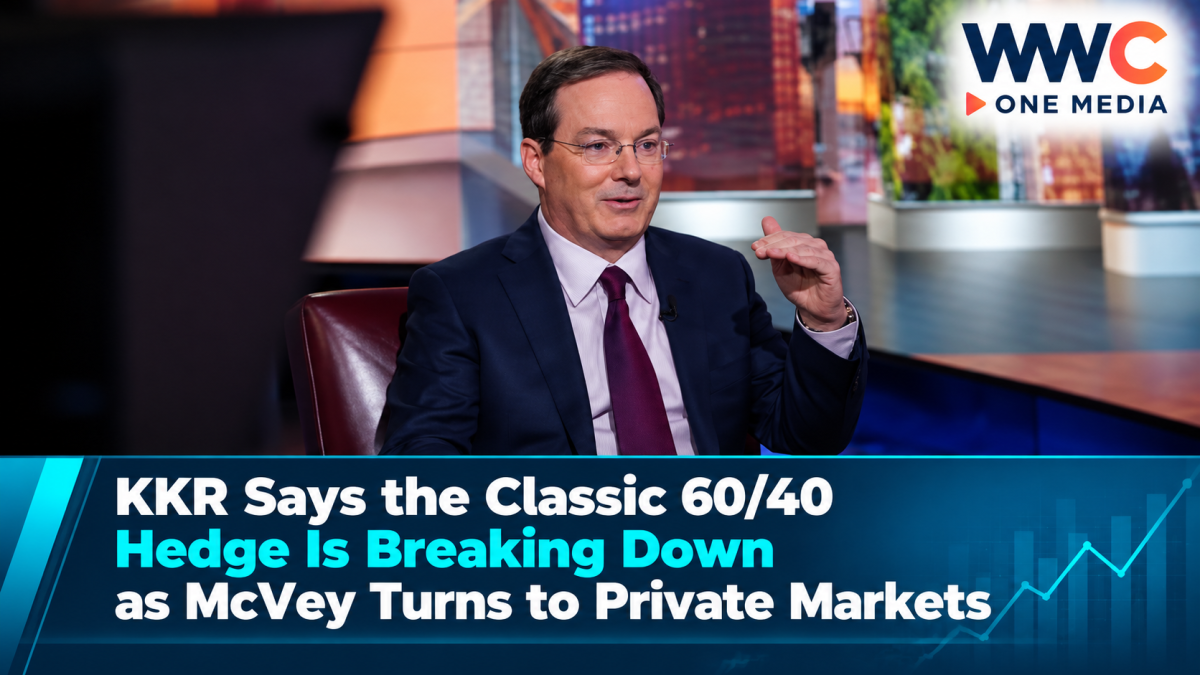
KKR’s Henry McVey says that formula is becoming less dependable.
McVey, KKR’s partner and head of global macro and asset allocation, argues that a combination of persistent inflation, large government deficits, geopolitical tensions and changing economic conditions has weakened the traditional relationship between stocks and bonds.
His answer is a greater focus on private markets and other sources of return that do not depend primarily on falling interest rates.
But that argument comes with an important caveat: private markets are not a risk-free replacement for bonds. They can be difficult to sell, harder to value and exposed to credit and economic risks of their own.
McVey Says the Old Diversification Model Is Under Pressure
McVey’s argument centers on what KKR describes as a broader “regime change” in markets.
In the previous low-inflation, low-interest-rate environment, government bonds frequently provided diversification when equities came under pressure.
That relationship becomes more complicated when inflation rises and interest rates increase because both stocks and bonds can lose value at the same time.
KKR says stock-bond correlations have become less reliable as inflation, fiscal spending and geopolitical risks have changed the market environment. The firm argues that investors need multiple sources of diversification rather than relying on government bonds as the primary hedge.
McVey has therefore argued for greater consideration of private assets, particularly for investors with sufficiently long time horizons.
In his Bloomberg discussion, he pointed to private markets as a potential source of diversification and cited the possibility of an illiquidity premium — compensation investors may receive for accepting the inability to quickly sell an investment.
The Fed Is Making the Debate More Urgent
The argument comes at a particularly important moment for markets.
On September 16, the Federal Reserve raised its benchmark interest-rate target by 25 basis points to 3.75%–4%, its first rate increase since 2023.
The Fed’s latest projections put the median federal-funds rate at 4.1% at the end of 2026, compared with 3.8% in its June projections.
Officials also raised their median 2026 PCE inflation projection to 3.7%, from 3.6% previously. Core PCE inflation was projected at 3.4%.
Sixteen of the 18 officials submitting rate projections indicated that they expected at least one additional increase during 2026.
That does not guarantee another hike. The projections are individual forecasts, not a binding policy commitment, and future decisions remain dependent on economic data.
For investors, however, the message is significant: the period of structurally falling interest rates that supported both bond valuations and many asset prices may not return in the same form.
KKR Is Looking Beyond Traditional Bonds
KKR’s investment framework reflects that view.
The firm’s latest capital-market assumptions say investors should pay more attention to the source and durability of returns, rather than simply choosing broad asset classes.
KKR identifies several private-market areas it believes can provide differentiated exposures, including:
- Infrastructure
- Asset-based finance
- Private credit
- Real estate
- Reinsurance
- Private equity focused on operational improvements
The firm says these investments can offer different combinations of upfront income, collateral protection, inflation sensitivity and exposure to nominal economic growth.
KKR has also expanded its capital-market framework to include five additional private-market categories, including sports private equity, private investment-grade and asset-based finance, opportunistic asset-based finance, reinsurance and core real estate.
But Higher Rates Are a Double-Edged Sword for Private Markets
This is where the story gets more complicated.
Higher rates may make private assets more attractive relative to some traditional portfolios, but they also create pressure inside private markets themselves.
Higher borrowing costs can make leveraged acquisitions more expensive, reduce the valuations buyers are willing to pay and complicate exits.
The Wall Street Journal recently reported that U.S. private-equity investments stuck in funds at least 10 years old reached approximately $348.5 billion at the end of 2025, according to PitchBook data. These so-called “zombie funds” have struggled to sell portfolio companies and return capital to investors.
That means private markets should not be viewed simply as an escape from rising rates.
The same higher-rate environment that can undermine the traditional stock-bond hedge can also create problems for private equity and private credit.
KKR Is Not Calling for a Blind Rush Into Private Assets
McVey’s argument is more nuanced than simply moving money out of public markets.
KKR’s own latest research emphasizes that investors need to evaluate specific return drivers, managers, structures and underlying assets.
The firm says future private-market performance will depend increasingly on underwriting, governance, collateral, operational improvement and execution rather than simply relying on leverage or rising valuations.
That distinction is important.
Private equity, private credit and infrastructure are not interchangeable. Their liquidity profiles, fee structures, leverage, valuation methods and underlying risks can differ substantially.
And because private assets do not trade continuously in the same way as publicly listed securities, their reported valuations can appear less volatile even when the underlying economic risk has not disappeared.
Investors Are Already Paying More Attention
The growing interest in private markets is not limited to large institutions.
KKR’s own 2026 investor survey found significant interest among individual investors with at least $500,000 in investable assets, while also highlighting gaps in understanding around liquidity, risk and fund structures.
That education issue is becoming increasingly important as private-market products expand toward wealth-management and individual-investor channels.
Unlike a publicly traded stock or Treasury security, a private investment can require an investor to commit capital for years.
McVey has reportedly emphasized a five- to 10-year horizon when discussing private-market allocations, underscoring that these investments are not designed for money that may be needed in the short term.
The Bigger Shift: From Rate Bets to Cash-Flow Resilience
At the heart of McVey’s argument is a broader change in how portfolios may need to be constructed.
If inflation remains higher than it was during the pre-pandemic era, government deficits remain large and geopolitical risks remain elevated, investors may have less opportunity to rely on a single asset class to protect portfolios.
KKR says it therefore favors investments whose returns can be supported by nominal economic growth, inflation-sensitive cash flows, contractual income, collateral or operational improvements.
That includes infrastructure and asset-backed investments as well as selected private-equity strategies.
The idea is not that public markets disappear.
Rather, the argument is that investors may need more diversified sources of return if the old stock-and-bond relationship continues to behave differently from the way it did in previous decades.
A New Test for Private Markets Is Coming
The strategy faces a major test of its own.
Higher interest rates are already putting pressure on private-equity exits, fundraising and leveraged companies. At the same time, private-credit investors are confronting questions about credit quality and defaults.
Bloomberg Intelligence’s 2026 private-market survey found that investors remain interested in infrastructure, direct lending and asset-backed finance, but concerns about deteriorating credit quality, rising defaults and macroeconomic pressure remain significant.
So the debate is no longer simply stocks versus bonds.
It is becoming a much broader question:
Which investments can continue generating durable cash flows when inflation is less predictable, borrowing costs are higher and traditional diversification offers less protection?
McVey’s answer is increasingly private markets — but the success of that strategy will depend on what investors buy, how much they pay, how much leverage is involved and whether they can afford to leave their money invested for years.
For investors, the biggest change may not be the disappearance of the traditional portfolio.
It may be the realization that diversification itself is becoming more complicated.