
MANILA, Philippines — For many Filipino entrepreneurs, the path to bigger markets is no longer about abandoning their local roots. Instead, more homegrown businesses are discovering that their communities, traditions and locally made products can become their biggest competitive advantage in the digital economy.
A new wave of Filipino entrepreneurs is using e-commerce to take products that once served mainly local customers to buyers across the Philippines—while keeping the stories and communities behind those products at the center of their brands.
The trend was highlighted in “Grit Expectations,” a docuseries presented by Shopee Kultura+ and produced by FEATR. The series follows three homegrown businesses—Cacao Culture, Organic Options and FilDogScarf—and examines how they are using digital commerce to expand their reach without losing their Filipino identity.
FROM DAVAO CACAO TO A WIDER MARKET
For Cacao Culture founders Shiela and Ken Reyes-Lao, the journey began after moving from Manila to Davao and discovering the potential of Philippine cacao.
What started as an appreciation for locally produced cacao eventually developed into a business platform supporting more than 20 local chocolate brands, helping connect consumers with Philippine cacao producers and locally made chocolate products.
Their story illustrates an increasingly important business strategy: local identity does not necessarily have to be a limitation.
With online commerce, a product rooted in one community can potentially find customers far beyond its original geographic market.
FARMERS FIND A BIGGER DIGITAL MARKET
Organic Options offers another example.
The company has spent more than 25 years working with more than 300 smallholder farmers, developing organic produce and healthier rice products.
E-commerce has provided another avenue for the business to connect with customers outside its traditional market while continuing to work with its network of farmers.
The company’s experience also demonstrates how digital commerce can connect consumer demand with agricultural communities that have traditionally faced difficulties reaching distant markets.
A P2,500 START BECOMES A DIGITAL BUSINESS
For FilDogScarf founder Anilene Atanacio, the opportunity came from transforming a family tradition into something designed for a new generation of customers.
Atanacio started the business with just P2,500 and initially managed its Shopee operations herself.
Her products combine Filipiniana-inspired craftsmanship with pet apparel, allowing a traditional skill passed down through her family to become the foundation for a modern online business.
Her story reflects a broader lesson for aspiring entrepreneurs: scaling does not always mean starting with massive capital.
Sometimes, it starts with a small product, a distinctive story and access to customers beyond one’s immediate community.
THE PHILIPPINE DIGITAL ECONOMY IS ALREADY MASSIVE
The growth of these businesses comes as the country’s broader digital economy continues to expand.
According to the Philippine Statistics Authority (PSA), the Philippine digital economy generated P2.74 trillion in gross value added in 2025, equivalent to 9.8% of the country’s GDP.
The digital economy also employed 10.39 million Filipinos, or 21.2% of total employment, during the year.
E-commerce accounted for 32.2% of the digital economy, highlighting how significant online commerce has become to the country’s economic activity.
But simply putting a business online does not automatically guarantee success.
GOING ONLINE IS ONLY THE FIRST STEP
Recent reporting from BusinessMirror underscores the challenge facing Filipino micro, small and medium enterprises.
A recent partnership involving the Department of Trade and Industry, TikTok Shop and Converge SME Solutions aims to help MSMEs overcome barriers involving digital skills, marketplace access and connectivity.
The initiative initially focuses on Cebu and builds on the broader Unlad Lokal program, which provides entrepreneurs with training in digital commerce and tools such as live selling.
BusinessMirror reported that the Philippine digital economy’s 2025 figures included P880.46 billion in e-commerce shopping-platform volume, with the sector supporting millions of jobs.
The message is becoming increasingly clear: being online is no longer enough. Businesses need to know how to use digital platforms effectively.
WHY LOCAL IDENTITY CAN BECOME A BUSINESS ADVANTAGE
The success stories featured in “Grit Expectations” point to a different approach to digital expansion.
Instead of trying to make their products look like everything else available online, the businesses are using their origins as part of their brand identity.
Philippine cacao.
Farmer networks.
Filipiniana craftsmanship.
These are not merely backstories—they can become differentiators in a crowded online marketplace.
That strategy is particularly relevant as Filipino consumers gain access to thousands of products from sellers across the country.
OTHER DIGITAL PLATFORMS ARE SEEING THE SAME SHIFT
The movement is not limited to one marketplace.
OneNews.PH reported that TikTok Shop recorded more than 200% growth in sales for local sellers in 2025, according to figures shared by the platform, while its local-commerce initiatives also reported significant increases in product sales and exposure.
The platform said more than 25,000 entrepreneurs participated in its capacity-building initiatives in 2025.
Meanwhile, partnerships involving government agencies and digital platforms have increasingly focused on teaching entrepreneurs practical skills—from product listings and content creation to livestream selling and digital marketing.
That means the emerging competition is no longer simply about who has the best product.
It is increasingly about who can tell the story, reach the customer and operate effectively in a digital marketplace.
PHYSICAL STORES STILL MATTER
Despite the rapid growth of online commerce, physical retail has not disappeared.
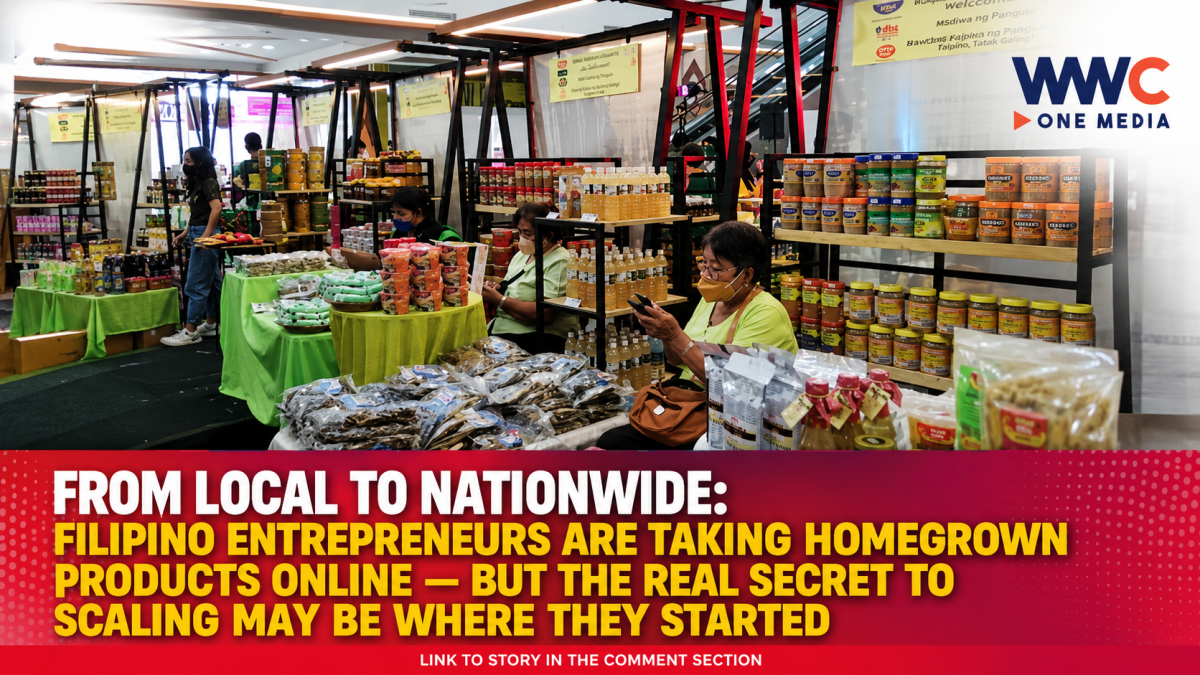
A recent Manila Bulletin report on SM for MSMEs highlighted how small businesses can also use physical retail spaces, bazaars and mall activations to gain visibility and access customers.
Since its launch in 2024, the program has supported more than 2,800 unique MSMEs across more than 80 SM malls, according to the report.
This suggests that the future may not be an online-versus-offline battle.
For many Filipino entrepreneurs, the stronger strategy may be both.
A physical presence can build trust and provide direct customer feedback, while e-commerce can extend the business beyond geographic boundaries.
DIGITALIZATION STILL HAS A LEARNING CURVE
The Asian Development Bank has also cautioned against assuming that simply adopting e-commerce automatically produces better business outcomes.
An ADB study on Philippine MSMEs found that the benefits of digitalization can take time to emerge and that businesses need a certain level of maturity to effectively harness digital tools. The study also highlighted the need for policies that help MSMEs navigate digital platforms and compete fairly.
That makes the stories of Cacao Culture, Organic Options and FilDogScarf particularly relevant.
Their journeys show that technology can expand a business—but the foundation still matters.
The product has to be useful.
The story has to be authentic.
The operations have to work.
And entrepreneurs need the skills to turn online attention into sustainable business.
THE BIGGER LESSON FOR FILIPINO ENTREPRENEURS
The rise of homegrown online businesses is changing the traditional idea of what it means to scale.
A business no longer has to immediately open branches in Manila or other major cities to reach customers nationwide.
A farmer-linked product from the provinces, a chocolate brand built around Philippine cacao or a handmade product inspired by Filipino craftsmanship can potentially find buyers thousands of kilometers away through a smartphone and an internet connection.
But the most powerful part of these stories may be that scaling does not require Filipino entrepreneurs to leave their roots behind.
Their communities, traditions and local products can actually become the reason customers choose them.
And as the Philippine digital economy continues to expand, that combination—local authenticity plus nationwide digital reach—could become one of the country’s most important engines for small-business growth.
WWC ONE MEDIA MJE




Leave a Reply