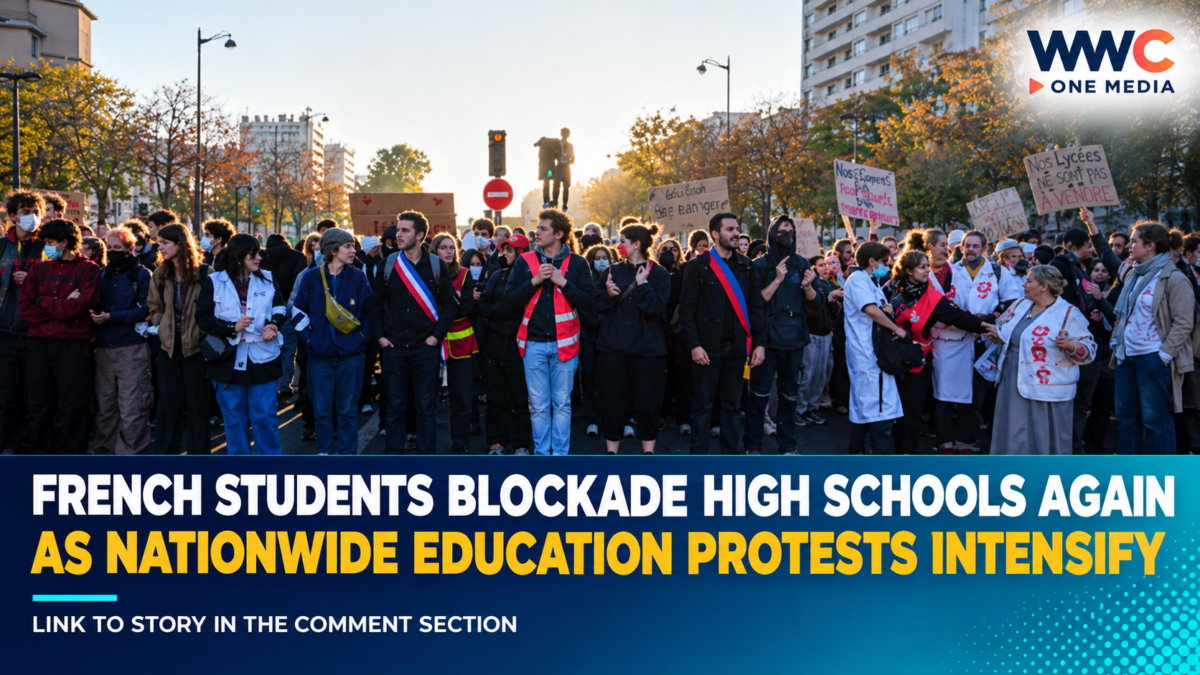
French high school students returned to the streets on Tuesday (Oct. 6), blocking entrances to schools across the country as a weeks-old protest movement demanding better education funding showed little sign of losing momentum.
At the Hélène Boucher high school in Paris’ 20th district, students placed rubbish bins and bicycles across the entrance to create a makeshift barricade. The school was among hundreds that were closed or partially closed as authorities attempted to contain the unrest.
The protests, which began in the Paris region in September, have since spread to cities and towns across France. Demonstrators are demanding more resources for schools, citing teacher shortages, deteriorating facilities, overcrowded classrooms and unequal opportunities for students in disadvantaged areas.
Tuesday’s action was expected to be an important test of whether the movement could maintain its momentum after weeks of demonstrations, school blockades and clashes with police.
Students Demand Better School Conditions
The movement began with complaints about staffing shortages and poor conditions at schools in the Paris suburbs before spreading nationwide.
Students have highlighted classrooms lacking basic equipment such as desks and chairs, buildings that become extremely hot during summer, and, in some cases, infestations of rats.
They have also complained about insufficient teaching staff and heavy workloads. French high school students already spend among the highest numbers of compulsory classroom hours in Europe.
For many protesters, the dispute is about more than individual school repairs. They argue that students in poorer neighbourhoods have fewer resources and opportunities than those in more affluent areas, despite France’s national ideal of “Liberty, Equality, Fraternity.”
A handwritten sign outside the Hélène Boucher school on Tuesday summed up the message: young people are being told they are the future and should therefore be heard.
Hundreds of Schools Closed
Authorities began closing schools last week in an effort to reduce the intensity of the demonstrations.
The move came after reports of property damage and increasing numbers of injuries involving students, school staff and police.
The Education Ministry had reported hundreds of schools either fully or partially closed as the protests continued. Reuters reported that between 400 and 500 high schools were expected to remain completely or partially closed on Monday, out of roughly 3,700 across France.
By Tuesday, demonstrations were reported in several other cities and towns, with students again using barricades and gathering outside school entrances.
Labour unions also called on workers to join demonstrations in solidarity with the students, broadening the movement beyond the school system and putting additional pressure on the government.
Police Response Comes Under Scrutiny
The government’s increasingly forceful response has become a major issue in its own right.
French police have made thousands of arrests since the protests began, with minors making up the overwhelming majority, according to government figures.
Reuters reported that the Justice Ministry had recorded 5,060 arrests, with 87 per cent involving minors. More than 1,800 people were being prosecuted, including 1,483 minors.
Police have used tear gas, arrests and riot-control weapons during clashes.
The response has drawn criticism from some parents, teachers and human rights advocates, who argue that the use of such measures against teenagers has intensified anger rather than restoring calm.
At Hélène Boucher on Tuesday, parents and other adults positioned themselves between students and police officers monitoring the protest.
Teenager Loses Hand During Clash
Tensions escalated further after a 15-year-old student suffered a severe injury during unrest on Monday.
Reuters reported that the teenager lost a hand and part of his lower arm after apparently picking up a police dispersal grenade during clashes in northern France. Local media reported that the device may have been responsible for the injury, although authorities said the exact circumstances were still being investigated.
The incident has intensified scrutiny of the methods being used by police to control the demonstrations.
French Interior Minister Laurent Nunez defended the police response, saying it had been proportionate in almost all cases.
The government has also pointed to injuries suffered by police officers and damage to public property as justification for its tougher approach. Reuters reported that at least 715 police officers and 215 teenagers had been injured in clashes, according to figures from Prime Minister Sebastien Lecornu’s office.
Government Faces Pressure to Respond
Prime Minister Sebastien Lecornu has ordered ministers to address the students’ principal complaints.
Among the issues being examined are the replacement of absent teachers, the length of the school day and the need for longer lunch breaks.
The government is also considering repairs and improvements to ageing school buildings.
Lecornu has asked ministers to present their first proposals by the end of October.
But finding additional funding could prove difficult.
The protests come as France’s government attempts to push through a deficit-reduction budget for 2027. The country’s financial position has already been under pressure, with borrowing costs rising and concerns about government debt and public spending weighing on markets.
Reuters reported that France’s 10-year bond yield briefly exceeded 5 per cent last week, its highest level since 2002.
That leaves the government facing a difficult balancing act: respond to demands for greater investment in education while simultaneously trying to control public finances.
Movement Tests Government’s Political Position
The protests have also taken on a wider political dimension.
With France approaching another presidential election cycle, opposition parties have sought to connect the demonstrations to broader concerns about inequality, public services and the direction of the country.
Members of the left-wing France Unbowed party have expressed support for the students, while government figures and members of the far-right National Rally have accused the party of helping fuel the unrest. France Unbowed has rejected those accusations.
At the same time, police officials have warned that violent groups could exploit the demonstrations.
Paris police chief Patrice Faure previously called for a return to peaceful protests, saying the movement had gone beyond the control of those who initially launched it. He urged parents to discourage young people from becoming involved in violence and vandalism.
Student protesters, however, say their core demands remain focused on education.
A Protest Movement That Has Quickly Expanded
What began as a dispute over teacher shortages at schools in the Paris suburbs has grown into one of France’s most significant student protest movements in years.
The rapid expansion has surprised authorities and educators alike. According to Le Monde, the demonstrations spread across the Paris region and then nationwide in roughly 10 days after beginning at a high school in the Paris suburb of Créteil on Sept. 21.
The movement now brings together students, parents, teachers and labour unions, although their individual demands and attitudes toward the protests vary.
For students continuing to blockade their schools, the immediate issue is straightforward: they want better-funded schools, more teachers and safer, better-maintained learning environments.
For the government, however, the challenge is becoming considerably broader.
As demonstrations continue, authorities must now manage school disruptions, public-order concerns, police scrutiny and mounting pressure to find money for education — all while attempting to keep control of a movement that has already spread far beyond its original starting point.
Tuesday’s renewed blockades therefore represent more than another day of student protests. They are a test of whether France’s young demonstrators can sustain nationwide pressure long enough to force meaningful changes to the country’s education system.