
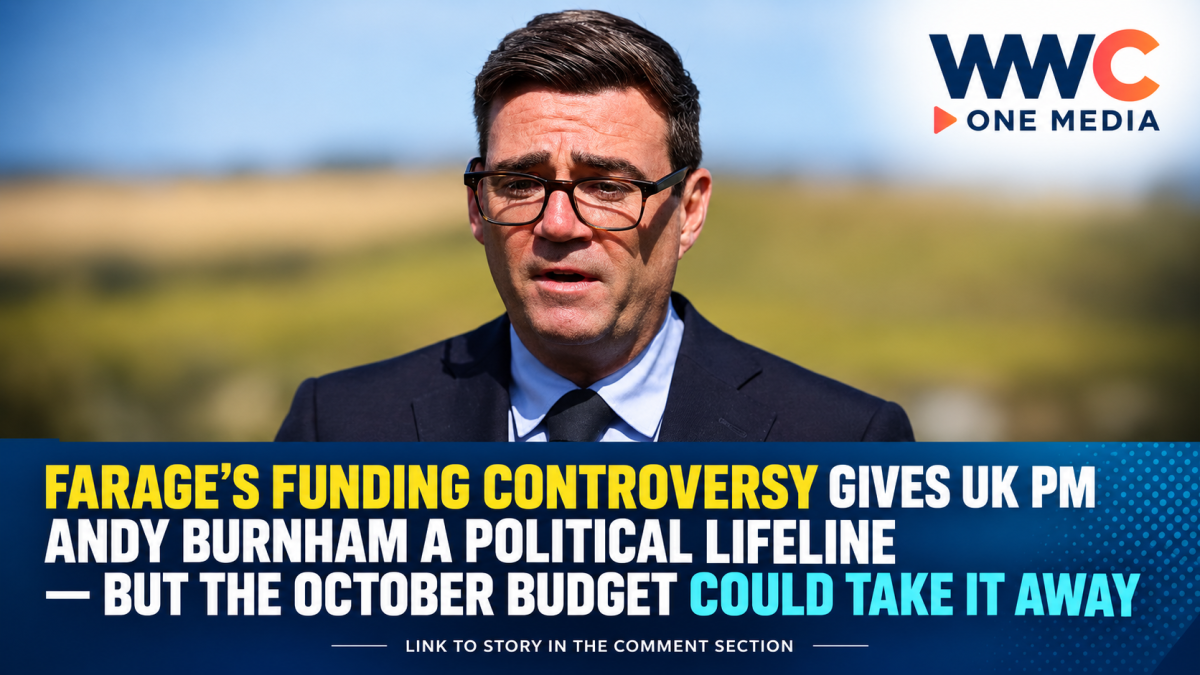
LONDON — For weeks, British Prime Minister Andy Burnham appeared to be heading toward an uncomfortable autumn reckoning.
His government has promised ambitious changes to housing, social care, public utilities and regional investment. At the same time, borrowing costs have risen and Britain’s room for new spending has narrowed.
Then Nigel Farage’s Reform UK convention began.
Instead of dominating headlines with plans for a future Reform government, Farage found himself answering questions about an undercover investigation involving two senior party figures and alleged attempts to secure political support connected to foreign money.
The controversy has given Burnham something every new prime minister values: time.
But it may not last.
Burnham’s real political test arrives on Oct. 28, when Chancellor John Healey delivers a Budget that will begin answering the question Westminster, investors and voters are already asking:
How much of Burnham’s ambitious agenda can Britain actually afford?
Reform wanted to look ready for government. Then the sting landed
Reform UK entered its Birmingham conference trying to transform its image from an insurgent protest movement into a credible government-in-waiting.
Instead, an undercover investigation broadcast by Channel 4 dominated the opening of the event.
Reuters reported that senior Reform figures Dan Jukes and James Orr stepped down from their roles after footage raised questions over potential breaches of political-finance rules. Investigators alleged that a U.S. company had paid more than £30,000 for opinion polling connected to Reform.
Separate footage showed discussions involving a hypothetical £500,000 donation from an American financier and whether money could be routed through a UK-based relative. Under British electoral law, political parties cannot simply accept donations from foreign nationals who are not permissible donors.
But that does not mean it has been established that Reform illegally accepted such a donation.
Farage has firmly denied wrongdoing.
He said the party had broken no laws and had taken no improper money, while characterizing some of his aides’ remarks as loose or inappropriate conversation. Reform announced its own internal investigation.
The Metropolitan Police said it was assessing information relating to the allegations, while the Electoral Commission said it was considering the material and was in contact with police. Reuters explicitly noted that the police assessment did not amount to the opening of a formal investigation at that point.
That distinction matters.
The timing could hardly be worse for Farage
Reform has spent much of the past year trying to persuade voters that it is capable not only of protesting against Westminster but of running it.
Its conference featured proposals covering taxation, migration and public spending, including a plan from economic spokesman Robert Jenrick to raise the personal income-tax allowance to £15,000 if Reform wins power. The Financial Times reported that the party was also seeking to demonstrate how it would act during its first 100 days in government.
But the funding allegations complicated that message.
Polling conducted by Opinium between Sept. 2 and Sept. 4 put Labour on 28% and Reform on 24%, giving Burnham’s party a four-point advantage. Crucially, Opinium said most fieldwork occurred before the Channel 4 investigation became public, meaning the poll should largely be treated as a pre-controversy snapshot.
The same poll found Burnham at a +14 net approval rating, while Farage stood at -26.
Only 25% of respondents said they regarded Reform as ready for government, compared with 54% who disagreed.
One poll is not an election forecast, and Reform still commands support from roughly a quarter of voters in that survey.
But the direction of travel is politically significant.
Burnham suddenly has breathing room
That is where the Japan Times story’s central argument becomes important.
Burnham’s Labour government had increasingly been facing scrutiny over its finances.
Reuters reported before Parliament returned that the prime minister’s summer honeymoon was giving way to a much harder question: how to fund his promises while sticking to Britain’s fiscal rules.
Burnham has spoken of major changes to social care, a substantial social-housing program and greater public involvement in utilities and infrastructure.
Those ambitions are expensive.
And Britain’s financial position has become more difficult.
The Guardian reported that a global bond sell-off, higher oil prices and inflation concerns had pushed UK borrowing costs upward, with economists estimating that roughly half of the £24 billion fiscal buffer available earlier in the year may already have disappeared.
So Farage’s difficulties do not solve Burnham’s fiscal problem.
They merely make it less politically dominant — for now.
The Oct. 28 Budget is where the numbers become real
Chancellor John Healey has confirmed that his first Budget will be delivered on Oct. 28.
He has also promised to maintain Britain’s fiscal rules, including the goal of covering day-to-day government spending with tax revenues by the end of the decade.
That commitment limits the government’s options.
Burnham can increase borrowing for some investment.
He could raise some taxes.
He could cut or delay spending elsewhere.
Or he could scale back parts of his agenda.
But doing everything simultaneously will be difficult.
Reuters noted that Burnham’s priorities on social care and defence alone could put substantial additional pressure on the public finances.
That is why the Budget may ultimately matter far more to Burnham’s long-term popularity than Reform’s current troubles.
One defence-spending claim needs correcting
Some coverage of this story has said Burnham committed to raising defence expenditure to 3% of GDP by 2030.
That needs qualification.
During Prime Minister’s Questions, Burnham appeared to endorse that date. But government sources subsequently said he had misspoken and that the standing government commitment is to meet NATO’s 3.5% of GDP target by 2035.
Chancellor Healey has said the government will set out a clearer path toward higher defence spending at the next spending review, while Reuters reported that reaching 3% by 2030 would require roughly £17.3 billion in additional funding.
That is a major difference.
For an accurate publication, 3% by 2030 should not currently be presented as Burnham government’s confirmed timetable.
Burnham’s promises are colliding with bond-market reality
Burnham came to office promising something larger than incremental management.
His political brand is built around decentralizing power, rebuilding public services and attempting to replicate some of the economic policies associated with his tenure in Greater Manchester.
Supporters argue that greater investment and regional devolution could eventually improve productivity and growth.
A new study cited by The Guardian estimated that wider adoption of policies modeled on Manchester could potentially unlock as much as £80 billion in economic output, although that is a modelling estimate rather than guaranteed government revenue.
The problem is timing.
Infrastructure investments can take years to generate returns.
Bond investors react now.
The government must finance debt now.
And voters dealing with energy bills, housing costs and public-service pressures want results now.
That tension could define Burnham’s premiership.
Farage is trying to turn the focus back to policy
Farage, meanwhile, is making clear that the funding controversy will not force Reform to retreat.
At the party conference, he continued presenting Reform as an insurgent alternative to Labour and the Conservatives, while party figures emphasized proposals on migration, tax and government spending.
Farage portrayed the undercover operation as an attempt by political opponents to damage his party and argued that Reform had done nothing unlawful.
His supporters largely remained behind him at the Birmingham gathering, according to Reuters.
That matters because Reform’s challenge is not simply Farage’s personal approval rating.
The party continues to benefit from deep dissatisfaction over immigration, living costs, public services and confidence in Britain’s established political institutions.
A few bad headlines do not automatically erase that constituency.
And Reform is putting a very different economic offer on the table
Reform is also attempting to open a second front against Burnham: tax.
Jenrick’s proposal to raise the personal allowance from £12,570 to £15,000 is designed to make a simple pitch to working households and pensioners.
The proposal would come with a large revenue cost and Reform says it would help finance its wider program through major reductions in government spending, including welfare and other areas.
Labour argues that such reductions could damage public services.
Reform argues that the British state spends too much and can be made substantially leaner.
That is a genuine policy divide, and the next election battle could increasingly become a choice between those two economic visions rather than simply a referendum on Farage himself.
Britain may now be watching two political countdowns
The first countdown concerns Reform.
Will authorities find grounds for further action over the funding allegations, or will the controversy fade after the party’s internal inquiry?
At present, it would be premature to say.
No illegal donation described in the undercover operation has been established as having been accepted by Reform, and Farage continues to deny wrongdoing.
The second countdown belongs to Burnham.
His date is already fixed:
Oct. 28.
That Budget will reveal much more about whether his promises for housing, public services, defence and regional renewal can coexist with the fiscal discipline he has repeatedly promised.
For the moment, the political spotlight has swung toward Nigel Farage.
But when the Treasury finally opens the books, Andy Burnham may discover that his biggest opponent is not Reform UK at all — it is the arithmetic.
WWC ONE MEDIA M.J.E



Leave a Reply