
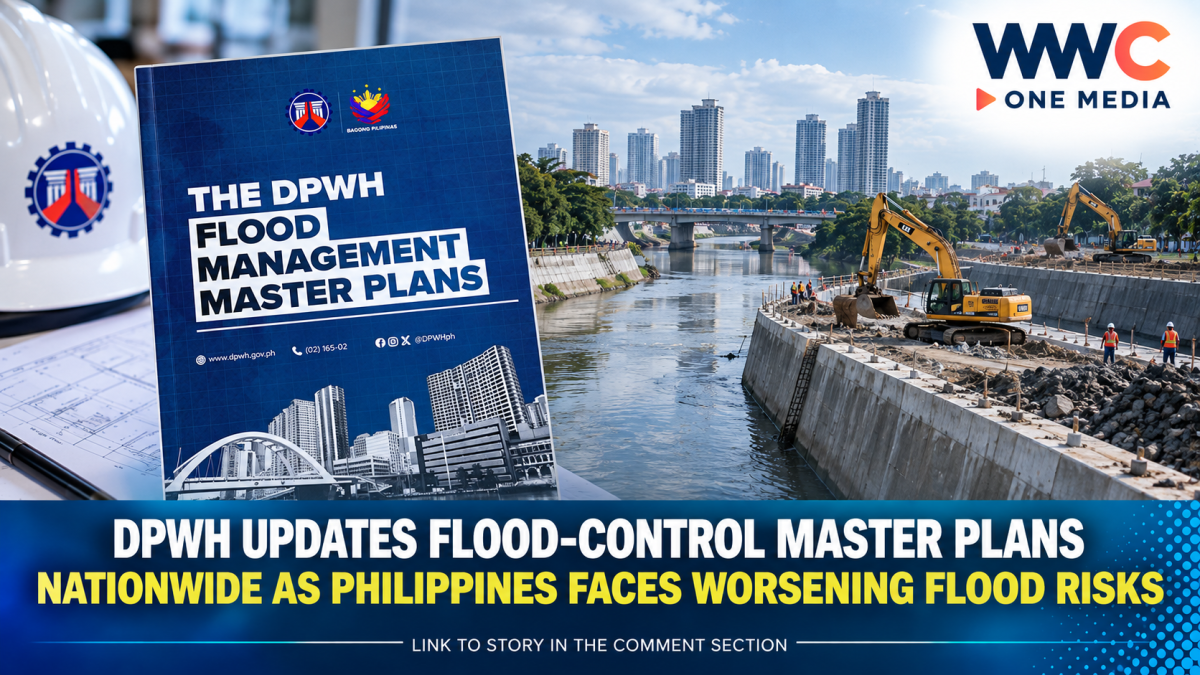
MANILA, Philippines — The Department of Public Works and Highways (DPWH) is moving to update and strengthen flood-management plans covering the country’s major river basins, as increasingly intense rainfall and recurring flooding continue to expose weaknesses in the Philippines’ flood-control system.
The latest move comes as the government faces mounting pressure to deliver a more coordinated and science-based response to flooding, particularly after severe rains caused widespread inundation and damage in several parts of the country.
According to the Philippine News Agency, DPWH is laying the technical groundwork for future flood-management projects through updated master plans, feasibility studies and detailed engineering work.
But there is an important distinction: the country does not yet have one consolidated national flood-control master plan covering the entire Philippines. Instead, DPWH has been working primarily through plans for individual major river basins.
18 major river basins are at the center of the effort
The government is updating flood-control master plans for 18 major river basins and other critical principal rivers, according to Malacañang.
As of May 31, 2026, DPWH had updated master plans and feasibility studies for 16 major basins. The plans covering the Cagayan and Pasig-Marikina-Laguna de Bay river basins were targeted for completion by the end of 2026.
The need for updating is significant because some existing plans were developed decades ago, when the country’s population, urban development and environmental conditions were very different.
Government officials have also pointed to climate change and increasingly intense rainfall as reasons old assumptions can no longer simply be carried forward.
The Palace has said that some flood-management plans date back as far as the 1930s and 1940s, making modernization necessary.
Why the river-basin approach matters
Instead of treating flooding as an isolated problem in individual cities or municipalities, DPWH is pursuing a river-basin approach.
That means flood-control measures are supposed to consider how water moves from upstream areas toward downstream communities.
Officials have said this approach is more appropriate for the Philippines because the country has different geographical and hydrological conditions from one area to another.
DPWH Secretary Vince Dizon previously explained that flood-management plans have traditionally been developed for major rivers and river basins rather than as one nationwide blueprint.
The government has also emphasized that flood-control projects should be based on scientific studies and coordinated with local government units.
That coordination is crucial because a project built in one location can have consequences elsewhere if it is not connected to the broader drainage and river system.
Aquino-era flood plan may also be reviewed
Another development could add an unexpected layer to the government’s flood-control strategy.
Malacañang said DPWH is considering studying the Aquino-Singson flood-control master plan, developed during the administration of former President Benigno Aquino III when Rogelio Singson served as public works secretary.
Palace Press Officer Claire Castro said the plan is among the options that could be examined alongside existing flood-control plans for major river basins.
The possibility of reviewing an older plan highlights one of the central problems confronting the government: the Philippines has accumulated numerous flood-management studies and plans over the years, but implementation has not always kept pace with changing conditions.
Metro Manila is also shifting toward ‘sponge’ solutions
Flood management is not limited to conventional dikes, drainage systems and river walls.
The Metropolitan Manila Development Authority (MMDA) has identified 39 proposed catchment and nature-based flood-mitigation sites around the capital under its so-called Sponge City initiative.
Five sites have been prioritized for possible funding, with the initial projects targeted for completion by June 2027, according to MMDA Chairman Romando Artes.
The concept is straightforward: rather than allowing massive volumes of rainwater to immediately overwhelm drainage networks, selected areas can temporarily capture and store excess water.
Among the priority locations identified by the MMDA are areas around Miriam College, Camp Aguinaldo, Rajah Sulayman Park and Remedios Circle.
The MMDA said the Asian Infrastructure Investment Bank has committed to provide up to US$200 million for the proposed projects, although the agency clarified that the financing is not yet final and terms still need to be discussed and processed.
Importantly, officials have cautioned that the projects will not make Metro Manila completely flood-free.
Instead, their objective is to reduce flood risks by temporarily storing rainwater and preventing drainage systems and waterways from becoming overwhelmed.
Government faces pressure to make projects count
The push to update flood-management plans comes amid heightened scrutiny of government flood-control spending.
The Senate finance committee has said it intends to prioritize the completion of unfinished flood-control projects rather than simply adding more disconnected projects to the pipeline. Senate Finance Committee Chair JV Ejercito said the government needs to close existing infrastructure gaps first.
That issue is particularly important because government records show that thousands of flood-control projects have already been completed or are under implementation.
In 2025, the government reported that nearly 10,000 flood-control projects had been completed nationwide since the Marcos administration began, while thousands more were ongoing.
Yet the persistence of severe flooding has raised questions about whether individual projects are sufficiently coordinated and whether they form part of effective long-term basin-wide strategies.
The bigger problem: flooding is changing
The government’s latest approach recognizes that the Philippines cannot rely solely on building more structures after every major flood.
Urbanization, loss of natural water-retention areas, clogged waterways, changing rainfall patterns and increasingly intense weather events all complicate flood management.
DPWH has therefore discussed measures that go beyond simply raising river walls or constructing additional dikes.
The agency has cited the importance of upstream interventions and retarding basins, which can slow or temporarily hold water before it reaches heavily populated downstream areas.
This represents a broader shift toward managing water across an entire system rather than attempting to push floodwater away from one community and potentially toward another.
What happens next?
For now, the government is updating the plans, completing feasibility studies and determining which projects should receive priority.
The remaining major basin plans are expected to move forward, while the government weighs whether older strategies—including the Aquino-Singson plan—can still provide useful guidance.
But the bigger test will come after the plans are completed.
Will the Philippines finally turn decades of flood-control studies into one coordinated, properly funded and climate-resilient system—or will another generation of plans remain on paper?
That may ultimately determine whether the government’s latest flood-control push becomes a genuine turning point or simply another chapter in the country’s decades-long struggle with flooding.




Leave a Reply