
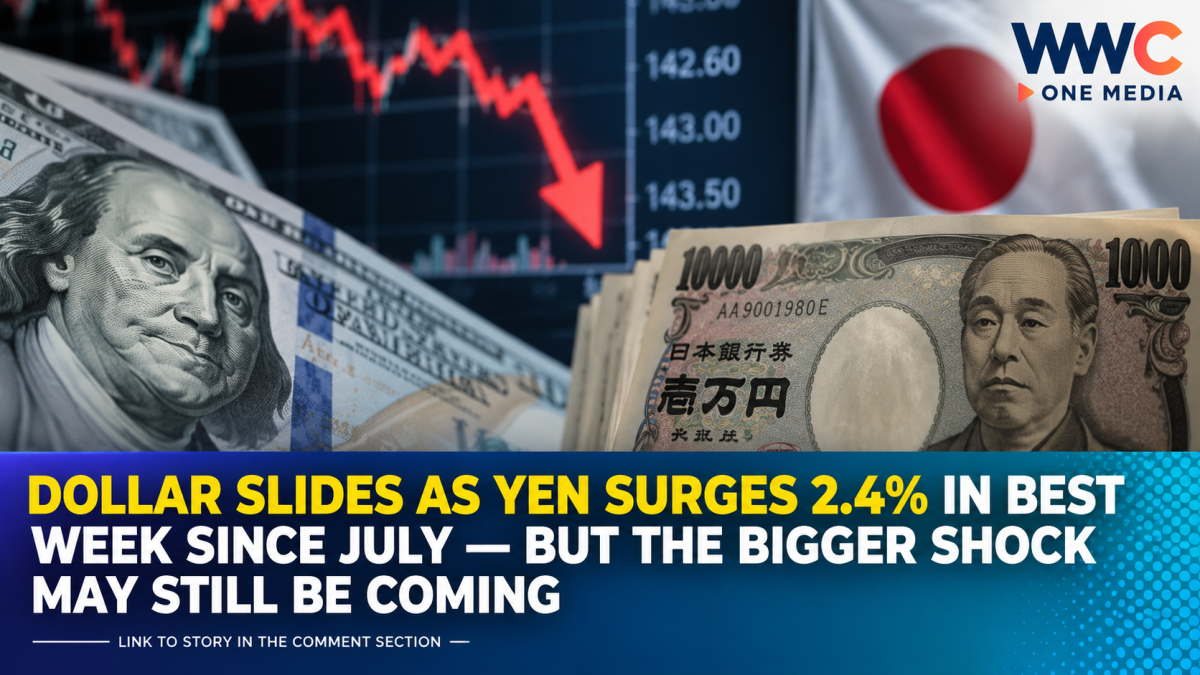
The Japanese yen is staging a powerful comeback against the U.S. dollar, posting its strongest weekly performance since July as traders increasingly bet that the Bank of Japan could accelerate its interest-rate normalization.
The yen gained about 2.4% against the dollar for the week, according to The Japan Times, marking a sharp reversal for a currency that had been battered to a four-decade low just weeks ago.
The rally intensified after the dollar-yen exchange rate moved sharply lower during the week. On Friday, the yen briefly strengthened to around ¥155.25 per dollar, before giving back some of its gains. Reuters reported that the currency remained on track for its strongest weekly advance in more than a month.
But despite the dramatic move, there is no clear evidence that Japanese authorities launched another currency intervention.
That distinction is crucial.
Japan has already spent a record ¥15.39 trillion on foreign-exchange intervention between July 30 and late August, buying yen and selling dollars in an effort to halt the currency’s historic decline. Tokyo and Washington also acknowledged a rare joint intervention in late July.
This week’s move, however, appears to have been driven more by changing expectations over monetary policy.
BOJ rate-hike bets surge
Investors are increasingly convinced that the Bank of Japan could raise interest rates at its upcoming September policy meeting.
Reuters reported that markets were assigning roughly a 97% probability to a 25-basis-point BOJ rate increase in September, up dramatically from the previous month. Traders are also considering the possibility of additional increases later in the year.
That would represent a major shift in expectations.
For years, Japan’s ultra-low interest rates helped make the yen a favored funding currency for the global carry trade — investors could borrow cheaply in yen and invest in higher-yielding assets elsewhere.
Now, as Japanese rates rise and the gap between Japanese and U.S. interest rates potentially narrows, investors have greater incentive to unwind those positions.
That can create a powerful feedback loop: investors sell overseas assets, buy back yen and close bearish yen positions, pushing the Japanese currency even higher.
U.S. rate expectations are also changing
The Federal Reserve is another important piece of the puzzle.
Recent comments from Fed Governor Christopher Waller have encouraged markets to reassess expectations for U.S. monetary policy. Meanwhile, U.S. employment data released Friday showed employers added 162,000 jobs in August, substantially above the 56,000 increase economists had expected, although softer wage growth complicated the outlook.
The result is a highly volatile currency market in which traders are trying to determine how quickly the Fed and BOJ will move in opposite or converging directions.
A narrower U.S.-Japan rate differential could further undermine the dollar against the yen.
Japanese investors could become another major force
Another potentially powerful factor is the enormous pool of Japanese money invested overseas.
Reuters reported that Japanese institutional investors have been selling foreign bonds at the fastest pace in four years, raising speculation that some capital could return home as Japanese bond yields rise.
Japanese 10-year government bond yields have also climbed above 3%, their highest level in roughly three decades, increasing the attractiveness of domestic assets relative to foreign bonds.
Attention is consequently turning toward Japan’s massive Government Pension Investment Fund, with investors watching for any significant change in its allocation between domestic and overseas assets.
If Japanese investors accelerate repatriation, the resulting demand for yen could add another layer of upward pressure on the currency.
Short sellers are suddenly facing a different market
The biggest threat may be to traders who have spent months betting against the yen.
Reuters reported that positioning has begun shifting from bearish to bullish, while leveraged funds, banks and other investors have been buying the Japanese currency.
JPMorgan analysts have estimated that as much as ¥17 trillion ($109 billion) in yen short positions accumulated since Prime Minister Sanae Takaichi took office could potentially be unwound.
A complete reversal, according to the bank’s analysis cited by Reuters, could push the dollar-yen exchange rate toward the ¥142–¥146 range.
That is not a forecast that the move will necessarily happen, but it illustrates how powerful a short-covering rally could become if market sentiment flips decisively.
Japan is still watching the currency closely
Tokyo has made clear that it remains alert to excessive currency movements.
Japan’s top currency diplomat, Atsushi Mimura, said Friday that authorities remained on alert and continued communicating with U.S. officials regarding exchange-rate developments.
The Japan Times also reported that analysts do not believe this week’s yen surge had the characteristics normally associated with direct government intervention. Official intervention tends to produce a much faster move, while this week’s appreciation developed more gradually.
That leaves markets facing a very different question from the one dominating trading earlier this year.
The issue is no longer simply whether Japan can stop the yen from falling.
It is whether the combination of BOJ rate hikes, repatriation of Japanese capital and the unwinding of massive yen-short positions could push the currency much higher — and how far the dollar could fall if that happens.
WWC ONE MEDIA M.J.E




Leave a Reply