
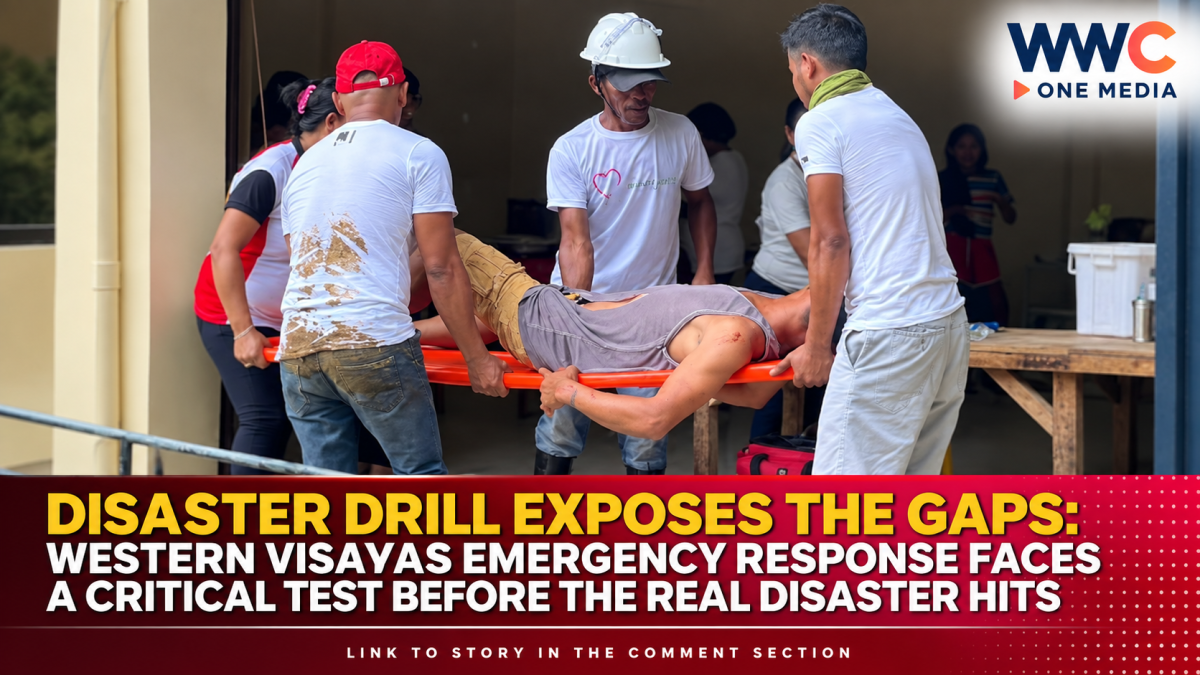
ILOILO — A massive disaster simulation in Oton has exposed critical areas that Western Visayas must address before a real mass-casualty emergency puts the region’s emergency response system to the ultimate test.
More than 30 government, healthcare, humanitarian, academic and private-sector institutions participated in PROJECT MedX: Western Visayas Emergency Medical Simulation Exercise on Wednesday, September 9, simulating a major road crash complicated by a hazardous chemical spill.
The exercise was not designed to prove that the region’s emergency system was already perfect.
Instead, organizers deliberately created a complex, high-pressure scenario to find out where the system could break down — and what needs to be fixed before lives are actually at stake.
A simulated catastrophe puts Western Visayas to the test
The scenario involved a simulated head-on collision between a commercial chemical tanker and several passenger vehicles along the Circumferential and Bypass Roads in Barangay Pakiad, Oton.
Responders had to deal with multiple challenges simultaneously:
- Mass-casualty triage
- Vehicular extrication
- Hazardous-material containment
- Chemical risk assessment
- Victim decontamination
- Ambulance coordination
- Field stabilization
- Hospital referrals
- Medical surge capacity
- Inter-agency communication
The medical staging and triage area was established at Oton National High School, while simulated casualties were distributed among participating public and private hospitals.
The exercise also tested whether agencies could operate under the Incident Command System (ICS) — a unified approach intended to coordinate multiple organizations during complex emergencies.
The drill revealed where the system needs work
According to A-PAD Philippines Executive Director Athena Peñaloza, the exercise identified several areas requiring closer examination.
These included coordination between government health offices and private hospitals, responder arrival times, and the ability of neighboring municipalities to reinforce Oton during a major emergency.
That distinction is important.
The organizers did not characterize the drill as a failure. Rather, the gaps were precisely what the simulation was intended to uncover.
Peñaloza said the exercise showed strengths while also identifying initial weaknesses that can be addressed to create a more resilient and unified emergency response.
Why hospital coordination could become crucial
One of the biggest challenges in a mass-casualty incident is what happens after victims are rescued from the disaster site.
A large-scale emergency can suddenly send dozens of injured people toward hospitals at the same time, potentially overwhelming emergency departments if patient distribution, transportation and communication are not properly coordinated.
PROJECT MedX therefore tested how simulated patients could be distributed among public and private hospitals, allowing organizers to assess medical surge capacity, hospital coordination and transportation routes.
Office of Civil Defense Region 6 and Regional Disaster Risk Reduction and Management Council 6 chairperson Raul Fernandez also emphasized the importance of medical supervision during patient transfers.
The goal is to ensure that patients receive appropriate medical attention while being transported and that receiving hospitals have adequate information before casualties arrive.
More than a drill: building one regional response system
A major objective of PROJECT MedX is to overcome one of the biggest problems during disasters: different organizations responding at the same time but not necessarily operating as one system.
The Western Visayas simulation brought together local disaster offices, health authorities, hospitals, emergency responders, military personnel, humanitarian groups, academic institutions and private organizations.
Participating local governments included Oton, Pavia, Tigbauan, Tubungan, Igbaras, San Joaquin, Miag-ao and Guimbal, while Iloilo City’s Urban Search and Rescue team also participated.
Hospitals and healthcare institutions involved included Western Visayas Medical Center, West Visayas State University Medical Center, The Medical City Iloilo, St. Paul’s Hospital Iloilo, Healthway Hospital by QualiMed and Metro Iloilo Hospital and Medical Center, among others.
Western Visayas exercise follows Central Luzon simulation
The Iloilo exercise is part of a broader PROJECT MedX initiative launched by Asia Pacific Alliance for Disaster Management Philippines (A-PAD PH).
A-PAD PH previously conducted a Central Luzon simulation in July 2026 involving a magnitude 6.8 earthquake scenario in San Fernando, Pampanga.
That exercise similarly tested on-site emergency response, patient transportation, hospital surge capacity and coordination among government, healthcare, academic, private-sector and humanitarian partners.
A-PAD PH launched PROJECT MedX nationally in February 2026 as a medical disaster-preparedness initiative designed to strengthen emergency medical systems through coordinated, multi-sector simulations.
The organization’s approach is straightforward: it is safer to discover weaknesses during a simulation than during an actual disaster.
The real test starts after the drill
The most important outcome of the Oton exercise may not be what happened during the simulation — but what authorities do with the problems it uncovered.
Participating agencies are expected to review response times, communication systems, operational performance, hospital referrals and coordination between jurisdictions.
The findings can then be used to improve standard operating procedures and regional disaster-response protocols.
For Western Visayas, the message is clear:
A disaster does not stop at a municipal boundary, and neither should the emergency response.
When a major crash, earthquake, chemical incident or other mass-casualty event occurs, seconds can determine whether a victim receives timely treatment.
The Oton simulation provided responders with something that a real catastrophe cannot: a chance to make mistakes, identify weaknesses and fix them before the consequences become real.
And now comes the harder question:
Will the gaps exposed by the drill be closed before Western Visayas faces the real thing?



Leave a Reply