
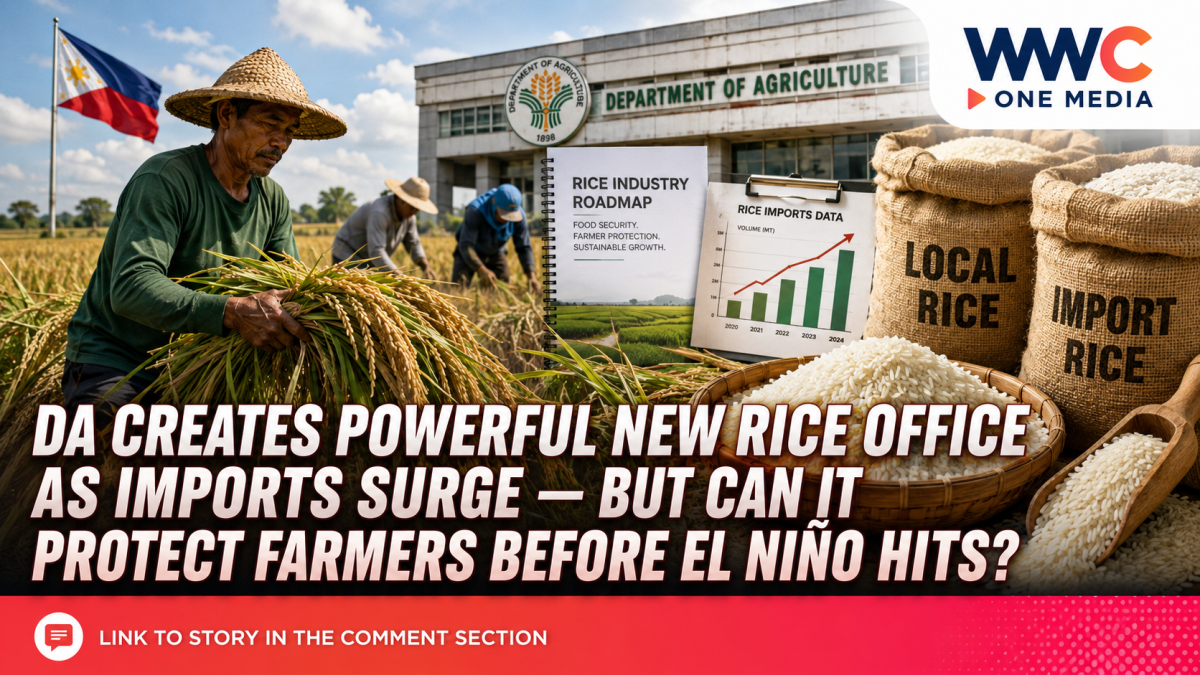
MANILA, Philippines — The Department of Agriculture has placed the government’s major rice programs, monitoring systems and rice-development funds under a newly created office, a sweeping reorganization that comes as the Philippines faces a difficult balancing act: keeping rice supplies plentiful and prices manageable without allowing surging imports to crush local palay farmers.
Agriculture Secretary Francisco Tiu Laurel Jr. created the Interim Rice Industry Development Office, or Rice Office, through Department Order No. 26 dated August 26, 2026. The order took effect immediately.
The move goes significantly beyond simply adding another unit inside the DA.
Under the department order, the Rice Office will plan, implement, monitor and evaluate programs under both the National Rice Program (NRP) and the Rice Competitiveness Enhancement Fund (RCEF). It will also coordinate rice-related programs involving other government offices and agencies.
More importantly, the new office is being given oversight across the rice value chain—from government interventions and program standards to monitoring, digitalization, databases and the use of rice-related government funds.
That could make the Rice Office one of the most consequential units inside the Agriculture Department at a time when billions of pesos are flowing into efforts to modernize one of the country’s most politically and economically sensitive industries.
One office will now connect programs that were previously spread across government
The order directs the Rice Office to consolidate and rationalize its operations with the National Rice Program, the RCEF Program Management Office and other DA bureaus, agencies and corporations handling rice-related functions.
It must also establish a unified monitoring and evaluation framework so the government can measure not merely how much money is spent or how many projects are distributed, but whether interventions are actually improving productivity, farmer income and the industry’s competitiveness.
The office will additionally lead rice-sector digitalization and maintain a comprehensive rice-industry database intended to support government planning and policy decisions.
That mandate is notable because the DA had already created a Rice Data Analytics Center in January 2026 as its central hub for rice-industry data. Department Order No. 26 now puts the broader Rice Office at the center of consolidating and managing rice information, suggesting an effort to bring previously fragmented initiatives under a single command structure.
The DA said the reorganization is necessary because the sector continues to struggle with high production costs, inadequate post-harvest facilities and the growing need for climate-resilient farming. The government’s broader goal is to shift the rice industry away from being almost entirely production-focused toward a more market-oriented, resilient and competitive system.
The new office will also manage rice-development funds
One of the most significant provisions received relatively little attention in the original report.
Department Order No. 26 states that all DA funds pertaining to or established for rice-industry development—or the rice-related portions of those funds—will fall under the management of the Rice Office. Until a separate organizational structure and budget are approved, its initial operations will be financed using existing General Appropriations Act allocations for rice-related programs.
That matters because RCEF alone now carries a guaranteed ₱30-billion annual appropriation through 2031.
Republic Act No. 12078, signed in December 2024, tripled RCEF’s annual allocation from ₱10 billion to ₱30 billion and extended the program through 2031. The money supports areas including certified seeds, mechanization, training, farmer financial assistance, credit, soil improvement and irrigation projects.
The 2026 expenditure program provides the full ₱30 billion for RCEF.
So the debate surrounding the new Rice Office is likely to extend well beyond bureaucratic restructuring. Its performance will ultimately be judged by whether stronger central control translates into better results for farmers—and whether billions of pesos in assistance produce measurable improvements on the ground.
The timing is critical: rice imports are surging
The restructuring comes while the Philippines is importing rice at an unusually rapid pace.
Bureau of Plant Industry data cited by the Manila Bulletin showed rice imports reached 3.27 million metric tons from January through July, up nearly 27 percent from 2.58 million MT during the same period in 2025. Vietnam supplied about 2.53 million MT, or roughly 77 percent of the total.
Separate Bureau of Customs figures reported by The Philippine Star put January-to-July import volume at about 3.42 million MT, reflecting differences in how government agencies record applications, arrivals and customs entries. Customs collected around ₱12.8 billion in rice tariffs during the seven-month period, an 18-percent increase from a year earlier.
The distinction is important: import statistics from BPI and Customs are not always directly interchangeable, so the safest conclusion is that rice imports have risen sharply rather than treating the agencies’ figures as contradictory.
Why isn’t the government simply stopping imports?
Because another threat is approaching.
Tiu Laurel said earlier this month that the government does not intend to suspend rice imports in 2026, unlike the four-month import halt imposed from September through December last year.
The DA is preparing for a potentially strong El Niño toward the end of 2026 that could reduce domestic palay production and leave the country vulnerable before the 2027 dry-season harvest. The department has estimated that El Niño could cut palay production by roughly 750,000 metric tons.
That creates an uncomfortable policy dilemma.
Import too little, and consumers could face supply shortages and higher rice prices.
Import too much—particularly as Filipino farmers begin harvesting—and an oversupplied market can push farmgate palay prices lower.
Farmer organizations have already raised that concern. The Federation of Free Farmers and Magsasaka party-list have sought a 30-percent safeguard duty on imported rice, on top of the existing tariff, arguing that excessive import volumes have harmed local producers.
The DA itself conducted a preliminary safeguard investigation and determined there was sufficient evidence of a causal link between increased imports and serious injury to the domestic rice industry, referring the matter to the Tariff Commission for further investigation.
At the same time, the government acknowledges that imports remain necessary because domestic production does not completely cover national demand.
That is precisely the contradiction the new Rice Office will inherit.
The real test won’t be the creation of another office
Creating a centralized Rice Office could solve a longstanding problem in Philippine agriculture: multiple agencies and programs working on different pieces of the same industry without a single body capable of seeing—and measuring—the entire picture.
But an organizational chart alone will not lower fertilizer expenses, build dryers, prevent post-harvest losses, raise palay prices or shield farmers from drought.
The Rice Office will now have something more important than a new name: authority over coordination, data, monitoring and substantial government resources.
And with rice imports accelerating, farmers demanding stronger protection and El Niño threatening the next harvest, the new office may not have much time to prove that centralizing control can produce better results.
The question is no longer whether the Philippines has enough rice programs. It is whether putting them under one roof can finally make them work together.




Leave a Reply