
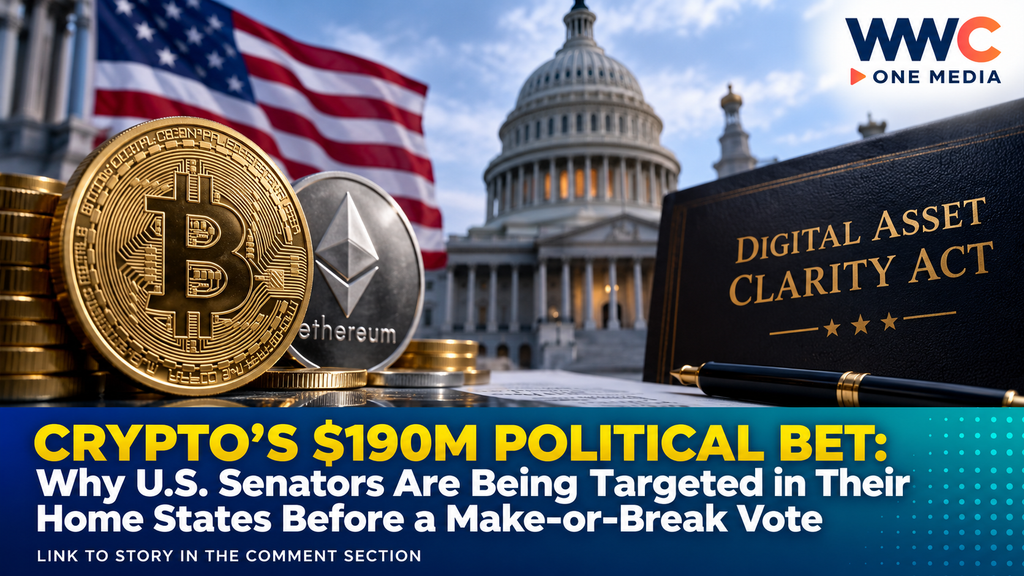
WASHINGTON — The battle over America’s cryptocurrency rules has moved far beyond Capitol Hill.
With the U.S. Senate preparing for a crucial procedural vote on September 15, crypto companies and traditional banks are taking their lobbying campaigns directly into senators’ home states in a final push that could determine the fate of the Digital Asset Market CLARITY Act.
The stakes are enormous.
The CLARITY Act is designed to establish a comprehensive federal framework for digital assets, including clearer lines between securities and commodities and which regulators—the Securities and Exchange Commission or Commodity Futures Trading Commission—should oversee different parts of the crypto market.
For the cryptocurrency industry, passage would provide something it has demanded for years: regulatory certainty in the United States.
For banks, however, parts of the legislation could create a new competitive threat—particularly around stablecoins and customer rewards that could compete with traditional bank deposits.
CRYPTO INDUSTRY GOES GRASSROOTS
During the congressional August recess, crypto advocates intensified their efforts outside Washington.
Stand With Crypto, an industry-backed advocacy organization, says its network has about 3 million supporters. The group has organized events, encouraged Americans to contact lawmakers and published opinion pieces in states including Oklahoma, Kentucky and Kansas.
The organization said its supporters made nearly 50,000 calls or emails to members of Congress during August while also arranging meetings with lawmakers and their staff.
The Blockchain Association has also launched a campaign encouraging voters and crypto supporters to contact their senators and push for passage of the legislation.
The broader political campaign is backed by serious money. Reuters reports that crypto interests have already spent at least $190 million on political efforts, underscoring how influential the industry has become in U.S. elections and policymaking.
BANKS ARE FIGHTING BACK
Traditional financial institutions are not standing aside.
The Independent Community Bankers of America has been mobilizing local bankers to meet senators in their home states, arguing that certain provisions could allow crypto companies and stablecoin platforms to compete directly with banks for deposits.
The concern is straightforward: if consumers move substantial amounts of money from bank accounts into digital assets, banks could lose a key source of funding for loans to households and businesses.
Some Republican senators have raised similar concerns, including James Lankford of Oklahoma and Mike Rounds of South Dakota.
The banking industry’s concerns are particularly focused on stablecoin rewards.
The latest CLARITY Act text would prohibit rewards on idle stablecoin balances that function like bank deposits, while allowing certain activity-based incentives. Banks argue that the distinction could still leave room for products that effectively compete with deposit accounts.
THE 60-VOTE PROBLEM
The biggest obstacle is political—not technological.
The Senate needs 60 votes to overcome the procedural hurdle. While Republicans control the chamber, the legislation needs Democratic support to reach that threshold.
That has forced negotiators to address concerns involving consumer protection, anti-money-laundering rules, financial stability and ethics provisions concerning government officials and cryptocurrency.
Some Democrats have argued that the bill does not go far enough to prevent illicit finance and conflicts of interest.
Senate Banking Committee Democrats have also criticized the legislation over what they describe as weaknesses in enforcement and national-security protections.
The bill nevertheless cleared the Senate Banking Committee in May by a 15-9 vote, a significant bipartisan step that sent it toward the full Senate.
WHY SEPTEMBER 15 COULD CHANGE EVERYTHING
The September 15 vote is not necessarily the final passage vote.
Instead, it is a procedural test that could determine whether the legislation can advance toward a full Senate debate and vote.
That distinction matters because a failure to secure the required 60 votes could effectively stall the legislation at a moment when the congressional calendar is rapidly shrinking ahead of the November midterm elections.
Reuters has described the bill’s prospects as uncertain, with lawmakers facing limited legislative days and major unresolved disagreements.
For crypto companies, the timing is critical.
The industry sees the legislation as a potentially historic opportunity to replace years of regulatory uncertainty with a federal framework governing digital assets.
For banks, the concern is equally fundamental: whether the growth of stablecoins and crypto platforms could eventually pull deposits away from traditional lenders and alter how credit is provided across the U.S. economy.
THE BIGGER POLITICAL BATTLE
The lobbying war also reflects the growing political power of the cryptocurrency industry.
President Donald Trump has made crypto policy a major priority of his administration, while the White House has backed the CLARITY Act. The administration’s broader crypto agenda follows the enactment of the GENIUS Act in 2025, which established a federal framework for payment stablecoins.
But the CLARITY Act goes much further.
It seeks to establish the broader regulatory architecture for digital assets—potentially determining which agencies oversee different tokens, how crypto companies interact with financial markets and what obligations they face.
That is why both sides are now fighting for every senator they can influence.
And with the September 15 procedural vote approaching, the question is no longer simply whether America will regulate crypto.
The bigger question is who will have the upper hand when the rules are finally written: Wall Street’s banks—or the rapidly expanding crypto industry.
Leave a Reply