
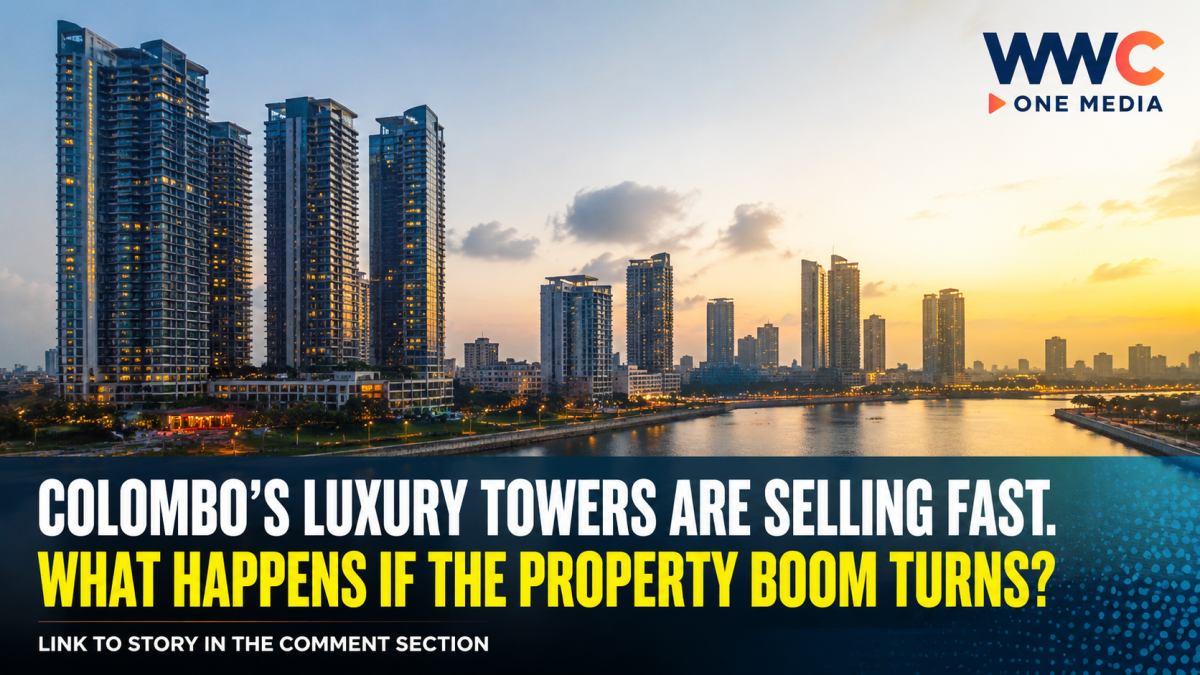
Sri Lanka’s Luxury Property Boom Is Accelerating—But Regulation May Not Be Keeping Up
Colombo, Sri Lanka — Sri Lanka’s luxury property market is entering a potentially decisive phase as high-end condominium prices climb, major developments advance in Colombo Port City and investors increasingly view apartments as financial assets rather than simply homes.
But behind the glittering towers is a growing regulatory question: Can Sri Lanka’s institutions keep pace with a property market that is becoming increasingly investment-driven?
The issue has gained fresh attention after The Diplomat reported that Colombo’s luxury property expansion may be moving faster than the country’s regulatory framework. The concerns are particularly relevant in Colombo Port City, where several major residential and mixed-use projects are being developed.
The latest Central Bank of Sri Lanka data provides evidence of strong price momentum—but also a more complicated picture of demand.
Luxury condominium prices jump 18.5%
According to the Central Bank of Sri Lanka’s first-quarter 2026 Real Estate Market Analysis, the Price Index for New Condominiums in Colombo District increased 18.5% year-on-year, reaching 284.4.
However, condominium sales activity moved in the opposite direction.
The Condominium Property Sales Volume Index declined 15.2% year-on-year during the first quarter. Colombo District nevertheless remained the country’s dominant condominium market, accounting for about 65% of transactions.
The data suggests that Sri Lanka’s property story is not simply a conventional sales boom. Instead, the market is experiencing strong price appreciation and growing demand for expensive units despite weaker overall transaction volumes.
Demand is also shifting toward the upper end of the market. Transactions involving properties priced between Rs.50 million and Rs.75 million, as well as properties above Rs.75 million, increased slightly, while transactions in the Rs.25 million-to-Rs.50 million category declined.
The Central Bank’s findings were reported by both Daily FT and EconomyNext.
Colombo Port City becomes a major investment magnet
One of the biggest drivers of Sri Lanka’s new luxury-property narrative is Colombo Port City, the large-scale reclaimed development being positioned as an international business and investment destination.
In April 2026, Sri Lanka’s Cabinet approved 77 Businesses of Strategic Importance under the Colombo Port City Economic Commission framework.
The Port City Economic Commission says the approved investments represent a major step in developing the Special Economic Zone. Among the projects are residential, marina and mixed-use developments.
The Commission reported that the approved projects included Prime Melwa Port City, Marina Hotel Holdings and Home Lands Port City, with land and development costs collectively valued at approximately Rs.125 billion, including around US$262 million in foreign inflows over five years.
Separately, Port City officials reported that the development had attracted approximately US$2.19 billion in investments to date.
That investment momentum helps explain why luxury residential projects are receiving renewed attention.
But it also raises a more difficult question: Does Sri Lanka’s regulatory system have the tools needed to manage a property market increasingly driven by investment expectations?
The biggest concern: money paid before construction is complete
One of the central concerns highlighted by The Diplomat is the treatment of buyer payments for properties sold before completion.
In mature property markets, regulators may require developers to place buyers’ money into protected escrow accounts, with funds released according to construction progress.
The Diplomat argues that Sri Lanka does not have a comparable mandatory, industry-wide escrow requirement for condominium developments. This means buyers need to pay particular attention to the developer, contractual protections, financing arrangements and project status before committing substantial amounts of money.
The article compares Sri Lanka’s system with Dubai, where escrow mechanisms have been used to protect buyers in off-plan property transactions.
This is an important distinction: the concern is not that every Sri Lankan developer is unsafe or that every project is destined to fail. Rather, the concern is whether the regulatory framework provides enough standardized protection as the volume and financial value of speculative property transactions increase.
Sri Lanka’s condominium regulator was created for a different era
The Condominium Management Authority (CMA) was established under legislation dating back to 1973, with subsequent amendments expanding its role.
Under the Condominium Management Authority Law, the institution’s responsibilities include controlling, managing, maintaining and administering condominium properties and common amenities. The law also gives the authority responsibilities relating to provisional condominium properties and monitoring construction progress to protect stakeholders.
That means the CMA is not simply a residents’ association. It has statutory responsibilities covering condominium developments.
However, the broader question raised by critics is whether an institution originally designed around condominium management has sufficient powers and resources to function as a modern financial-style regulator for an increasingly investment-driven, high-value property market.
Transparency is becoming increasingly important
Another major issue is market transparency.
When apartments are marketed as investments, buyers need reliable information about project progress, developer performance, sales, prices and financing.
Sri Lanka’s property market does not yet have the same level of publicly accessible project-by-project information available in some highly regulated international property markets.
That creates an information gap.
A developer may advertise strong demand or impressive future returns, but an individual buyer can have difficulty independently verifying the underlying market data.
This becomes especially important when marketing language suggests extraordinary capital gains.
The Diplomat report cited one advertisement promising buyers they could double their investment within four years. Such claims should be treated as marketing projections rather than guaranteed investment outcomes, unless backed by legally enforceable guarantees and independently verified evidence.
A booming property market does not automatically mean a bubble
There is another important side to the story.
Sri Lanka’s property market is supported by genuine domestic demand, improving economic conditions and renewed investment.
A July 2026 analysis published by Daily FT argued that local property demand remains significant, with strong absorption rates in several segments of the Colombo apartment market. The analysis also noted the importance of Sri Lanka’s diaspora as a potential source of demand.
At the same time, the Central Bank’s latest figures show that property prices have continued rising even while transaction volumes weakened.
That combination means it would be premature to declare that Sri Lanka is already experiencing a property bubble.
Instead, the warning signs deserve closer monitoring:
Rapid increases in luxury-property prices
Investment-oriented marketing
Expectations of large future capital gains
Large amounts of buyer money committed before project completion
Limited public information about individual projects
Concentration of high-value development in Colombo
Increasing financial exposure to the property sector
These conditions do not guarantee a crash. But together, they can increase vulnerability if investor expectations suddenly change.
Sri Lanka’s tourism recovery could add another layer of demand
The country’s broader economic recovery is also relevant.
Sri Lanka is aggressively rebuilding its tourism industry, which remains a major source of foreign exchange.
Reuters reported in August 2026 that Sri Lanka recorded 1.3 million tourist arrivals during the first seven months of the year, while tourism earnings reached approximately US$1.5 billion by the end of July.
The government has set a revised target of 2.7 million tourist arrivals for 2026 and is pursuing a major international tourism campaign.
A stronger tourism sector can support demand for hospitality, serviced residences, rental properties and other forms of real estate—particularly in Colombo and other high-demand locations.
Foreign buyers face their own rules
Sri Lanka also has specific legal restrictions governing foreign ownership of land.
Under the Land (Restrictions on Alienation) Act, transfers of land to foreigners are generally restricted, although the law contains important exemptions.
One significant exemption applies to condominium parcels under the Apartment Ownership Law, subject to conditions including payment of the full value through inward foreign remittance before execution of the deed.
Foreign investors therefore need to distinguish between buying a condominium unit and acquiring ordinary land in Sri Lanka, because the legal treatment is different.
Sri Lanka’s tourism investment authorities likewise identify condominium property as an important channel for foreign real-estate investment.
What Sri Lanka could do next
The debate ultimately comes down to regulation catching up with the market.
Several measures could strengthen confidence in Sri Lanka’s luxury-property sector:
Mandatory escrow arrangements: Buyer payments for unfinished developments could be protected and released according to verified construction milestones.
Public project databases: Buyers could have access to reliable information on approved projects, developers, construction progress, sales and other relevant indicators.
Stronger advertising rules: Developers and brokers could be required to distinguish clearly between guaranteed contractual returns and speculative projections.
Developer disclosure requirements: Large projects could be required to disclose standardized information on financing, construction status and sales.
Stronger regulatory capacity: Institutions responsible for condominium oversight could receive the staffing, technology and investigative powers necessary to monitor a rapidly expanding market.
Better investor protection: Clearer rules could reduce the possibility that problems at one development spread through interconnected projects or companies.
The real test is what happens when prices stop rising
For now, Sri Lanka’s luxury property market has powerful momentum.
Prices are rising. Port City is attracting investment. High-value condominiums are taking a larger share of transactions. Tourism is recovering. Developers are launching new projects.
But a property boom is easiest to manage when prices are rising.
The real test comes when expectations change.
If investors begin questioning projected returns, construction costs rise sharply, financing becomes more difficult or property prices stop climbing, the strength of the regulatory system will suddenly matter much more.
Sri Lanka’s luxury-property market may not be on the verge of collapse—and current data does not prove that it is.
But the country’s rapidly changing property landscape presents a clear policy challenge:
Build the regulatory guardrails before the market needs them, rather than after a crisis exposes the gaps.
For buyers, developers and policymakers alike, the question is no longer simply how high Colombo’s luxury towers can rise.
It is whether Sri Lanka can build the rules strong enough to support them.
WWC ONE MEDIA. G.A




Leave a Reply