
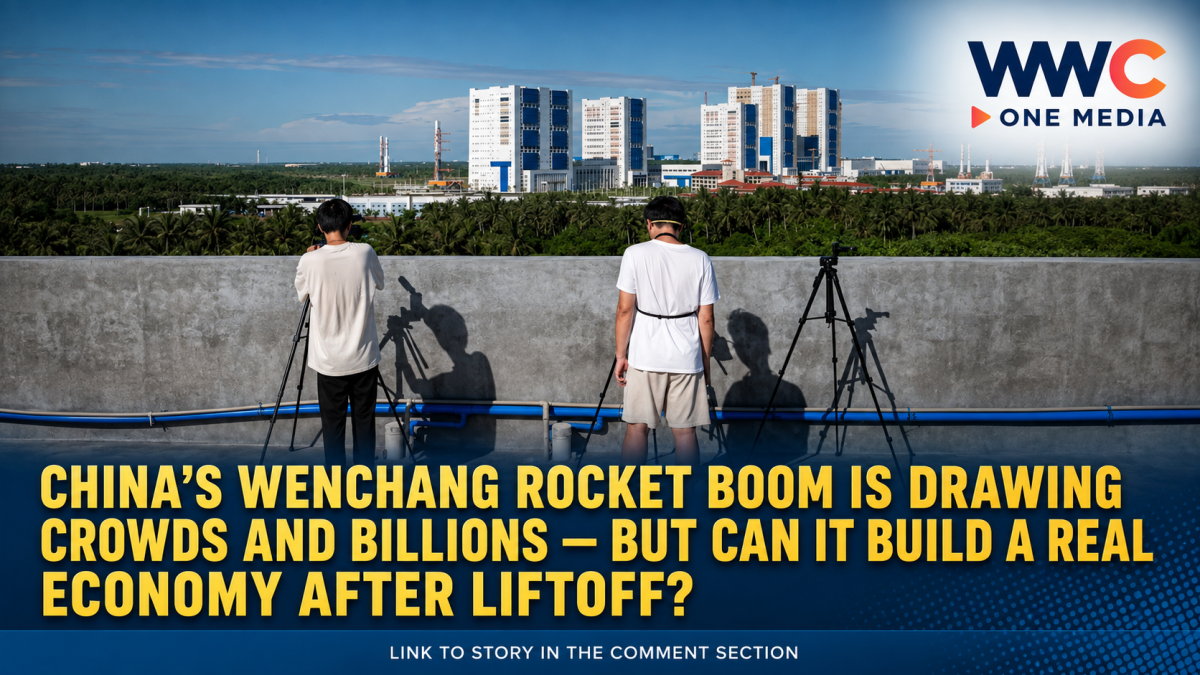
WENCHANG, China — On China’s tropical island of Hainan, rockets are increasingly becoming more than machines heading into orbit.
They are becoming an economic development strategy.
Wenchang, once known primarily for coconut groves, beaches and its famous Wenchang chicken, is attempting an ambitious transformation into one of China’s most important aerospace cities — combining government space missions, commercial rocket launches, satellite technology, manufacturing, data services and an emerging tourism industry built around the spectacle of liftoff.
The rockets are already attracting crowds. The bigger question is whether Wenchang can persuade those visitors — and aerospace companies — to stay.
CNA reported on August 31 that Wenchang authorities are trying to create an entire commercial ecosystem around the city’s growing launch infrastructure rather than allowing its economic benefits to disappear as soon as spectators leave after a launch.
From Coconut Country to China’s Rocket Coast
Geography gave Wenchang a major advantage.
Located at roughly 19 degrees north latitude, the city sits considerably closer to the equator than China’s older inland launch centres. Launching closer to the equator can allow spacecraft to benefit more from the Earth’s rotational speed.
Its coastal location also means large rockets and components can be transported by sea rather than relying entirely on difficult overland routes.
China’s state-run Wenchang Spacecraft Launch Site conducted its first mission in 2016.
Then came the development that dramatically expanded the city’s commercial ambitions: China’s first dedicated commercial spacecraft launch site began operations in Wenchang in November 2024. The city consequently became the only location in China hosting both government-operated and dedicated commercial launch facilities, according to CNA.
Construction of the commercial facility began in July 2022. By March 2025, both of its initial launch pads were operational, with the No. 1 pad designed to support a rapid launch-and-reset cycle as China tries to meet growing demand for satellite deployment.
And Beijing is already expanding the site again.
A second phase under construction includes additional launch pads, a commercial aerospace command-and-control centre, a rocket assembly and testing building and new tracking, telemetry and command infrastructure.
Launch Frequency Is Changing the Economics
The biggest difference between Wenchang’s earlier aerospace ambitions and today’s boom is simple: rockets are flying much more frequently.
CNA reported that Wenchang’s state-run and commercial facilities together recorded 21 orbital missions in 2025, compared with the much less frequent launch schedule of earlier years.
China Daily separately reported that the state-run Wenchang site alone conducted its 12th launch of 2025 on December 31, setting a record for that facility.
That increasingly busy schedule is creating businesses that barely existed a decade ago.
Rooftops have been converted into rocket-viewing platforms. Hotels advertise rooms with views of launch pads. Restaurants and cafes fill with space enthusiasts. Entrepreneurs sell models, souvenirs and educational products.
Rocket launches themselves are becoming tourist attractions.
Reuters reported on August 19 that launches in China have increasingly evolved into public spectacles, with crowds gathering in Wenchang and other space-themed destinations as the country’s space programme becomes part of popular culture as well as national technological ambition.
Some hotels are now trying to turn what was once a one-night launch trip into a two- or three-day stay by offering additional activities.
That matters because Wenchang has identified a fundamental weakness in rocket tourism: people often arrive, watch the launch — and leave.
Hundreds of Aerospace Companies Are Moving In
Tourism, however, is only the visible side of a much larger strategy.
CNA cited official data showing that Wenchang International Aerospace City had 673 aerospace companies as of April 2026, compared with just 30 in 2021.
The development zone generated 23.53 billion yuan, or about US$3.5 billion, in revenue in 2025, more than twice its 2022 level of 10.7 billion yuan.
Other Chinese official and state-media reports have described the cluster as containing more than 700 aerospace businesses, suggesting the precise company count varies depending on timing or classification. The broad trend, however, is clear: aerospace investment has expanded dramatically.
The objective is eventually to establish a full “rocket-satellite-data” industrial chain.
That means Wenchang does not just want rockets arriving from elsewhere to use its launch pads.
It wants rockets and satellites designed or manufactured locally, launched locally and their data processed and commercialised locally.
Officials have set a longer-term objective of having rockets and satellites made in Wenchang and launched from its spaceports by 2035.
Satellite Data Could Be Worth More Than the Launch
One of the most important parts of Wenchang’s strategy may be largely invisible to tourists watching rockets streak across the sky.
It is satellite data.
The Wenchang Aerospace Supercomputing Centre is being positioned to process and develop applications from Earth-observation and other satellite information.
Those applications can extend into mapping, agriculture, environmental monitoring, disaster response, urban planning and other commercial services.
That is crucial because launching a satellite is only one part of the space economy. Potentially greater recurring value can come from the information satellites collect and the services built on that information.
CNA reported that researchers from the University of Hong Kong have already worked with Wenchang’s supercomputing operations on remote-sensing and artificial-intelligence applications. Singapore has also been explored as a possible market and business base for overseas satellite-data services.
China Is Also Chasing the Reusable-Rocket Breakthrough
Wenchang’s expansion comes as China intensifies its competition in commercial launch technology.
In July 2026, China reported achieving its first controlled recovery of a carrier rocket’s first stage after the maiden flight of the Long March-10B from the Hainan commercial spacecraft launch site.
The first stage returned and was captured on a sea-based platform using a net system, according to Xinhua.
It was an important milestone for China’s efforts to lower launch costs through reusable technology.
But competition remains formidable.
Reuters reported in June that Chinese commercial rocket companies were increasingly looking toward public markets and trying to follow SpaceX’s vertically integrated model. Analysts nevertheless said Chinese companies still faced major gaps in reusable-flight experience, satellite-constellation scale and proven commercial revenue compared with SpaceX.
In other words, building launch pads is only part of the race.
Building businesses that repeatedly make money from them is harder.
A Rocket Failure Exposed the Risks
Wenchang also received a reminder this month that spaceflight is inherently unpredictable.
On August 10, a Long March 7A carrying the ChinaSat-4B communications satellite suffered an anomaly shortly after launching from Wenchang.
The rocket broke apart at relatively low altitude, and the mission failed.
It was the Long March 7A’s first failure since its unsuccessful maiden flight in 2020. The cause remains subject to investigation.
For Wenchang’s tourism industry, even ordinary schedule changes can cause problems.
Visitors frequently organise flights, hotel reservations and wider Hainan holidays around launch dates — only for missions to be postponed because of weather or technical issues.
CNA found tourists whose travel plans prevented them from staying after a launch was delayed by one day.
That is why local planners increasingly want museums, simulations, beaches, food, cultural attractions and aerospace exhibitions capable of keeping tourists occupied whether a rocket flies or not.
The Hardest Part Comes After Liftoff
Wenchang therefore faces a paradox.
Launching rockets may actually be easier than creating a sustainable city around them.
The foundations are increasingly visible: launch pads, aerospace companies, manufacturing projects, supercomputing infrastructure, hotels and thousands of spectators.
But an enduring aerospace hub also requires skilled engineers, entrepreneurs, private investment, insurance, suppliers, research institutions and customers willing to pay for satellite-derived services.
Talent may be particularly challenging.
CNA cited official wage data showing average private-sector pay in Hainan in 2025 at roughly 5,500 yuan per month, compared with around 8,300 yuan in Shenzhen, illustrating the competition Wenchang faces when trying to attract young skilled workers away from China’s established technology centres.
And established aerospace manufacturing clusters around Beijing and Shanghai already possess supplier networks and experienced workforces that cannot simply be recreated by constructing new facilities.
That may ultimately determine whether Wenchang becomes a genuine commercial-space powerhouse or mainly an increasingly busy launch location.
China has already succeeded in making rockets a spectacle on Hainan.
Now comes the more difficult mission:
turning those few spectacular minutes in the sky into businesses, jobs and economic activity that remain long after the rocket disappears from view.


Leave a Reply