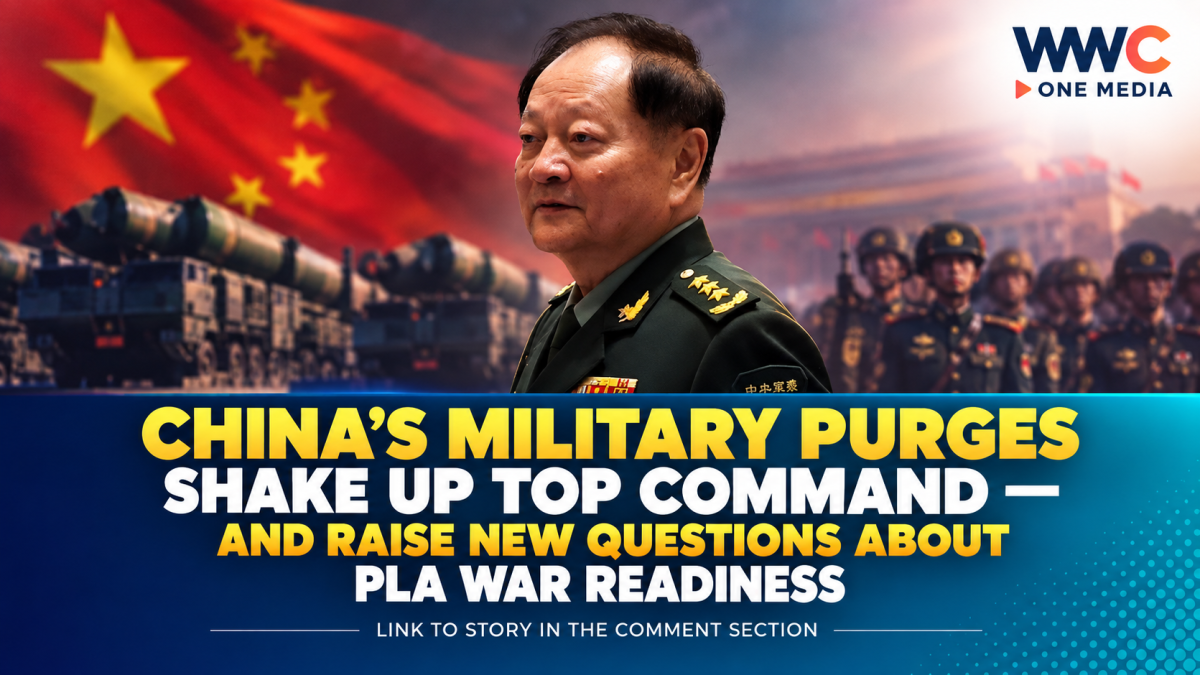
BEIJING — China’s sweeping purge of senior military commanders is creating an unusual leadership vacuum at the top of the People’s Liberation Army (PLA), prompting analysts and regional security officials to examine what the upheaval could mean for military readiness and command effectiveness.
The latest development came this week with the expulsion of Gen. Zhang Youxia and Gen. Liu Zhenli, two of China’s most senior military figures, from the Communist Party and armed forces. Chinese authorities accused the generals of serious disciplinary violations, corruption and disloyalty to the Party. Their cases have been referred to military prosecutors.
The removals are particularly significant because Zhang had served as a vice chairman of the Central Military Commission (CMC), China’s top military command body, while Liu had been chief of its Joint Staff Department.
Why Zhang’s Removal Is So Significant
Zhang was not simply another senior officer.
He was widely regarded as one of President Xi Jinping’s closest military allies and was among the few senior PLA officers with actual combat experience, having participated in China’s 1979 war with Vietnam.
His removal therefore eliminates an experienced figure from the military’s upper command structure at a time when China is continuing to modernize its armed forces and conduct exercises and deployments around Taiwan and disputed areas of the South and East China seas.
Reuters reported that analysts believe the scale of the leadership upheaval could create challenges for complex military operations, although the PLA’s routine operations and command structures remain functional.
The Command Structure Is Facing Major Turnover
The latest expulsions are part of a much broader campaign.
A CSIS database tracking senior PLA officers found that more than 100 senior Chinese military officials had been officially purged or gone missing since 2022, based on information available through February 2026. The research also found substantial turnover among senior leadership positions.
The database’s figures include both confirmed purges and cases where officers were considered potentially purged, so they should not be interpreted as a confirmed list of criminal wrongdoing.
The continuing turnover has left observers watching closely for how quickly Beijing can rebuild a stable senior command structure.
Reuters reported that five positions on the CMC’s seven-member ruling panel remained vacant following the latest upheaval.
Corruption Crackdown Meets Questions About Military Professionalism
Beijing has presented the campaign as an effort to eliminate corruption and strengthen discipline within the armed forces.
Chinese state media accused Zhang and Liu of violating political discipline, forming factions and abusing their positions. Those are official allegations, rather than independently established findings in the public record.
The campaign has also extended beyond individual commanders.
Former Chinese defense ministers Wei Fenghe and Li Shangfu have faced severe punishment in separate corruption cases, illustrating the depth of the leadership shake-up within the defense establishment.
The central question for outside observers is whether removing senior officials can simultaneously strengthen political control while creating short-term disruption within the military.
What Could the Purges Mean for China’s Military?
Analysts cited by Reuters offer different interpretations.
Some argue that eliminating corrupt or politically unreliable officers could ultimately strengthen military discipline and combat effectiveness.
Others point to the loss of experienced commanders, vacancies in senior positions and disruption to established leadership networks as potential problems for complicated military operations.
Singapore-based China security scholar James Char told Reuters that the purge is likely to strengthen Xi’s control over military affairs. Other analysts cited by Reuters cautioned that upheaval on this scale could create difficulties for complex contingencies.
The result is therefore not straightforward: political consolidation and operational disruption can occur at the same time.
Taiwan Is One of the Biggest Areas of Concern
The leadership shake-up is receiving particular attention because China continues to regard Taiwan as part of its territory, while Taiwan rejects Beijing’s sovereignty claims.
Chinese military aircraft and naval vessels routinely operate around Taiwan, and Taipei continues to report and monitor those activities.
But the current purge should not automatically be interpreted as evidence that China is preparing for, delaying or abandoning military action against Taiwan.
Reuters reported that analysts are instead examining whether prolonged leadership disruption could affect the PLA’s ability to coordinate more complicated operations.
That distinction matters: military readiness is broader than the number of commanders removed, and open-source reporting cannot provide a complete picture of the PLA’s operational capabilities.
Xi’s Control Appears Stronger
At the political level, however, the purge has another clear consequence.
By removing senior officers accused of disloyalty and factional behavior, Xi is reinforcing the principle that the PLA must remain firmly under Communist Party control.
Reuters quoted analysts who said the removal of Zhang and officers associated with other purged commanders has strengthened Xi’s position within the military.
The Financial Times likewise reported that the accusations against Zhang and Liu went beyond the corruption allegations frequently associated with previous military purges, with authorities also emphasizing political disloyalty and faction-building.
The Biggest Question Is What Happens Next
China’s military remains a large and heavily modernized force, and the latest purge does not by itself demonstrate a loss of operational capability.
What it does reveal is the extent of the leadership turnover underway at the top of the PLA.
The immediate questions are whether Beijing can fill vacant senior positions, preserve command continuity and maintain military professionalism while continuing its campaign against corruption and disloyalty.
For regional governments watching China’s military activity, the issue is therefore less about whether the PLA can operate today and more about how prolonged leadership disruption could affect the force’s ability to manage increasingly complex military operations in the future.
For now, analysts remain divided over the balance between the two effects: a more politically controlled military on one side, and the potential costs of losing experienced commanders on the other.
WWC ONE MEDIA G,A