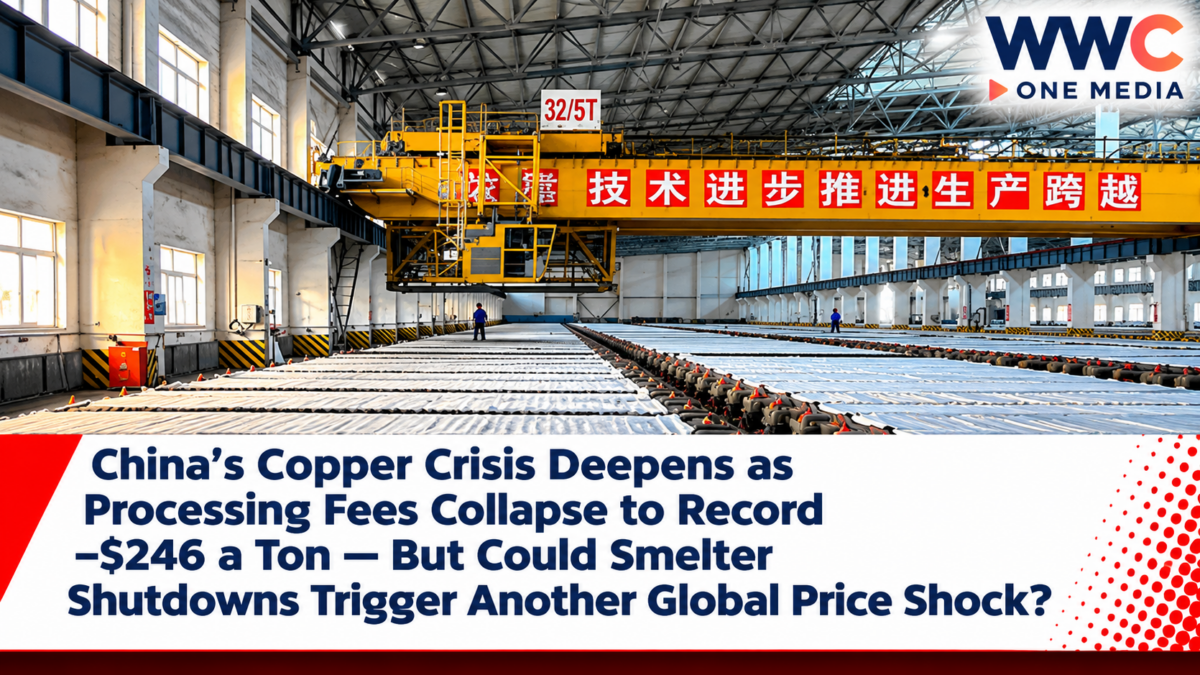
BEIJING, CHINA / MANILA, PHILIPPINES — November 11, 2026 — A growing crisis is gripping China’s copper industry as soaring raw-material costs, collapsing processing fees and weakening income from industrial byproducts threaten the profitability of some of the world’s most important metal producers.
The situation is becoming increasingly serious for Chinese copper smelters, which account for more than half of global refined copper production.
While copper prices remain historically elevated, the companies transforming mined copper concentrate into usable metal are facing a damaging contradiction: the product they manufacture is valuable, but processing it is becoming increasingly expensive.
According to Reuters and market intelligence providers, Chinese smelters are now confronting record negative treatment charges, a shortage of copper concentrate and a sharp decline in sulphuric acid prices.
Spot copper treatment charges fell to a record minus $246.40 per metric ton on October 30, according to Argus data cited by Reuters.
Meanwhile, Chinese sulphuric acid prices have dropped approximately 30% from their recent peak, eliminating an important source of income that previously helped smelters remain profitable.
The crisis is already influencing production decisions.
Some operators have extended maintenance shutdowns, while industry analysts expect more companies to reduce output if financial conditions do not improve.
At the same time, copper inventories in China have fallen sharply, forcing industrial buyers to compete for increasingly scarce physical metal.
The result could be a major disruption in a market essential to electricity networks, electric vehicles, renewable energy, manufacturing and artificial intelligence infrastructure.
But the critical question is whether China’s copper processors can survive the margin squeeze without triggering a wider shortage of refined metal.
Why China’s Copper Industry Is Under Pressure
China sits at the center of the global copper supply chain.
The country is the world’s largest copper consumer and dominates the processing of copper concentrate into refined metal.
Its smelters purchase copper-rich material from mines around the world, process it and produce refined copper used by manufacturers.
However, China’s smelting industry has expanded much faster than the availability of mined copper concentrate.
This mismatch has created intense competition for raw materials.
Smelters that need copper concentrate to keep their operations running have been forced to accept increasingly unfavorable commercial terms.
For decades, copper miners generally paid smelters treatment and refining charges to process their material.
But as processing capacity expanded and concentrate became scarce, the balance of bargaining power shifted toward mining companies.
The result has been an extraordinary collapse in processing fees.
Copper Treatment Charges Fall Below Zero
Copper treatment and refining charges, commonly called TC/RCs, are central to the economics of smelting.
Under traditional arrangements, miners compensate smelters for converting copper concentrate into refined metal.
When concentrate is plentiful, smelters have greater bargaining power.
When concentrate becomes scarce, mining companies can demand more favorable terms.
In December 2025, Chilean producer Antofagasta reportedly agreed to a 2026 annual benchmark of zero treatment and refining charges with a Chinese smelter.
That was already a dramatic change from the previous year’s positive benchmark.
Conditions have since deteriorated further in the spot market.
According to Argus data reported by Reuters, spot treatment charges fell to minus $246.40 per metric ton on October 30, 2026.
Negative charges indicate that smelters are effectively accepting a payment disadvantage to secure concentrate rather than receiving the traditional processing compensation.
That puts extraordinary pressure on operating margins.
However, the negative treatment charge does not mean copper’s market price itself is negative.
Copper remains a valuable commodity trading at thousands of dollars per metric ton.
The negative figure refers specifically to the commercial terms associated with processing concentrate.
Falling Sulphuric Acid Prices Remove a Critical Financial Lifeline
For much of 2026, Chinese copper smelters benefited from an unusual source of income.
Sulphuric acid, produced during the copper smelting process, became significantly more valuable.
The rise was partly associated with disruptions to Middle Eastern supplies during the Iran conflict.
Higher acid prices helped compensate for declining copper-processing revenue.
But that financial cushion is now disappearing.
Reuters reported that Chinese sulphuric acid prices fell to approximately 1,484 yuan per metric ton from a July peak of 2,107 yuan.
The decline represents almost 30%.
For companies already suffering from negative concentrate-processing charges, the combination is particularly damaging.
Smelters face higher effective costs for obtaining concentrate while earning less from a major byproduct.
Industry analysts warn that continued weakness could force more operators to reconsider production levels.
The outlook may become even more difficult if improved Middle Eastern supply conditions put additional downward pressure on sulphuric acid prices.
Major Chinese Copper Producers Report Profit Pressure
The financial strain is increasingly visible among publicly listed copper companies.
Reuters reported that major producers including Jiangxi Copper and Yunnan Copper recorded sharp quarter-on-quarter declines in third-quarter profits.
Different companies have different operating structures, so their results cannot be attributed exclusively to treatment charges.
However, the broader market deterioration is an important source of pressure.
Daye Nonferrous, another member of China’s major smelter industry group, has also warned that operating conditions are becoming increasingly difficult.
Copper smelters typically have substantial fixed costs.
Facilities require expensive equipment, electricity, maintenance and skilled employees.
When the economics of processing concentrate deteriorate, reducing production may help limit losses.
But extended shutdowns can also affect employees, customers and the companies supplying smelting equipment and materials.
That creates a difficult choice between maintaining output and protecting profitability.
China Could Record Its Slowest Copper Production Growth in Decades
The pressure is beginning to affect national copper-production forecasts.
According to Reuters, analysts from Wood Mackenzie and Zijin Tianfeng Futures expect China’s refined copper output to grow by only 3% to 3.4% in 2026.
That would represent a sharp slowdown from approximately 10.4% growth in 2025.
Reuters’ review of official data suggested this could be the slowest annual growth pace since at least 2000.
Several smelters scheduled maintenance during October and November.
Analysts expected those shutdowns to remove approximately 80,000 metric tons of potential production.
Shanghai Metals Market separately estimated that planned maintenance affected about 103,200 metric tons of output in October.
These are different estimates covering different periods and methodologies and should not simply be added together.
The underlying message is consistent: China’s enormous smelting capacity is becoming increasingly difficult to utilize profitably.
Copper Inventories Plunge as Buyers Scramble for Metal
The impact extends beyond the companies producing copper.
Chinese manufacturers are increasingly concerned about the availability of refined metal for immediate delivery.
According to Reuters, copper inventories monitored by the Shanghai Futures Exchange fell to approximately 33,848 metric tons in early November, a three-year low.
The decline indicates that readily available stocks had become unusually tight.
Meanwhile, the Yangshan premium, a closely watched measure of demand for imported copper, climbed to a record $230 per metric ton on November 9.
That premium represents the additional amount buyers were prepared to pay for imported copper under the relevant market quotation.
It is not the total market price of the metal.
The premium’s rise suggests that Chinese buyers were willing to pay significantly more to secure supply.
Bloomberg also reported that Shanghai spot premiums surged as manufacturers competed for scarce immediately available copper.
The tightening market has attracted international commodity traders seeking to supply copper to Asia.
Trafigura Moves to Secure Copper Across Asia
Global commodity trading company Trafigura has reportedly been purchasing substantial quantities of copper across Asia.
Bloomberg reported on November 7 that the trader approached producers and other market participants to secure additional physical metal for November and December delivery.
The buying interest reflects the increasingly tight conditions in China.
While overall demand has not necessarily surged across every industrial sector, immediate supply has become difficult to obtain.
That distinction matters.
A physical shortage can develop even when overall economic activity is relatively weak.
If producers cannot supply metal where and when customers need it, buyers may compete aggressively for available cargoes.
This can push up regional premiums even when global futures prices move in the opposite direction.
For manufacturers, the resulting cost increases may complicate procurement and production planning.
America’s Copper Stockpiling Has Added to the Imbalance
The Chinese copper shortage is also connected to shifting international trade flows.
During 2026, substantial quantities of refined copper were shipped toward the United States amid expectations of possible import tariffs.
Higher American futures prices encouraged traders to move metal into US warehouses.
That movement increased copper availability in the United States while tightening supplies in other markets.
In related reporting, WWC ONE MEDIA examined a $500-million copper shipment heading to New Orleans amid growing concerns about US warehouse capacity and tariff-driven stockpiling.
The report explored how trade policy can change the geographical distribution of metals inventories.
The current shortage in China therefore reflects more than insufficient mine production.
It also involves where refined copper is being stored and how traders respond to expected tariffs.
If US trade incentives change, some copper could eventually be redirected toward Asian markets.
However, shipping constraints, contracts and domestic demand mean that such movements would not necessarily happen immediately.
Copper Prices Remain Elevated Despite Market Volatility
The squeeze is unfolding against a backdrop of high and volatile global copper prices.
On November 10, Reuters reported that benchmark three-month copper on the London Metal Exchange traded around $13,939 per metric ton in early Asian trading.
Shanghai’s most-traded copper futures contract traded around 107,700 yuan per metric ton during the same reporting period.
Prices were supported by tight physical supplies and an improvement in broader investor sentiment.
However, copper has also experienced sharp fluctuations as global investors reassess the outlook for artificial intelligence spending and economic growth.
As WWC ONE MEDIA reported in its coverage of copper-price declines during an AI stock-market selloff, the metal’s price can be influenced by financial-market expectations as well as physical industrial demand.
That creates an unusual environment.
Some financial investors may be reducing bullish commodity positions even while Chinese manufacturers face a shortage of physical copper.
The difference between futures-market sentiment and immediate supply conditions is becoming increasingly important.
Why the AI Boom Is Making Copper More Strategic
Copper is essential to modern electrical infrastructure.
It is widely used in power cables, transformers, motors, industrial equipment and renewable energy systems.
Artificial intelligence infrastructure also requires large amounts of electricity.
That creates demand for electrical networks, power distribution equipment and associated construction materials.
Copper therefore has an indirect but important role in supporting the expansion of AI data centers.
However, strong long-term demand expectations do not guarantee uninterrupted price increases.
The pace of investment can change.
Technology companies can revise construction schedules.
Economic downturns can reduce industrial consumption.
The current Chinese supply squeeze reflects genuine processing and inventory constraints, but it does not establish that copper prices can only move higher.
Why the Philippines Should Pay Attention
The Philippines has substantial copper and gold mineral resources.
Projects across the country could potentially benefit from long-term interest in securing copper supplies.
However, converting mineral deposits into commercially operating mines requires financing, permitting, engineering and compliance with environmental and social obligations.
The global shortage of copper concentrate may improve the commercial attractiveness of some mining projects.
But that does not automatically make every undeveloped deposit profitable.
One major example is the Tampakan copper-gold project in South Cotabato.
Historical estimates suggest the deposit contains approximately 15 million tonnes of copper and 17.6 million ounces of gold.
These figures represent historical mineral-resource estimates and should not be confused with guaranteed economically recoverable reserves.
As WWC ONE MEDIA reported on the proposed ₱30-billion Tampakan-related mining transaction and its competition-law clearance, major copper projects are attracting investor attention even as legal, financial and operational questions remain.
China’s supply difficulties could add to international interest in copper-producing countries.
But Philippine projects would still need to address their own development challenges.
Copper Opportunities Come With Legal and Environmental Risks
Another Philippine example involves the Maalinao-Caigutan-Biyog copper-gold project in Kalinga.
The project has been associated with Celsius Resources and Makilala Mining Company.
Its development has faced financial and legal disputes.
As WWC ONE MEDIA reported on the legal battle involving Celsius Resources’ interest in the Kalinga project, ownership and financing uncertainty can affect mining investments even when the underlying commodity has strong market demand.
The case illustrates why investors should not evaluate mining projects solely on the direction of copper prices.
Development timelines, ownership arrangements, community consultation, environmental approvals and financing can all influence the outcome.
The Philippines may have opportunities in a tighter global copper market, but converting those opportunities into production requires more than higher prices.
Could Copper Shortages Affect Electric Vehicles and Renewable Energy?
Copper is widely used across industries that are central to the energy transition.
Electric vehicles require copper for motors, electrical connections and charging infrastructure.
Solar and wind developments rely on electrical equipment and grid connections.
Transmission networks need substantial quantities of conductive materials.
When copper becomes more expensive or difficult to obtain, manufacturers and project developers may face higher procurement costs.
However, the effect on final product prices depends on many factors.
Copper is only one component of an electric vehicle, renewable energy installation or industrial system.
Companies may use long-term contracts, inventories and other arrangements to manage changes in commodity prices.
It would therefore be premature to claim that China’s current supply squeeze will automatically cause an immediate increase in electricity bills or electric vehicle prices.
The more defensible conclusion is that persistent copper-market tightness could create additional cost pressure across industries dependent on the metal.
What Happens Next for China’s Copper Industry?
Several developments will determine whether the crisis eases or intensifies.
First, mining companies and Chinese smelters will need to negotiate future treatment and refining charges.
Second, smelters will assess whether continuing production remains economically viable at current margins.
Third, sulphuric acid prices will influence the profitability of refining operations.
Fourth, Chinese buyers will monitor the availability and cost of imported copper.
Fifth, changes in US tariff expectations could influence the movement of copper inventories between international markets.
Finally, the pace of global mine production will determine whether concentrate shortages can ease sustainably.
A sharp recovery in concentrate availability could improve smelter economics.
Continued shortages, however, may lead to additional production cuts.
The Bigger Picture: The World’s Copper Problem Is More Complicated Than High Prices
China’s copper crisis demonstrates how a commodity boom can benefit one part of an industry while placing another under severe pressure.
Mining companies can benefit from higher copper prices and favorable conditions for selling concentrate.
Smelters can suffer when concentrate is scarce and processing fees turn negative.
Industrial buyers can face record premiums when refined metal is difficult to obtain.
Meanwhile, traders can influence regional availability by moving inventories toward markets offering better prices.
These forces are now colliding in the world’s largest copper-consuming economy.
China’s smelters are facing record negative treatment charges.
Sulphuric acid prices have fallen sharply.
Production growth is forecast to slow significantly.
And physical copper inventories have tightened to unusually low levels.
For global manufacturers, the consequences could extend beyond China’s borders if sustained production cuts reduce the availability of refined copper.
For miners and investors, the crisis could create opportunities—but also substantial volatility.
China’s copper industry is entering a dangerous squeeze as rising raw-material costs, collapsing smelter margins and shrinking inventories put the world’s biggest refining hub under pressure. But if more producers decide that making copper is no longer profitable, could the resulting supply disruption ignite another global price surge just as the world needs more metal for AI, electric vehicles and clean energy?