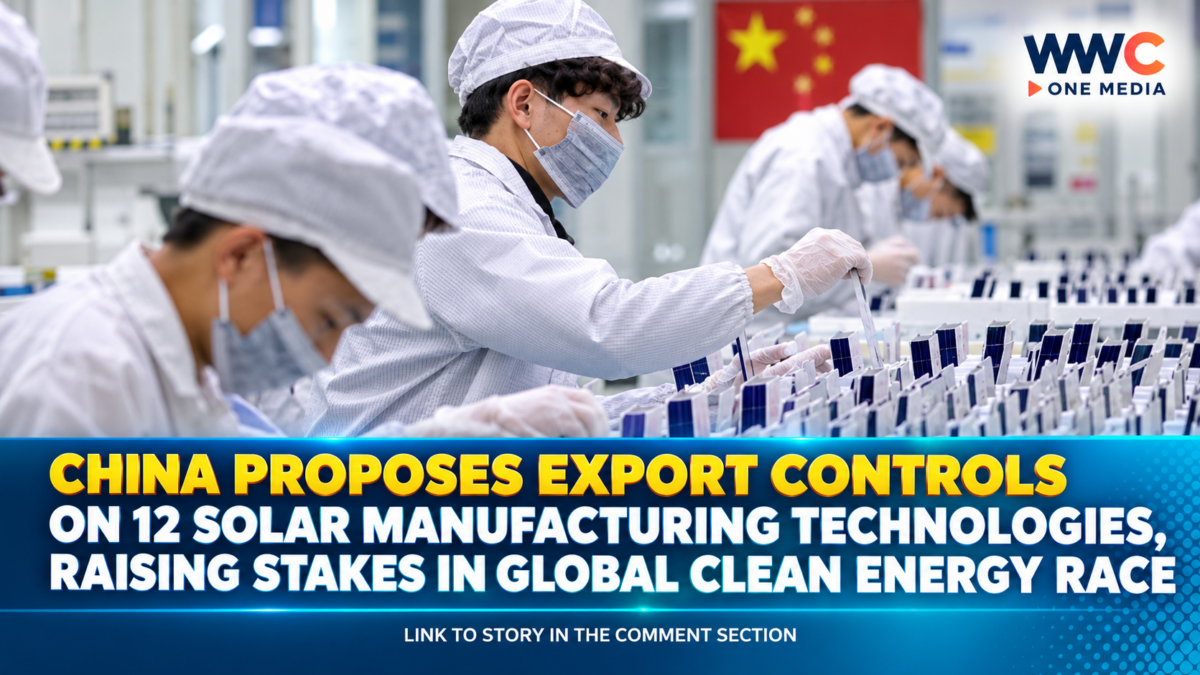
China has proposed new export controls on 12 technologies used to manufacture solar equipment, citing national security concerns as countries worldwide expand their domestic renewable energy industries and compete for leadership in advanced solar production.
The proposal, announced by China’s Ministry of Commerce on October 16, forms part of a broader review of technology export rules covering solar manufacturing, artificial intelligence and biotechnology. Officials said tighter oversight was needed because some of these technologies are increasingly being used in sensitive fields, including aerospace and national defence.
The proposed measures target technologies involved in producing silicon wafers, polysilicon and advanced solar cells. Some technologies would face outright export prohibitions, while others would be subject to restrictions requiring government approval.
Among the technologies targeted are manufacturing processes for thin silicon wafers, perovskite solar cells and tandem cells, which combine different materials to capture more sunlight and improve energy-conversion efficiency.
The proposal also covers fluidized-bed processes used to produce polysilicon, a key raw material for solar panels. These processes can offer cost and energy-efficiency advantages over conventional production methods.
Advanced solar-cell manufacturing techniques, including tunnel oxide passivated contact (TOPCon), heterojunction (HJT) and back-contact technologies, would also face export restrictions rather than a complete ban.
The distinction is significant because the measures focus on manufacturing know-how and related technologies, not a blanket prohibition on exporting finished solar panels.
Potential impact on the global solar industry
China dominates much of the global solar supply chain, from polysilicon production and wafer manufacturing to solar-cell and module assembly. Its proposed controls could make it more difficult for overseas manufacturers to access some of the country’s most advanced production techniques.
The changes could affect companies seeking to build or expand solar manufacturing operations outside China, including businesses in the United States and India.
For the United States, restrictions could complicate efforts to develop domestic solar production capacity. Companies investing in new factories may face additional hurdles in obtaining Chinese manufacturing technology, technical support or licensing arrangements.
India could also face challenges as it works to strengthen its domestic solar industry and reduce dependence on Chinese equipment and expertise.
However, the proposal does not automatically mean that solar panels manufactured using the affected technologies will be barred from export. The main concern is access to the processes and technical knowledge required to produce them.
Public consultation remains open
China has opened the proposed changes for public consultation until November 15. The restrictions and prohibitions outlined in the draft have not yet taken full effect.
Separately, a temporary registration requirement for certain overseas transfers of the listed technologies began on October 16. Companies involved in qualifying transfers must register them with the authorities while the proposed export-control catalogue is being reviewed.
Chinese officials said the measures are intended to prevent technologies from being transferred or used improperly while preserving legitimate international scientific and technological cooperation.
The proposal comes amid intensifying global competition over clean energy manufacturing, with governments investing in domestic supply chains to improve energy security and reduce reliance on foreign suppliers.
If adopted, the controls could strengthen China’s influence over the international spread of advanced solar manufacturing technology. At the same time, they may increase compliance costs, delay overseas factory projects and add to trade tensions as countries seek to accelerate their transition to renewable energy.