
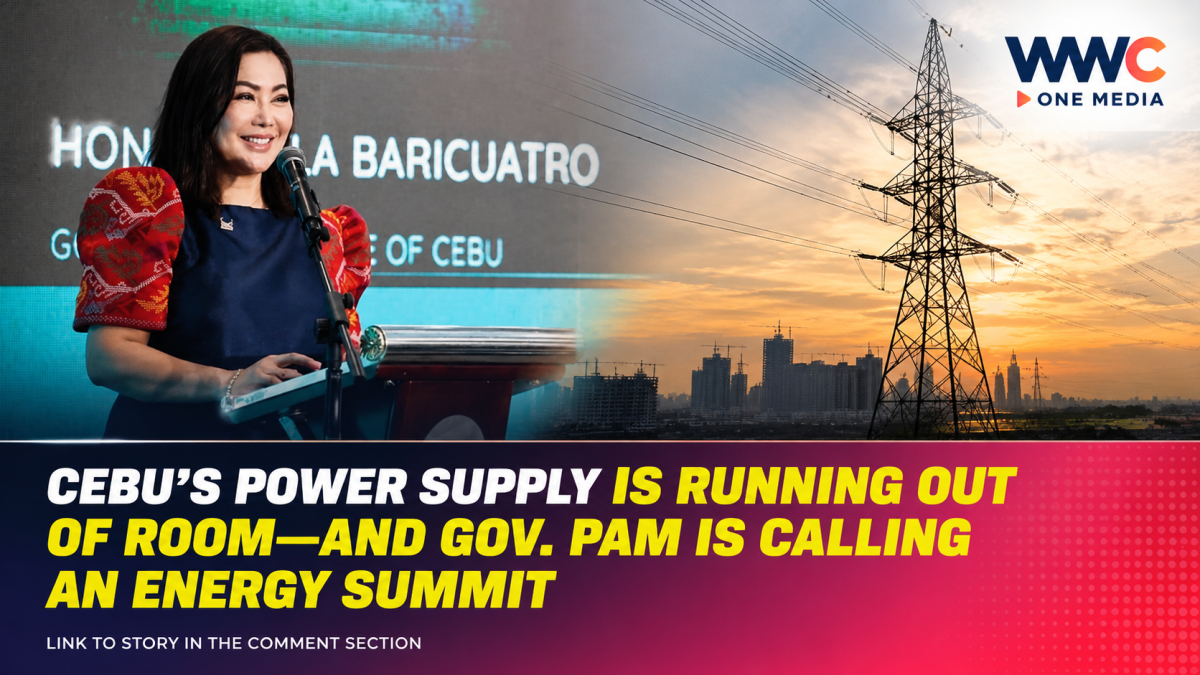
CEBU CITY, Philippines — Cebu is confronting a growing power-supply challenge as recurring rotational brownouts and thin reserves put pressure on households, businesses and the province’s plans for economic expansion.
Cebu Gov. Pamela Baricuatro has called for an urgent meeting with power suppliers and energy-sector officials and announced a Cebu Energy Summit on October 7, 2026, seeking both immediate measures and longer-term solutions to the province’s electricity needs.
The move came as the Visayas power grid entered another prolonged Red Alert on September 3, highlighting how vulnerable the region has become when several generating units are unavailable.
According to the National Grid Corporation of the Philippines (NGCP), the Visayas had only about 2,187 megawatts (MW) of available capacity against projected peak demand of 2,575 MW—a gap of roughly 388 MW.
NGCP reported that around 792 MW of generating capacity was unavailable, consisting of power plants on forced outage and generating units operating below their full capacity.
Brownouts stretch as supply tightens
The shortage has already been felt by consumers.
Visayan Electric said rotational interruptions in its franchise area were linked to generation and transmission shortages rather than a problem within its own distribution network. Reports indicated that some interruptions stretched from about one hour to as long as 2.5 hours as the grid struggled to meet demand.
The situation is particularly concerning for Cebu because electricity demand is closely tied to the province’s expanding residential, commercial and industrial activity.
Baricuatro warned that unreliable power could undermine efforts to attract investments, expand industries and create jobs.
“We want more investments. We want industries to expand. We want more businesses and more jobs for Cebuanos. But none of these can happen sustainably if our energy supply cannot keep pace with our growth,” the governor said.
Why Cebu is under pressure
The immediate problem is not simply rising electricity consumption.
Several generating units have been unavailable, while electricity imports from Mindanao have also been constrained. SunStar reported that Therma Visayas Inc. Unit 1 and Panay Energy Development Corp. Unit 3 remained among the unavailable major generating units during the latest grid strain.
This leaves the Visayas grid with less room to absorb sudden increases in demand or additional plant failures.
A Red Alert does not automatically mean every consumer will lose electricity. It indicates that available supply is insufficient to meet demand while maintaining the required contingency reserve, increasing the possibility of controlled interruptions to protect the stability of the grid.
Gov. Pam wants answers—and a longer-term plan
Baricuatro acknowledged that the provincial government does not directly control electricity generation, transmission and distribution.
Still, she said the Capitol has a responsibility to bring the major players together, determine where the gaps are and push for solutions that can support Cebu’s continued growth.
The planned Cebu Energy Summit on October 7 is expected to bring together representatives from the energy sector, national government, businesses, investors and other stakeholders to discuss Cebu’s immediate and long-term power requirements.
The governor has also pointed to several projects that could eventually strengthen Cebu’s energy supply.
Among them are the ACCIONA solar farm in Daanbantayan, an Alternergy-backed wind project in Alegria, and oil and gas exploration activities in southern Cebu.
The Daanbantayan solar development is particularly significant for Cebu’s future supply. The planned project has a capacity of 150 MW, with construction targeted for the latter part of 2026 and commercial operation expected by the end of 2027, according to reporting from SunStar.
Meanwhile, an up-to-80-MW wind project in Alegria has also been endorsed at the provincial level and has a committed delivery date in late 2028 under the Department of Energy’s Fourth Green Energy Auction.
The bigger question: Can Cebu keep growing without more power?
Cebu has spent years warning about the possibility of an energy shortfall as electricity demand grows.
A 2024 Cebu Daily News report previously cited projections that Cebu Island’s electricity demand could reach roughly 1,400 MW by 2026, underscoring the need for additional generation capacity and infrastructure to keep up with economic expansion.
The latest grid crisis shows why that concern remains relevant.
In May and June, the Visayas grid also experienced periods of tight reserves and Red Alert conditions. In one May episode, available generation was reported at around 2,510 MW against projected peak demand of 2,413 MW, leaving only a 97-MW margin after several plants became unavailable.
By early June, NGCP projections continued to show relatively narrow reserve margins for the Visayas, even while the grid remained technically capable of meeting projected demand.
What happens next?
The October energy summit could become an important test of whether Cebu can move from reacting to brownouts toward building a more resilient power system.
For consumers, the immediate concern remains simple: when will the electricity stay on?
For businesses and investors, the question is bigger: will Cebu have enough reliable power to sustain the next wave of growth?
With the Visayas already experiencing supply constraints, the answer may depend not only on bringing existing plants back online but also on how quickly new renewable and conventional energy projects can be developed, connected and brought into operation.
The October 7 summit therefore comes at a critical moment—not simply as another government meeting, but as an opportunity to determine how Cebu will secure the electricity needed for its next stage of economic growth.



Leave a Reply