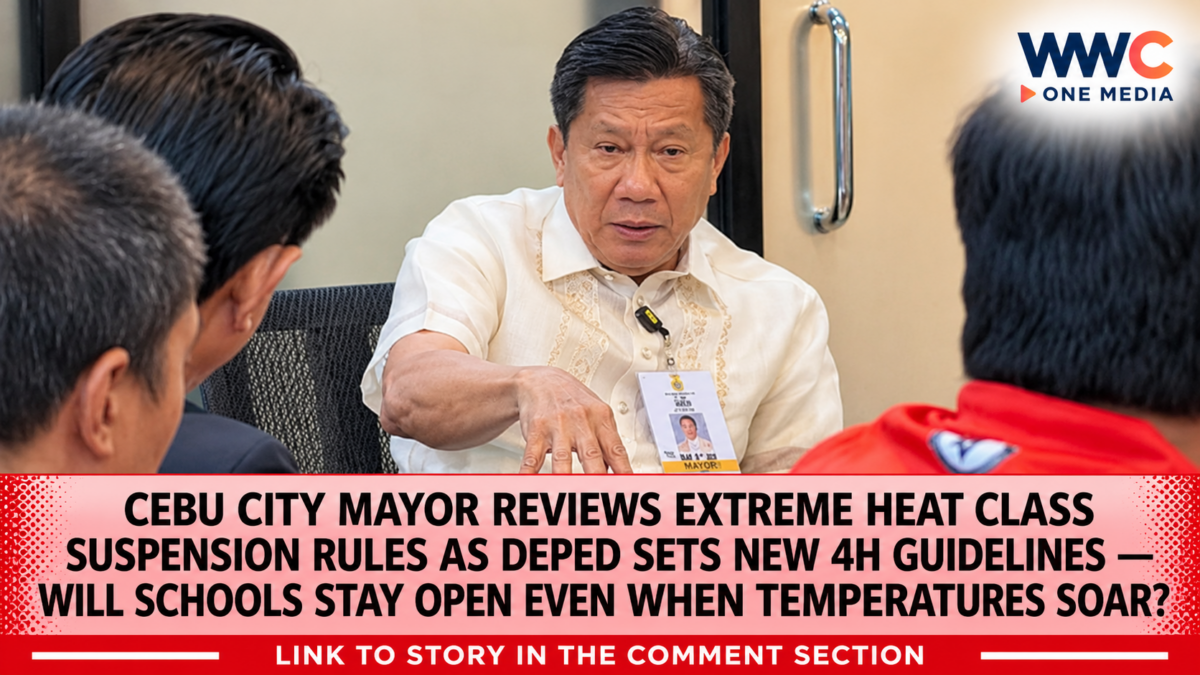
Cebu City Mayor Nestor Archival is seeking a meeting with school officials to review how schools respond to extreme heat, questioning whether suspending face-to-face classes should automatically be the first option whenever dangerous heat conditions are recorded.
The proposed consultation comes as the Department of Education (DepEd) implements new heat-response guidelines for School Year 2026–2027, introducing a four-level system that determines when schools can continue in-person instruction, shorten class hours, shift to home-based learning or suspend all academic activities.
Archival raised the issue on November 4, 2026, saying he wanted to discuss possible alternatives with school administrators and establish clearer guidance for schools across Cebu City.
His remarks do not mean that existing DepEd rules have been withdrawn or that schools can disregard the prescribed safety measures. Instead, the mayor wants to consult education officials about how the rules should be implemented while protecting students and minimizing disruptions to classroom learning. SunStar Publishing Inc.+1
DepEd Introduces Four-Level Heat Response System for Schools
Under DepEd Memorandum No. 064, Series of 2026, schools must follow the 4H Learning Modality Framework, which classifies heat conditions into four levels: Hayo, Hinay, Hinga and Hinto.
The framework is designed to help schools respond to extreme heat and the anticipated effects of a potentially very strong El Niño during the current school year.
The four levels are:
Hayo — Below 27°C
Regular face-to-face classes may continue, with preventive measures such as hydration breaks, proper ventilation and monitoring of students’ health.
Hinay — 27°C to 32°C
Schools may shorten class hours, adjust schedules or introduce hybrid and home-based learning arrangements to reduce students’ exposure to heat.
Hinga — 33°C to 41°C
Face-to-face classes must be suspended, with learners shifting to lighter home-based learning activities. Schools are also expected to monitor students’ well-being.
Hinto — 42°C and above
All academic activities must stop, including home-based learning, as conditions reach a level considered dangerous to students and school personnel.
School heads are responsible for assessing conditions and determining the appropriate learning arrangements in coordination with their respective Schools Division Offices. SunStar Publishing Inc.+2
Why Mayor Nestor Archival Wants to Reconsider Automatic Class Suspensions
Archival said he wants to bring school administrators together to discuss how Cebu City should respond when heat levels reach the thresholds specified in the new guidelines.
His concern centers on whether suspending in-person classes should always be the immediate response or whether schools can consider other arrangements when conditions allow.
The mayor’s position reflects a difficult balance facing local governments and education officials: protecting children from heat-related illnesses while preventing repeated interruptions to their education.
However, any alternative must remain consistent with DepEd’s national framework. Schools cannot simply continue regular face-to-face instruction when the applicable guidelines require suspension.
The consultation could help clarify how schools should adjust schedules, improve classroom ventilation, provide drinking water and organize alternative learning activities during periods of extreme heat.
The Freeman separately reported that Archival wanted to meet with school officials to discuss appropriate responses and ensure that institutions understand the latest national policies. The Freeman+1
Marcos Signs Executive Order 130 to Change How Class Suspensions Are Decided
The Cebu mayor’s proposed consultation comes shortly after President Ferdinand Marcos Jr. issued Executive Order No. 130, establishing a unified framework for suspending and resuming classes, school activities and onsite work in educational institutions.
Announced on November 3, 2026, the order introduces three mechanisms for suspension decisions.
- Automatic suspension: Classes and onsite work are suspended once prescribed technical thresholds are reached based on official warnings or advisories from competent government agencies.
- Localized suspension: Local chief executives may declare suspensions in affected areas based on documented risk assessments and prevailing conditions.
- Granular suspension: Individual schools and learning centres may suspend activities when site-specific assessments identify actual or imminent threats to the health and safety of learners and personnel, in coordination with their local government.
The order also establishes procedures for resuming classes once the relevant warnings or suspension periods have ended and safety assessments have been completed.
Importantly, EO 130 states that suspending face-to-face classes does not automatically mean learning must stop. Schools are expected to use alternative learning arrangements whenever feasible.
The Department of Education and other relevant agencies have been directed to issue detailed implementing guidelines, including technical thresholds and coordination procedures, within 30 days from the order’s effectivity. Presidential Communications Office+2
DepEd Says Heat Decisions Must Be Based on Actual School Conditions
The updated approach also moves away from treating extreme heat as a reason for blanket nationwide suspensions.
GMA News reported on October 28 that DepEd expects school officials to use localized assessments, including indoor classroom temperature and humidity readings taken at 8 a.m., noon and 2 p.m.
Education Secretary Sonny Angara said schools should prepare before extreme heat becomes dangerous, while coordinating suspension decisions with their local government units.
This means conditions inside an individual classroom matter, not just the temperature reported for a city or weather station.
A school with poor ventilation, crowded classrooms and limited access to drinking water may face different risks from another school in the same locality with better facilities.
The approach is intended to make decisions more responsive to actual conditions while avoiding unnecessary loss of classroom time. GMA News Online+1
Extreme Heat Is Already Disrupting Classes in Other Parts of the Philippines
The issue is not limited to Cebu.
The Philippine Information Agency reported on November 5 that schools in Iloilo had suspended or adjusted classes after heat-index forecasts reached as high as 43°C.
The affected schools were responding to conditions under DepEd’s 4H framework, which requires different measures depending on the level of heat exposure.
The Philippine News Agency also reported that 122 public schools in Western Visayas suspended in-person classes after forecasts indicated heat-index levels of 43°C in Iloilo City and 42°C in Roxas City, among other areas.
These developments show how the new guidelines are already affecting school operations, particularly in areas experiencing dangerous heat conditions. Philippine Information Agency+1
Cebu Has Faced Repeated Class Disruptions During Extreme Weather
Cebu has experienced similar challenges before.
In April 2024, SunStar reported that 10 local government units in Cebu suspended face-to-face classes because of rising heat-index levels.
Some local governments shifted students to modular or alternative learning arrangements, while others shortened school hours to reduce exposure during the hottest parts of the day.
The disruptions also raised concerns among parents about transportation, supervision and the difficulty of arranging childcare when students were dismissed earlier than usual.
Teachers and education groups likewise emphasized that suspending classroom instruction should not mean leaving students without learning support. SunStar Publishing Inc.
WWC ONE MEDIA has previously examined the need for more localized decisions in its report, Gatchalian Wants Class Suspensions to Get More Local — But Could This Finally Stop Nationwide Learning Disruptions?.
The discussion is also connected to Cebu’s efforts to establish clearer rules for environmental hazards affecting schools. Read WWC ONE MEDIA’s report on Cebu’s proposed unified class suspension rules amid air pollution.
Earlier, the city suspended face-to-face classes when worsening Indonesian wildfire haze pushed pollution readings into dangerous levels. WWC ONE MEDIA covered the disruption in Cebu City’s class suspension as haze pushed the Air Quality Index past 200.
The wider health implications of the haze were also examined in Metro Cebu’s air quality crisis as Indonesian smoke lingered.
These reports highlight why class suspension decisions increasingly need to account for more than one hazard, including extreme heat, poor air quality, flooding and other emergencies.
What Cebu Parents and Students Should Expect Next
For now, Archival’s proposal remains a plan for consultation. No new Cebu City heat-class suspension policy has been announced through his remarks, and the existing DepEd framework remains the basis for schools’ responses.
Parents should therefore continue monitoring announcements from their children’s schools, the Cebu City Government and DepEd.
Schools must also communicate clearly when they shift to shortened schedules, hybrid arrangements or home-based learning so parents can make the necessary arrangements.
The challenge is not simply deciding whether classes should continue. It is ensuring that students can learn without being exposed to conditions that threaten their health.
As the country prepares for the possible effects of a very strong El Niño, Cebu’s discussions could become an important test of how local governments balance educational continuity with student safety.
The question now is whether Cebu City can develop practical measures that keep students learning without putting them at risk when temperatures rise to dangerous levels.