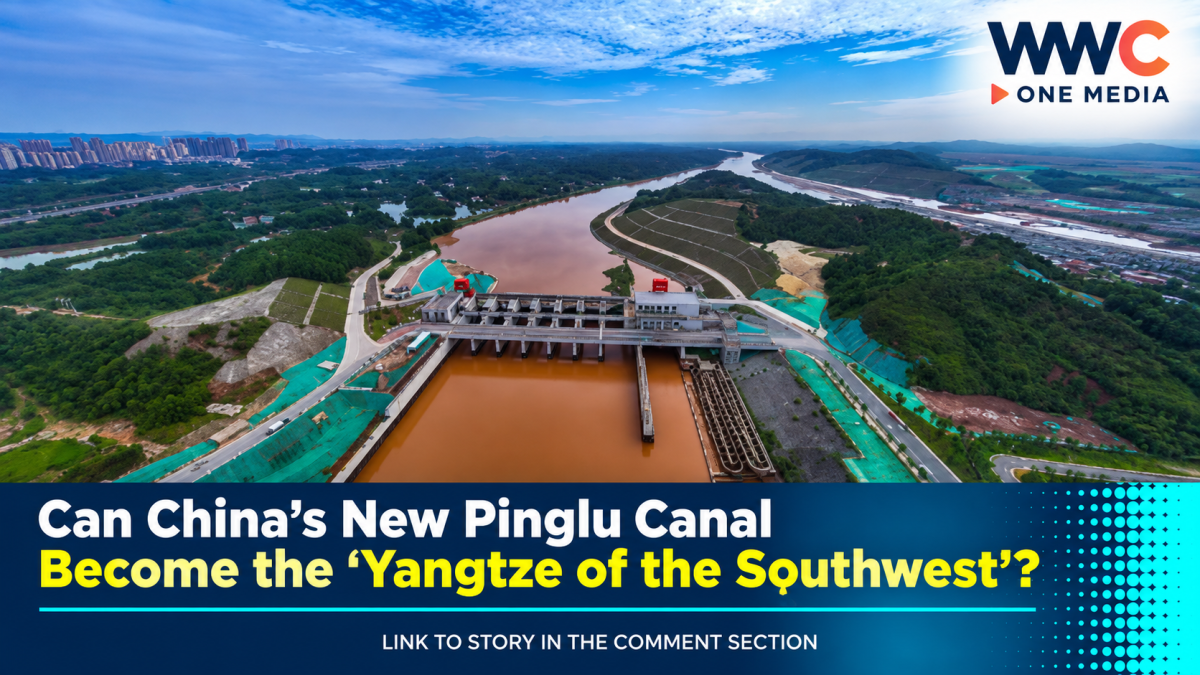
China’s newly opened Pinglu Canal could reshape trade and economic activity across the country’s southwestern interior by providing a much shorter route from inland regions to the sea and Southeast Asian markets.
The 134.2-kilometre waterway in Guangxi opened to navigation on September 16. It connects the Xijiang River system near Nanning with the Beibu Gulf, allowing cargo from southwestern China to reach the sea without taking the traditional route through Guangdong.
The canal cuts more than 560 kilometres from some inland shipping routes and is expected to reduce logistics costs by between 18% and 30%, according to Guangxi authorities. The savings could exceed 5 billion yuan (about US$745 million) a year.
The project cost about 72.7 billion yuan (US$10.8 billion) and can accommodate vessels of up to 5,000 tonnes. It is China’s first major river-to-sea canal built under national coordination since 1949.
The waterway is designed to strengthen connections between southwestern provinces such as Sichuan, Chongqing, Yunnan and Guizhou and Southeast Asian markets. Two new freight routes have already begun operating, including an international service linking Nanning with Can Tho in Vietnam.
Officials and analysts see the canal as more than a transport project. By lowering shipping costs, it could encourage companies to expand production and logistics operations along the route and strengthen Guangxi’s role as a gateway between China’s interior and ASEAN.
The canal is also a major component of the New International Land-Sea Trade Corridor, which links western and southwestern China with ports and markets in Southeast Asia and beyond. Its development comes as China seeks to deepen trade ties with ASEAN, already one of its most important trading partners.
Whether the Pinglu Canal can achieve an economic impact comparable to the Yangtze’s role in the development of Shanghai remains to be seen. Its long-term success will depend on how quickly shippers shift cargo to the new route, as well as the capacity of connected ports, railways and road networks to handle growing volumes.
For now, the canal gives China’s landlocked southwest a new southern outlet to global markets and could alter the country’s freight map by making Southeast Asia more accessible to inland manufacturers and traders.