
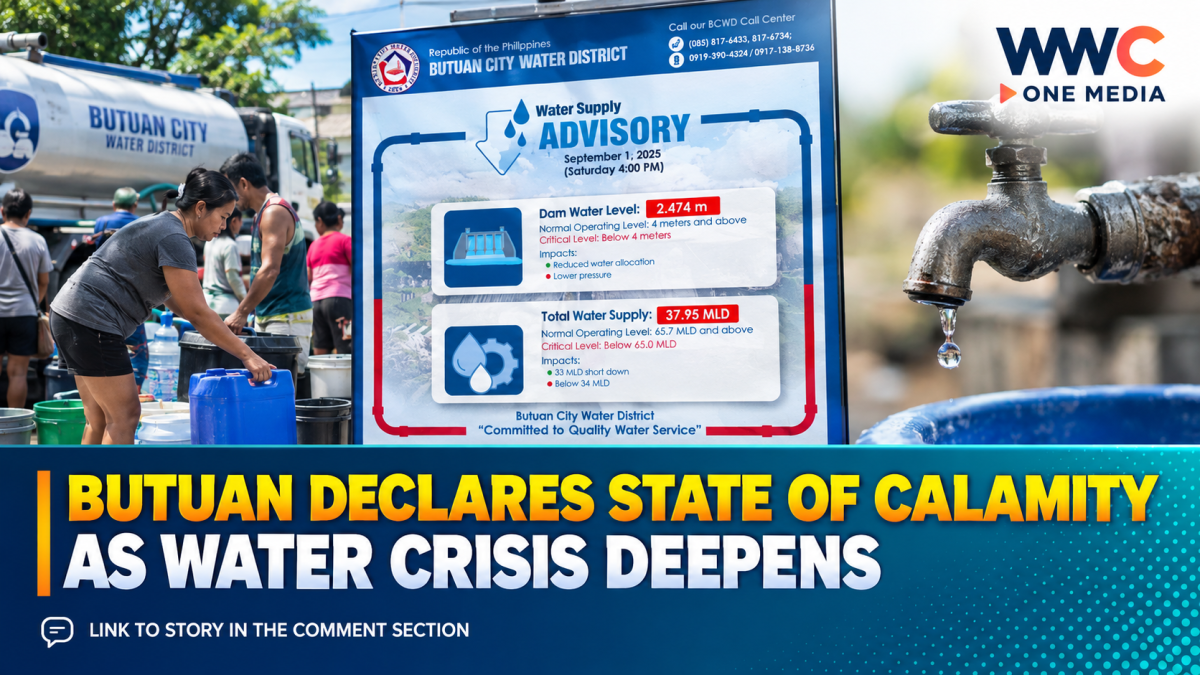
BUTUAN CITY, Philippines — Butuan City has declared a state of calamity over a worsening water crisis, as prolonged dry conditions continue to squeeze the city’s main water sources and disrupt supplies to communities.
The Sangguniang Panlungsod approved the declaration amid severe and continuing water-supply disruptions, according to the Philippine News Agency.
The move elevates the city’s response to the water shortage as authorities confront a crisis that has been building for months—not merely a temporary service interruption.
Water supply falls to critical levels
The crisis is closely linked to declining water availability in the Taguibo watershed, one of the primary sources supplying Butuan City.
The Butuan City Water District (BCWD) previously warned that prolonged dry conditions had severely reduced streamflows in Taguibo. In an August 24 advisory, the utility said the watershed had gone through 23 consecutive days without sufficient rainfall, with streamflows falling to around 42–43 million liters per day (MLD).
The pressure has already forced the water district to operate below normal requirements.
Earlier, BCWD reported that available supply had fallen to 41.89 MLD, compared with a normal requirement of about 55 MLD, prompting emergency water rationing in affected barangays.
The figures illustrate the scale of the problem: demand remains high while the natural source feeding the system continues to weaken.
Residents turn to water rationing
As supply deteriorated, BCWD began distributing water through designated points in several barangays.
Water tankers were deployed to areas experiencing interruptions, with distribution points established in communities including Lumbocan, Masao, Ambago, Bonbon, Villa Kananga, Bit-os and San Vicente.
The water district has also received assistance from the city government’s disaster-response office, Chinese fire volunteers and other groups to support emergency distribution.
For residents, the crisis has transformed something as basic as turning on a faucet into a daily challenge.
The problem started months ago
The latest declaration did not come out of nowhere.
Butuan had already been experiencing declining water availability earlier in 2026. In April, BCWD activated “Oplan Sag-OB”, allowing affected concessionaires to obtain water directly from Pump Station No. 1 in Barangay Baan.
At that time, the water district was operating at only 41.61 MLD, substantially below its normal capacity of 56.5 MLD.
Water rationing followed days later as the shortage intensified.
The continuing deterioration shows how a prolonged lack of rainfall has gradually turned a supply-management problem into a broader emergency.
El Niño adds pressure
The water crisis is occurring against the backdrop of persistent dry conditions associated with El Niño.
In an earlier report, the Philippine Daily Inquirer said declining water levels in the Taguibo watershed had been worsened by the dry spell and the onset of El Niño. The watershed is a major water source for Butuan City.
The effects are not limited to households.
Reduced water availability can affect sanitation, schools, health facilities, businesses and other essential services, increasing the pressure on local authorities to secure alternative supplies.
Crisis extends beyond Butuan
Butuan’s declaration comes as other parts of the Caraga region are also struggling with water shortages.
Nearby Dinagat Islands was placed under a state of calamity in late August after authorities determined that the prolonged dry spell had placed at least 15 percent of the provincial population at risk.
Provincial officials said more than 18,000 people were affected or at immediate risk because of constrained water supplies.
The provincial government has responded with water rationing, drilling operations and plans to install solar-powered pumps.
It has also procured three reverse-osmosis machines that can be used to convert seawater into potable water.
The Philippine Information Agency separately reported that water tankers and fire trucks have been deployed to communities in Dinagat affected by the shortage.
What happens next?
The state-of-calamity declaration gives Butuan’s government greater room to coordinate emergency measures and mobilize resources as the water shortage continues.
But the bigger challenge is restoring the city’s water sources.
BCWD’s own advisories show that the immediate problem is closely tied to the continuing absence of rainfall and falling streamflows in the Taguibo watershed.
That means emergency water deliveries can provide temporary relief—but they cannot solve the underlying shortage if the watershed continues to receive inadequate rainfall.
For residents, the warning is clear: water conservation is no longer simply an environmental message. It has become an urgent necessity.
And with the dry conditions continuing to test water systems across Caraga, the question facing Butuan is no longer whether the city has a water problem.
It is how long the emergency can be sustained—and how quickly reliable water supplies can be restored.



Leave a Reply