
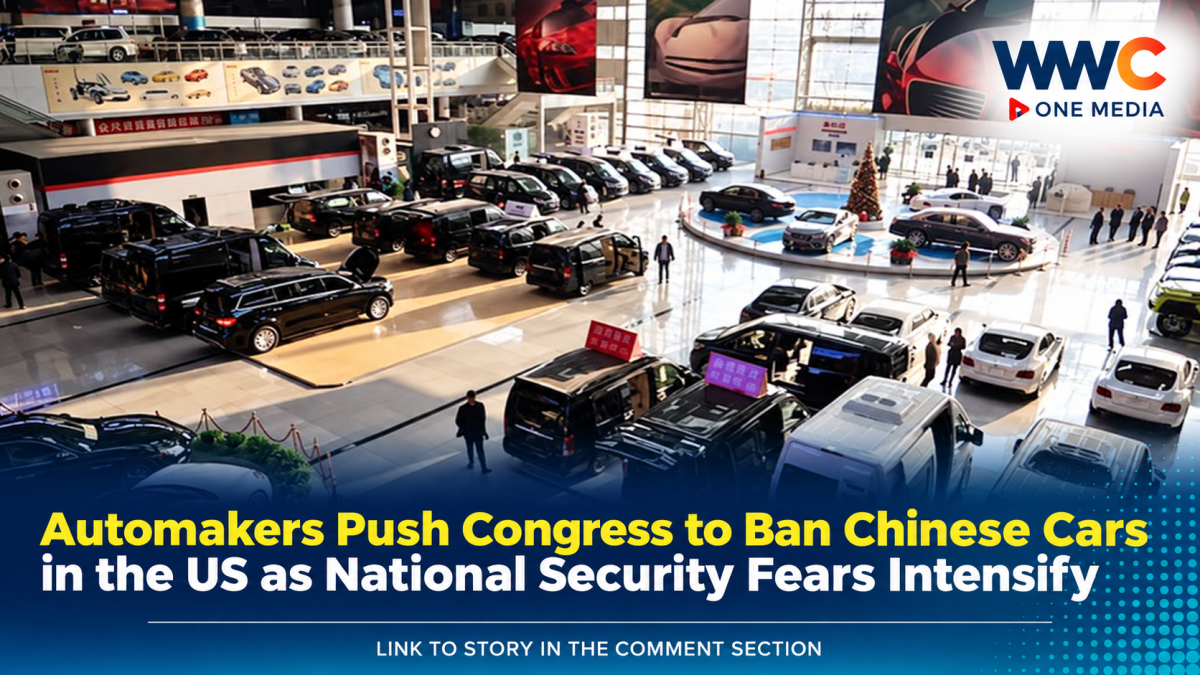
Industry group representing GM, Ford, Toyota, Volkswagen, Hyundai and others wants lawmakers to act before year-end
WASHINGTON — A major US automotive industry group is urging Congress to move quickly on legislation that would permanently block Chinese vehicles, software and key connected-car hardware from the American market, escalating pressure on Washington to confront China’s growing influence over the global auto industry.
The Alliance for Automotive Innovation, which represents major manufacturers including General Motors, Ford, Toyota, Volkswagen, Hyundai, Honda and Stellantis, has called on lawmakers to pass the restrictions before Congress adjourns for the year.
In a letter to congressional leaders, Alliance CEO John Bozzella argued that Chinese automakers are exporting heavily subsidised vehicles equipped with connected technologies into markets around the world.
The industry group says the United States should act before Chinese manufacturers establish a significant foothold in the American market.
But there is an important distinction: Chinese vehicles have not been completely banned from the US by Congress.
Instead, lawmakers are considering legislation that would strengthen and codify restrictions already being imposed through federal regulations.
Why US automakers want the ban
The dispute is about much more than the price of Chinese electric vehicles.
Modern cars increasingly function as connected computers on wheels. They can contain cameras, microphones, GPS systems, Bluetooth, Wi-Fi, cellular connections and other technologies capable of collecting and transmitting information.
US officials have warned that technology linked to countries considered foreign adversaries could create national-security and privacy risks if sensitive information were accessed or vehicles were remotely manipulated.
The Alliance for Automotive Innovation has therefore called for restrictions covering not only Chinese-made vehicles, but also certain software and hardware used in connected vehicles.
The group argues that China is pursuing a strategy aimed at dominating global automotive manufacturing and critical supply chains.
Its position is broadly aligned with Washington’s existing concerns over connected-car technology, although the proposed legislation is still subject to debate in Congress.
The US already has restrictions in place
The push for legislation comes after the Biden administration’s Commerce Department established a separate regulatory framework targeting certain connected-vehicle technologies linked to China and Russia.
In January 2025, the Commerce Department’s Bureau of Industry and Security finalised a rule restricting certain transactions involving connected vehicles and related hardware and software with a sufficient connection to China or Russia.
The regulation covers Vehicle Connectivity System hardware, including technologies used for cellular, Bluetooth, satellite and Wi-Fi communications, as well as certain software used for connectivity and automated driving.
The rule took effect in March 2025, with the restrictions being phased in according to vehicle model year. Software-related prohibitions apply beginning with Model Year 2027, while restrictions on certain connected-vehicle hardware begin with Model Year 2030, or January 1, 2029, for components without a model year.
That means the latest congressional push is not starting from zero.
Instead, lawmakers are debating how far those restrictions should go and whether they should be permanently embedded in federal law.
Bipartisan legislation faces a major complication
The legislation being discussed has bipartisan backing.
Republican Senator Bernie Moreno of Ohio and Democratic Senator Elissa Slotkin of Michigan have proposed legislation aimed at codifying the Biden-era restrictions and preventing Chinese automakers from establishing a larger presence in the US light-duty vehicle market.
But the bill has run into an unexpected problem involving a major European automaker.
Senate Commerce Committee Chairman Ted Cruz has raised concerns about language dealing with foreign ownership.
One provision would affect companies with more than 15% ownership by Chinese entities.
Cruz has pointed out that such a threshold could potentially affect Mercedes-Benz, because Chinese investors hold nearly 20% of the company.
He has said the legislation needs changes before it can move forward.
That complication illustrates just how difficult it may be to create a law that targets Chinese-controlled automotive companies without unintentionally affecting global manufacturers that have Chinese shareholders or business interests.
Automakers want Chinese companies such as BYD and SAIC specifically addressed
The Alliance has also pushed for restrictions preventing the Commerce Department from granting certain authorisations to Chinese automakers including BYD, Chery and SAIC Motor.
The industry group says companies receiving substantial Chinese government support should not be allowed to manufacture, sell or import connected vehicles into the United States under exemptions that could weaken the restrictions.
This is significant because Chinese automakers have become increasingly competitive in electric vehicles and other advanced automotive technologies worldwide.
Companies such as BYD have expanded aggressively outside China, offering relatively inexpensive electric vehicles that have put pressure on established global manufacturers.
The Alliance’s concern is that allowing Chinese automakers to establish a US presence could make it considerably harder for American manufacturers to compete later.
China rejects the US approach
Beijing has pushed back against Washington’s efforts.
The Chinese Embassy in Washington said it opposed attempts to restrict Chinese vehicle exports and pointed to China’s efforts to open its manufacturing sector to foreign investment.
The embassy also highlighted the presence of foreign automakers such as Tesla, Buick, Toyota and Ford in the Chinese market.
China’s position is that the US should not use national-security arguments to restrict normal commercial competition.
The dispute therefore sits at the intersection of trade, technology, national security and the global electric-vehicle race.
Polestar has already felt the impact
The debate is also affecting automakers that are not traditionally viewed by consumers as Chinese brands.
In June, electric-vehicle manufacturer Polestar said the Trump administration was forcing the company to stop selling vehicles in the United States beginning with the 2027 model year.
Polestar is a Swedish automotive brand but is majority-owned by China’s Geely Holding.
The case demonstrates the difficulty Washington faces in defining what constitutes a “Chinese” vehicle company in an industry where ownership, manufacturing, investment and supply chains cross multiple countries.
The bigger battle is over connected cars
The debate could ultimately reshape the American automotive market beyond the question of where a vehicle is assembled.
Washington’s concern increasingly focuses on the technology inside vehicles.
A connected car can communicate with external networks and devices, potentially generating large quantities of information about drivers and their surroundings.
The Commerce Department has said that hostile access to certain connected-vehicle technologies could potentially allow sensitive information to be collected or vehicles to be remotely manipulated.
Its rules therefore target specific technology systems rather than simply applying a blanket restriction based solely on the country where a vehicle is manufactured.
What happens next?
The Alliance for Automotive Innovation wants Congress to act before the end of 2026.
But the legislation still faces hurdles.
The Senate Commerce Committee has already advanced legislation designed to strengthen restrictions on Chinese automakers, but it must still clear further legislative stages before it can become law.
The ownership issue raised by Cruz could also require lawmakers to rewrite portions of the proposal.
For American consumers, the outcome could have major implications for the future availability of electric vehicles and connected-car technology.
A permanent ban could shield US manufacturers from rapidly expanding Chinese competitors.
But it could also further divide the global automotive market, complicate international supply chains and make it harder for some multinational manufacturers with Chinese investment or technology links to operate in the United States.
The US-China auto war is entering a new phase
For years, the biggest concern in Washington was whether China could dominate battery production and electric vehicles.
Now the debate has moved inside the vehicle itself.
Software, sensors, communications modules and data are becoming just as strategically important as engines, batteries and factories.
US automakers are effectively telling Congress that waiting until Chinese manufacturers establish a substantial American market share could be too late.
China, meanwhile, rejects the premise that its automotive expansion should be treated primarily as a national-security threat.
The result is a rapidly developing confrontation that could determine who controls the next generation of connected and electric vehicles — and who gets to sell them in the world’s second-largest auto market.
For now, however, there is no new blanket congressional ban in force. The immediate development is the automotive industry’s push for lawmakers to turn existing restrictions into stronger, permanent federal law.
WWC ONE MEDIA J.M.D


Leave a Reply