
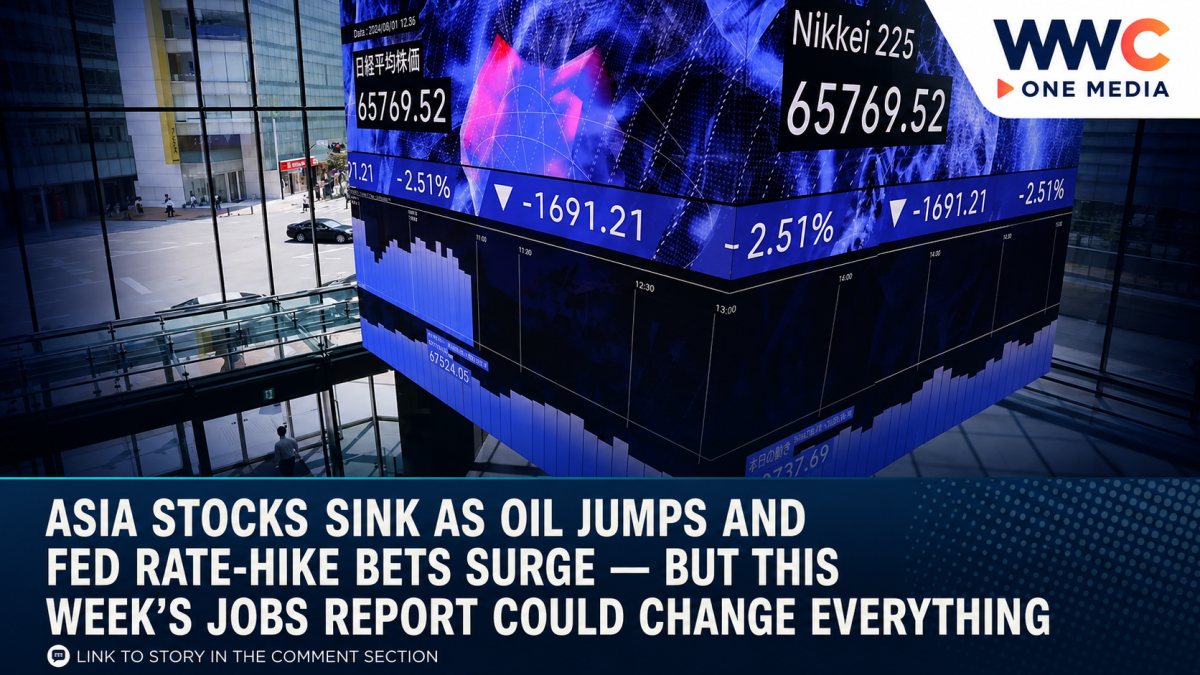
SYDNEY, Aug. 31, 2026 — Asian markets opened the week under pressure Monday as investors confronted a dangerous combination: renewed fighting between the United States and Iran, oil prices climbing toward $90 a barrel and a Federal Reserve increasingly focused on inflation.
Japan and South Korea suffered some of the region’s steepest losses as higher energy prices and rising US Treasury yields forced investors to reassess whether interest rates could stay elevated — or even rise again — for longer than markets had expected.
The immediate trigger was a fresh escalation around the Strait of Hormuz.
US forces struck two Iranian launchers on Larak Island on Sunday after American officials said Iran’s Revolutionary Guard Corps had been preparing rockets capable of deploying sea mines into the strategically critical waterway. Iran subsequently launched missiles toward US forces in Jordan, according to reporting from Reuters and the Associated Press.
That was enough to put the oil market back on alert.
Brent crude futures rose about 1.4% to $89.38 a barrel, while US crude advanced roughly 1.3% to $84.50, according to the Reuters market report carried by Channel NewsAsia.
And for investors, the problem goes far beyond the price of a barrel of oil.
Why the Strait of Hormuz Matters Again
The renewed military exchange occurred close to one of the most important energy corridors in the world.
The Strait of Hormuz normally handles roughly 20% of global oil shipments, according to the Associated Press, meaning even the threat of further disruption can quickly add a geopolitical risk premium to crude prices.
That creates an uncomfortable chain reaction for financial markets.
More expensive oil can increase transportation, manufacturing and consumer costs. Persistent energy inflation can then make it harder for central banks to cut interest rates — and in the United States, investors are now contemplating something even more disruptive: another rate increase.
That possibility intensified after Federal Reserve Chair Kevin Warsh delivered a notably inflation-focused message at the Jackson Hole economic symposium on Friday.
Warsh said the Fed’s 2% inflation objective remained a “firm, fixed target” and stressed that recent better inflation readings had not convinced him that underlying price pressures had meaningfully improved. He said the central bank needed confidence that inflation was moving toward target at sufficient speed — otherwise policymakers still had “work to do.”
Importantly, Warsh did not announce that the Fed would raise rates in September.
But traders moved quickly anyway.
September Rate-Hike Odds Suddenly Jump
Market pricing pushed the probability of a September US rate increase to around 57%, sharply higher than before Warsh’s speech. MarketWatch reported that the probability had climbed from roughly 36% before the address, while AP similarly reported that traders moved the odds of a near-term increase to almost 58%.
That repricing hit the bond market particularly hard.
The US two-year Treasury yield — one of the securities most sensitive to expectations for Federal Reserve policy — jumped sharply Friday and remained around 4.36% in Monday’s Asian session.
The result was a double blow for stocks: geopolitical uncertainty was pushing energy costs higher while tighter monetary-policy expectations were increasing the discount rate investors apply to future corporate earnings.
Technology and other highly valued growth stocks are particularly sensitive to that combination.
Japan and South Korea Take the Hit
Japan’s Nikkei fell about 2.1% during Monday trading, while South Korean equities dropped around 2.4%. MSCI’s broad index of Asia-Pacific shares excluding Japan declined roughly 0.7%.
The Wall Street Journal reported the Nikkei was down about 2.2% later in the session, with semiconductor-related stocks among the biggest casualties. Advantest dropped 7.8%, SoftBank Group fell 4.2% and Tokyo Electron lost 3.8%, underscoring how quickly higher-rate expectations can hit expensive technology shares.
The pressure was also spreading beyond Asia.
EURO STOXX 50 futures were down around 0.5%, Germany’s DAX futures slipped about 0.4%, while S&P 500 and Nasdaq futures also pointed lower.
The Yen Creates Another Headache
Currency markets added another warning signal.
The Japanese yen again weakened around the psychologically important 160-per-dollar level, raising renewed questions about how far Japanese authorities will tolerate depreciation before considering intervention.
Reuters reported the dollar trading near a two-week high after Warsh’s comments, while the yen’s weakness was again drawing scrutiny from investors and policymakers.
US Treasury Secretary Scott Bessent, however, described the yen’s recent decline as relatively contained, suggesting conditions had not yet reached the kind of disorderly move that would necessarily provoke coordinated intervention.
For Japan, a weak yen can be a mixed blessing. It can improve overseas earnings when exporters convert foreign revenue back into yen, but it also raises the local cost of imported commodities — especially energy.
With oil prices already elevated, that trade-off is becoming increasingly uncomfortable.
Now the Market Turns to One Number
Despite all the geopolitical headlines, the event that could ultimately decide the Federal Reserve’s September move may come from Washington rather than the Middle East.
Investors are waiting for Friday’s August US employment report.
Economists surveyed in the Reuters report expect payrolls to rebound by around 58,000 jobs after July recorded a surprise decline of 23,000, with unemployment forecast to remain around 4.1%.
The Financial Times similarly noted that the employment numbers have become critical because Warsh’s hawkish inflation stance now has to be reconciled with signs of softer job creation.
Then comes another major test: US consumer-price data scheduled for September 11.
Stronger-than-expected employment or inflation numbers could reinforce the argument for another Fed rate increase. A materially weaker labor report, meanwhile, could force traders to pull back some of the aggressive tightening bets that swept through markets after Jackson Hole.
The Bigger Risk for Investors
Monday’s selloff is therefore not being driven by a single crisis.
Three forces are colliding at once.
The US-Iran conflict is putting an additional premium into oil. Higher oil creates another potential source of inflation. And persistent inflation is making investors question whether the world’s most influential central bank is finished tightening monetary policy.
That is why a relatively limited military exchange around Larak Island was able to reverberate through crude oil, government bonds, currencies and equity markets within hours.
For Asian investors, the next move may depend on whether geopolitical tensions around the Strait of Hormuz remain contained.
But the bigger answer could arrive with the next batch of US economic data.
Because if inflation stays stubborn while the American labor market refuses to weaken significantly, the question facing markets may no longer be when the Federal Reserve will cut rates.
It may be whether the next move is actually another hike.



Leave a Reply