
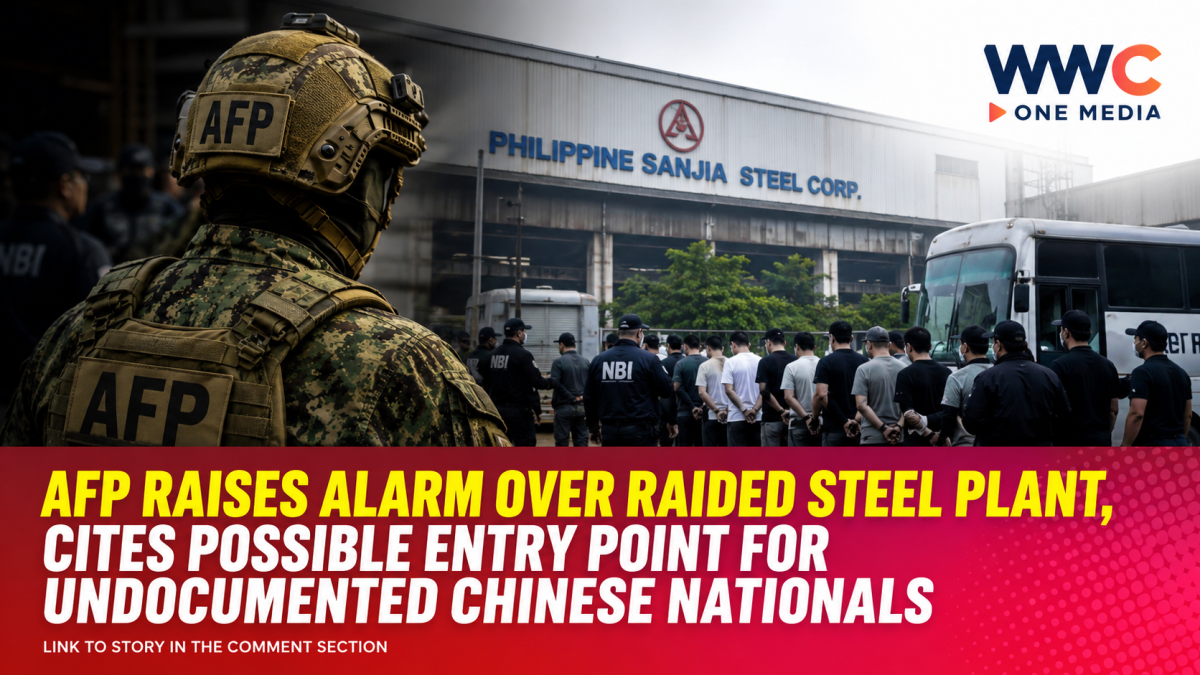
MANILA, Philippines — A steel plant in Misamis Oriental that was raided by Philippine authorities earlier this year may have been used as a possible entry point for undocumented Chinese nationals, according to an Armed Forces of the Philippines (AFP) official, raising fresh questions about immigration enforcement and national security in the strategically sensitive area.
AFP spokesperson for the West Philippine Sea, Rear Admiral Roy Trinidad, said authorities are looking into the possibility that undocumented Chinese nationals could use facilities such as the raided steel plant to enter or remain in the country before dispersing to other areas.
Speaking at the Saturday News Forum, Trinidad warned that such activity, if confirmed, could have wider security implications.
The comments come months after authorities raided Philippine Sanjia Steel Corp. in Tagoloan, Misamis Oriental, where 69 Chinese nationals were arrested. Authorities said many of those apprehended were allegedly undocumented or had issues involving their immigration and employment papers.
Why the Plant’s Location Is Raising Security Questions
Trinidad pointed to the facility’s location near several strategically important sites, including areas associated with the Philippine military and Laguindingan International Airport. Earlier reporting also said officials had raised concerns about the plant’s proximity to a naval facility being developed in the province.
The raid was part of a broader government operation involving the Presidential Anti-Organized Crime Commission (PAOCC), the National Bureau of Investigation (NBI) and other agencies, with the AFP providing support.
Authorities initially said the facility was under scrutiny over alleged immigration, labor, environmental and public safety violations. Reports also raised concerns about potentially substandard steel and possible hazardous materials, although allegations surrounding the plant and its products remain subject to ongoing investigations and legal proceedings.
According to the NBI, charges were later filed against the 69 Chinese nationals and one Filipino in connection with alleged violations of immigration, labor, nuclear safety and consumer protection laws. The agency said some of those apprehended allegedly lacked valid alien employment permits or proper immigration documents.
Raid Sparks Diplomatic and Political Dispute
The Sanjia Steel operation has since become the subject of a public dispute involving Philippine officials and the Chinese Embassy in Manila.
The Chinese Embassy questioned the treatment of the Chinese workers and accused Philippine officials of selective enforcement, while questioning the role of the military in the operation. Philippine authorities, however, rejected allegations that the raid targeted workers based on nationality.
The PAOCC said the operation was a law-enforcement action based on alleged violations of Philippine laws and maintained that the AFP’s role was limited to security and logistical support. It said the different treatment of individuals was based on their respective legal circumstances, including compliance with immigration and labor requirements, rather than nationality.
Defense Secretary Gilberto Teodoro Jr. has also publicly defended the government’s actions and exchanged sharp criticism with the Chinese Embassy over the case.
Company Denies Wrongdoing, Calls Raid ‘Harassment’
For its part, Philippine Sanjia Steel Corp. has denied the government’s characterization of the operation and described the raid as “harassment.” The company argued that alleged regulatory violations should be addressed through civilian regulatory processes rather than through criminal search warrants and the detention of workers.
The company has also said that businessman Tony Yang, whose alleged links to the facility drew additional public scrutiny, was no longer one of its shareholders. Authorities have continued to investigate the circumstances surrounding the plant and other companies operating in the industrial complex.
A Wider Crackdown on Steel Facilities
The Misamis Oriental case is unfolding against the backdrop of broader government action against steel facilities in the Philippines. Authorities have also raided other plants over allegations involving substandard products, hazardous working conditions and immigration violations.
In Pampanga, separate government operations led to investigations into another steel facility, while the Department of Labor and Employment later canceled the employment permits of several Chinese nationals linked to alleged labor and workplace safety violations.
The Bigger Question
For Philippine authorities, the issue surrounding the Misamis Oriental plant now goes beyond alleged industrial and immigration violations. AFP officials are examining whether facilities operating near strategically important areas could potentially be exploited in ways that create broader security concerns.
However, the claim that the raided steel facility may have served as an entryway for undocumented Chinese nationals remains an official security assessment and possibility raised by the AFP, not a publicly established conclusion that has been proven in court.
As investigations continue, one question remains at the center of the controversy: Was this simply a case of alleged regulatory and immigration violations—or could investigators uncover a much wider security network behind the steel plant’s operations?




Leave a Reply