
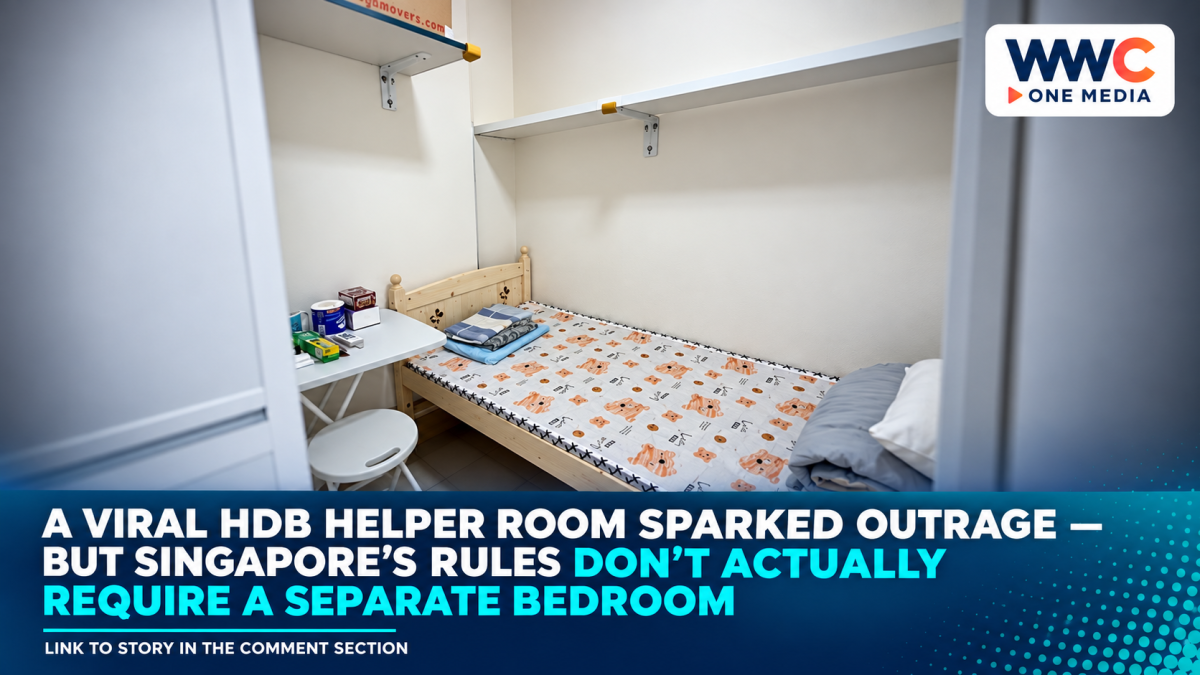
SINGAPORE — A bed, a work desk and a partition inside a four-room Build-To-Order flat have reopened one of Singapore’s most uncomfortable household debates:
If a family does not have a spare bedroom, should it employ a live-in domestic worker at all?
The controversy began after a Singapore woman posted images showing how she had converted part of her home office into sleeping quarters for her migrant domestic worker.
A partition separated the bed from the work desk. The employer later explained that the desk was used only during the day and that her helper had full use of the room at night.
She also argued that the arrangement allowed the worker to sleep without being disturbed by the family’s baby.
But online criticism was swift.
Commenters questioned whether the worker had enough privacy and whether a room that remained part office could reasonably be considered her personal living space. Some went further, arguing that households without a dedicated helper’s room simply should not hire one.
The reaction sounds straightforward.
The reality is much more complicated.
Singapore has around 300,000 migrant domestic workers, and about 72% of households employing them qualify for a concessionary levy because they have caregiving needs involving young children, elderly people or persons with disabilities.
Those may be precisely the families most likely to have multiple generations competing for limited space at home.
And under current Singapore rules, a helper should ideally have her own room — but a separate bedroom is not an absolute legal requirement.
What does Singapore actually require?
The Ministry of Manpower’s accommodation rules are more nuanced than much of the online debate suggests.
MOM says employers “should provide” a migrant domestic worker with a separate room.
But when that is not possible, employers must ensure her accommodation still provides adequate space and privacy.
Employers must also provide:
- a mattress, pillow and blanket;
- adequate shelter;
- sufficient ventilation;
- a safe sleeping environment;
- and accommodation that respects the worker’s modesty.
A domestic worker cannot be required to sleep in the same room as a male adult or teenage boy.
If surveillance cameras are installed inside the home, the worker must be told where they are, and cameras cannot be placed where they compromise her privacy or modesty — including sleeping, changing and bathroom areas.
So the legal question is not simply:
“Does she have her own room?”
It is:
“Does the space she has actually allow her to sleep, change clothes, rest and have reasonable privacy?”
That can be harder to judge.
A study room can technically be sleeping space — but boundaries matter
The CNA commentary by writer Annie Tan argues that multifunctional rooms can work when households lack space, provided the domestic worker retains genuine privacy and uninterrupted rest.
Tan describes her own four-room flat, where she lives with two children and her 86-year-old father.
Her children sleep in her bedroom, her father occupies another bedroom, while her helper’s room also functions as a children’s study and play space during part of the day.
The worker receives exclusive use of the room after 9.30pm, Tan wrote, adding that the arrangement was discussed before employment began and has continued during the helper’s seven years with the household.
That arrangement illustrates the argument made by some employers:
A room does not necessarily have to serve only one purpose for 24 hours a day to provide meaningful privacy.
But that creates another question.
If a worker has to wait until everyone else has finished studying, playing or working before her bedroom becomes hers, when exactly does her working day end?
That is where worker advocates say the issue becomes less about floor plans and more about power.
Domestic-worker advocates have warned about this for years
The Humanitarian Organisation for Migration Economics, or HOME, has argued that domestic workers without dedicated private space may struggle to fully disengage from work because they live inside their workplace.
Its research and casework have documented workers sleeping in children’s rooms, storage areas and communal spaces, where rest may depend on when other members of the household stop using the area.
HOME has advocated a stronger standard under which live-in domestic workers would receive a separate, private and suitably furnished room, reflecting international decent-work recommendations.
Its older 2015 study involving about 670 domestic workers found that more than half felt they lacked adequate privacy in their employer’s home, while about one-third reported some form of privacy intrusion. Those figures are now more than a decade old and should not be treated as a current 2026 estimate, but they illustrate why personal space has long been part of the domestic-worker welfare debate.
This is the central tension.
Employers may view a converted study as a practical compromise.
Workers may experience the same arrangement very differently if they never have a reliable place where they can close a door and stop being available.
Singapore’s typical family flat has several people competing for the same rooms
Space constraints are not imaginary.
Recent HDB Build-To-Order launches show four-room flats commonly offering around 86 to 90 sq m of internal floor area, depending on the project.
A four-room HDB flat generally includes three bedrooms.
For a couple with two children and an elderly parent, all three may already have obvious uses before a helper enters the picture.
Add working from home, children’s homework and caregiving equipment, and the idea of keeping one room permanently unused during the day can become difficult.
That does not negate an employer’s obligation to provide acceptable accommodation.
But it helps explain why a simple rule such as “no spare bedroom, no helper” would have consequences for households whose need for domestic help is primarily about caregiving rather than convenience.
Nearly three in four helper households have recognised caregiving needs
This may be the most important number in the discussion.
MOM told Parliament in January that roughly 72% of households employing migrant domestic workers receive the concessionary levy.
They qualify because their household contains at least one of the following:
a Singaporean child below 16;
an elderly person aged at least 67;
or a person with disabilities.
The standard monthly levy for a first domestic worker is S$300.
For qualifying caregiving households, it falls to S$60.
The policy itself therefore recognises that migrant domestic workers have become part of Singapore’s caregiving system.
And demand for care is unlikely to shrink.
Singapore is ageing fast
In 2025, 20.7% of Singapore citizens were aged 65 or older, up sharply from 13.1% a decade earlier.
By 2030, the Government projects that roughly one in four citizens could be 65 or above.
Singapore is consequently approaching what health authorities describe as “super-aged” status.
At the same time, smaller families mean there may be fewer adult children available to share the work of caring for ageing parents.
MOM says the number of migrant domestic workers grew by roughly 3% a year on average between 2011 and 2025, reaching about 300,000, driven partly by population ageing, dual-income households and reduced extended-family support.
That turns the helper-room argument into something larger than interior design.
Singapore simultaneously wants more seniors to age at home, more parents to remain economically active and migrant workers to receive dignified living conditions.
Those goals all compete for the same scarce household resource:
space.
“Adequate privacy” can also be difficult to define
This may be the weakness in the current framework.
MOM specifies clear minimum requirements for basic amenities, safety, ventilation and modesty.
But it does not prescribe a universal minimum room size for domestic workers or require every worker to receive a bedroom exclusively for her use.
That leaves households with significant flexibility.
Flexibility can be useful because Singapore homes and caregiving arrangements vary considerably.
But it can also produce radically different interpretations of what constitutes adequate accommodation.
A partitioned study where the employer leaves at 6pm might be workable.
The same arrangement might become unreasonable if family members use the desk until midnight.
A room shared with a young child may give both people plenty of physical space but still leave the worker unable to sleep through the night.
A utility area may technically fit a mattress but fail tests of ventilation, safety or dignity.
The physical dimensions alone cannot answer those questions.
MOM has recently reiterated that privacy is part of employers’ obligations
The issue reached Parliament again in May.
Asked whether further protections were needed for domestic workers’ privacy, MOM said employers are already required to provide accommodation with adequate space and privacy.
The ministry also clarified that domestic workers are not required to disclose where they are on their rest days.
MOM said there were no current plans to introduce additional privacy provisions, but that it would continue monitoring the issue.
Since 2023, every domestic worker must also receive at least one rest day each month that cannot be exchanged for additional pay.
MOM said in May that enforcement action is taken against roughly 90 employers each year for breaching that mandatory monthly rest-day requirement, out of a population of about 300,000 domestic workers.
Accommodation is therefore only one part of worker welfare.
A private bedroom does not compensate for inadequate rest.
And a multifunctional bedroom does not automatically mean exploitation if the worker’s privacy, sleep and agreed boundaries are genuinely respected.
Could Singapore simply rely less on live-in helpers?
That is increasingly part of the policy discussion.
MOM points households that need only cleaning or occasional household assistance toward the Household Services Scheme, under which companies provide part-time services such as cleaning, grocery shopping and pet care.
Selected providers can also offer basic elder-minding services.
The number of companies participating in the scheme grew from around 80 in 2021 to about 240 by early 2026, according to MOM.
For households whose main need is cleaning, such services could remove the need to employ and house a full-time live-in worker.
But they are not a direct replacement for every family.
A household caring for someone with dementia, a frail elderly parent or an infant may need help at unpredictable hours.
Part-time cleaners cannot necessarily cover a medical emergency at 2am or allow two parents to leave for work before a childcare centre opens.
That flexibility is precisely why live-in care remains attractive.
And the live-in model itself creates the privacy problem
Migrant domestic work is unusual because the workplace and the worker’s home are the same place.
A helper may finish cooking dinner yet remain physically inside her employer’s household.
She may be off duty but still hear a crying child.
She may be resting while family members walk through the room she sleeps in.
That makes boundaries much harder to enforce than in ordinary employment.
MOM tells prospective employers to consider before hiring whether they actually have enough room to provide suitable accommodation with sufficient space, ventilation, safety and privacy.
But there is no architectural solution that completely removes the inherent tension of living where you work.
There are two legitimate concerns — and neither cancels the other
One side of the debate is about dignity.
Domestic workers are employees, not furniture that can simply be fitted wherever unused floor space remains.
They need sleep.
They need privacy.
They need somewhere to change clothes and keep personal belongings.
And they need meaningful time when they are not implicitly on call simply because they remain inside the employer’s home.
The other side is about Singapore’s care economy.
Thousands of families are balancing young children, ageing parents and two working adults inside relatively compact flats.
For many, domestic help is not a luxury in the conventional sense.
It is what makes employment and home-based caregiving possible at the same time.
Pretending one of those realities does not exist will not solve the problem.
The viral photo may be asking the wrong question
The easiest question to ask is whether the woman in the viral post should have given her helper a dedicated bedroom.
The harder question is what Singapore should expect when three long-term trends collide:
smaller households, an ageing population and continuing reliance on live-in migrant care.
A strict private-bedroom rule could improve clarity and worker protection, but it could also prevent some smaller-flat households with genuine caregiving needs from employing live-in help.
Keeping today’s flexible standard gives families more room to adapt, but puts greater responsibility on employers — and regulators — to distinguish genuine compromise from arrangements that deny workers meaningful privacy.
More part-time care services could reduce dependence on domestic workers, but they may not provide the flexibility some families require.
And building larger flats for every caregiving household is hardly a simple solution in land-scarce Singapore.
That is why the argument over one partitioned room became so heated.
It touches on several things Singaporeans care deeply about at the same time:
housing space, ageing parents, working families, affordability and the dignity of migrant workers.
The answer cannot simply be that every family deserves a helper.
Nor can it simply be that every household without a spare bedroom must manage alone.
The stronger test is whether the arrangement gives the worker real privacy, real rest and a clear boundary between working time and personal time.
Because the central issue is not whether a bed fits into the floor plan.
It is whether the person sleeping in it is being given a space that can genuinely feel like her own.




Leave a Reply