
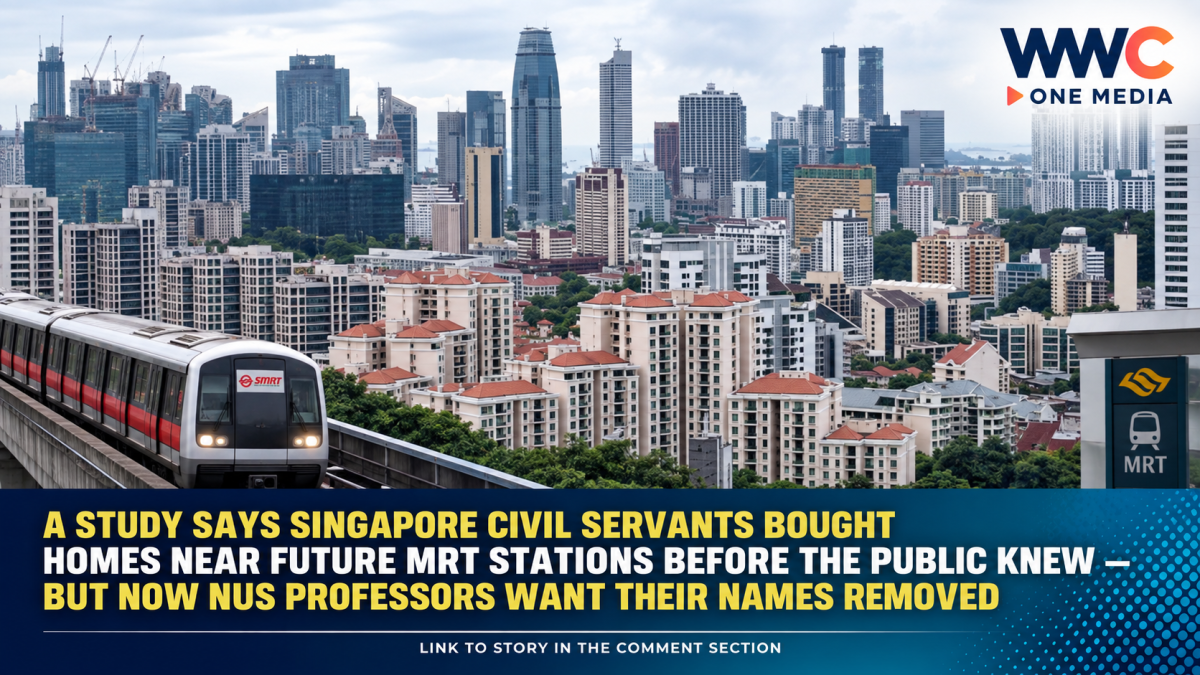
SINGAPORE — An academic paper alleging that Singapore civil servants disproportionately bought private homes near future MRT stations before those stations were publicly announced has triggered a government review — and now another controversy is growing around the research itself.
Two National University of Singapore academics named in the paper’s acknowledgements say they did not know about the study and have asked the authors to remove their names.
Distinguished Professor Ivan Png told CNA he did not know the authors, had never seen the paper before recent news reports and had provided neither comments nor data.
NUS vice-provost Jessica Pan similarly said her name appeared in the acknowledgements “by mistake” and that she had asked for it to be removed.
That matters because the working paper makes an unusually serious claim.
Published this month by the US-based National Bureau of Economic Research, or NBER, the study argues that Singapore public officers were statistically more likely than comparable private individuals to buy homes near planned MRT stations one to two years before the locations were announced publicly.
The Public Service Division, which sits under the Prime Minister’s Office, says it is now checking the research.
“We take any integrity concerns extremely seriously,” PSD said, adding that it is reviewing the data and methodology and will refer the matter to the Corrupt Practices Investigation Bureau if there is a material basis to do so.
The key word is if.
No finding of misconduct has been announced.
No civil servant has been publicly identified by the authorities as having improperly traded on confidential MRT information.
And the paper itself remains a working paper that has not undergone peer review.
What exactly does the paper allege?
The 86-page study is titled “Do Social Norms Substitute for Enforcement? Evidence from Public Officials’ Home Purchases in Singapore.”
Its four authors are Tomasz Piskorski of Columbia University, Amit Seru and Chun Zhao of Stanford University, and Jian Zhang of the University of Hong Kong.
Their broader research question is whether a country known for strong anti-corruption norms can continue maintaining integrity even if formal enforcement weakens.
Singapore was chosen partly because of its international reputation for low corruption and a highly professional public service.
The researchers then used the housing market as a way to test their theory.
Their argument is straightforward:
If an official knew privately where a future MRT station would be located, buying property near the station before the information became public could potentially produce a financial advantage once the announcement increased the area’s attractiveness.
The authors say they found a pattern consistent with that possibility.
But “consistent with” is not the same as proof in an individual case.
Researchers matched property records with civil-service directories
The study combined several sets of information.
The authors examined private-property transaction filings from January 1995 to December 2019.
They then used snapshots of the Singapore Government Directory Interactive, or SGDI, from six different years to identify people they classified as civil servants and reconstruct parts of their employment history.
They also used the Council for Estate Agencies’ public register and a proprietary dataset containing demographic and residential information for a large sample of Singapore residents.
Homes within roughly 1km of planned MRT stations were treated as the main “target” properties, although the researchers also tested other distances.
For comparison, the researchers created a control group of private individuals matched with the civil servants on characteristics including age, gender, marital status and ethnicity.
They then compared buying patterns before and after MRT station announcements.
The paper estimates 113 extra purchases by civil servants
The numbers are what have attracted the most attention.
According to analysis reported by The Business Times, the researchers estimated that civil servants made about 113 additional private-home purchases near future MRT stations in the two years before those locations were publicly announced, relative to their matched comparison group.
Those homes had a combined purchase value of approximately S$138 million.
The study further estimated that people it classified as relatives or co-registrants of civil servants made another 108 additional purchases, worth roughly S$132 million, during the three years before announcements.
Combined, that produces an estimated 221 additional purchases with a gross transaction value of about S$270 million.
But that S$270 million figure requires an important clarification.
It is the estimated gross value of the properties purchased — not an estimate of illegal profits.
Someone buying a S$2 million apartment did not necessarily earn S$2 million from the transaction.
And statistical “additional purchases” are estimated relative to a control group; they are not 221 individually proven misconduct cases.
That distinction is essential.
The strongest pattern appeared before the announcements
CNA reported that the paper’s statistical model estimated roughly 50 additional civil-servant purchases two years before MRT announcements and another 63 one year before them.
After stations were publicly announced, the purchasing difference between civil servants and the control group largely disappeared.
The authors interpret that timing as evidence consistent with pre-emptive buying rather than ordinary enthusiasm for property near newly announced transport infrastructure.
The researchers also reported that the effect was concentrated among what they classified as mid-level officials and among agencies they regarded as connected to rail planning.
They argued that those patterns were consistent with greater access to non-public information.
Again, that is the authors’ inference from aggregated data.
It does not establish what information any specific individual actually knew.
No individual officer is named
That is one of the most important limitations of the controversy.
The study does not publicly identify a specific civil servant and then show:
this officer had access to this confidential station plan;
this officer bought this apartment;
and this officer acted because of that information.
Instead, the authors use proxies and group-level statistical patterns.
SGDI listings are used as a proxy for civil-service employment.
Agency affiliation is used as an indicator of possible access.
Job titles help the authors classify seniority.
Property purchases are then compared with where future MRT stations eventually appeared.
That can reveal patterns worth investigating.
It does not automatically prove misconduct by the people inside the dataset.
PSD’s review is therefore important because the government may have access to employment, planning and confidentiality records unavailable to outside researchers.
The authors also looked at property agents and corporate directors
To test whether the effect simply reflected financially sophisticated people spotting where MRT expansion was likely to occur, the authors compared civil servants with other groups.
According to CNA, the researchers examined buying patterns among real-estate agents and corporate board members.
They said neither group displayed a similar increase in property purchases near planned stations before public announcements.
The authors present that result as evidence against a simpler explanation that civil servants were merely better-informed property investors.
But other academics are now questioning parts of the interpretation.
One University of Chicago professor questions the size of the claimed gain
University of Chicago economist Chang-Tai Hsieh was among the scholars acknowledged by the authors as having discussed the research.
Unlike Png and Pan, Hsieh confirmed to CNA that he had previously discussed the paper at a conference.
But he questioned aspects of its conclusions.
Hsieh noted that private housing can often be located farther from MRT stations than public housing, potentially making the financial benefit from advance information about a station location much smaller than the paper’s framing suggests.
That does not by itself invalidate the statistical findings.
It does show that interpretation of those findings remains contested.
And that is precisely the type of debate working papers are normally intended to provoke.
The paper has not been peer-reviewed
NBER is one of the most influential economic-research organisations in the world, and its working-paper series frequently features research by leading economists.
But NBER itself prominently warns readers that its working papers are circulated for discussion and comment.
They have not undergone peer review and have not received the review by the NBER Board of Directors that accompanies official NBER publications.
That does not mean the paper is wrong.
It means its methods, assumptions and conclusions remain open to challenge and revision.
The fact that two NUS academics now say they were acknowledged despite having no involvement reinforces the importance of treating the current version as unfinished research rather than an official finding of wrongdoing.
Ivan Png says he had never even heard of the paper
Png’s response was especially direct.
He told CNA that he was puzzled to see his name acknowledged and said he only learned of the paper after a colleague drew his attention to the media coverage.
“I do not know the authors,” he said, adding that he had supplied neither comments nor data.
Png emailed the lead author asking for his name to be removed.
Pan gave a similar account, saying she became aware of the paper only after publication and asking for her name to be deleted from the acknowledgements.
Two other NUS academics named in the paper, Sumit Agarwal and Wenlan Qian, referred CNA to the paper’s authors.
Professor David Reeb said he might have made a comment or asked a question when an earlier version was presented years ago.
Acknowledgement in an academic paper does not normally mean that a person co-authored, approved or endorsed the research.
But incorrectly acknowledging scholars who say they never interacted with the work raises obvious questions about how the acknowledgements were assembled.
At the time of CNA’s report, the authors had been approached for clarification.
Singapore’s public-service rules are clear on confidential information
Whatever the paper’s methodology ultimately proves or fails to prove, Singapore’s conduct rules for public officers are not ambiguous about using official information for private benefit.
The government has previously stated that a public officer may not directly or indirectly use official information or an official position to further anyone’s private interest, including his or her own.
The Public Service Code of Conduct also requires officers to avoid conflicts between official duties and personal interests, remain impartial and uphold the integrity and reputation of the service.
PSD has additionally said public officers are expected to safeguard the confidentiality of official information.
So if an investigation were eventually to establish that an officer had used confidential infrastructure plans for personal financial advantage, that would raise serious conduct issues.
But the current academic paper alone has not established that conclusion for any particular individual.
Why MRT information could theoretically matter to property prices
In land-scarce Singapore, proximity to an MRT station can materially affect the convenience and attractiveness of residential property.
New stations can shorten commutes, improve accessibility and change perceptions of previously less-connected neighborhoods.
That means information about a future station can potentially be financially valuable before the wider market knows about it.
The exact size of any price premium depends heavily on the property, distance, housing type, neighborhood, market cycle and what investors had already anticipated.
A proposed MRT station is also not necessarily impossible for sophisticated buyers to predict.
Urban planners publish long-term transport strategies.
Land parcels and construction activity can create clues.
Transport corridors may sometimes be inferred from existing development patterns.
One of the questions PSD’s review may therefore have to consider is whether the statistical difference identified in the paper is best explained by privileged information or by some other characteristic not fully captured by the model.
The paper says stronger enforcement reduced the pattern
The study goes beyond the property purchases themselves.
Its authors argue that the apparent pre-announcement purchasing pattern became less pronounced following what they describe as stronger integrity and enforcement measures.
They use that change to support their broader thesis that social norms alone may not permanently deter misconduct, even in a country with a strong integrity culture.
The NBER abstract concludes that continued formal enforcement may still be necessary to sustain low levels of corruption.
That is an academic interpretation built into the paper’s research design.
PSD has not endorsed it.
Singapore’s integrity system already includes multiple enforcement layers
Singapore’s public-service framework includes internal disclosure channels, disciplinary procedures and independent bodies such as CPIB.
PSD has previously said that officers who commit serious misconduct can face penalties ranging from warnings and fines to demotion, compulsory retirement or dismissal, even where conduct does not result in criminal charges.
Where there is evidence of corruption or potential criminal wrongdoing, independent investigations can follow.
That background helps explain why PSD’s response to the new study is deliberately procedural rather than declarative.
The division has not dismissed the allegations.
But it has also not treated the working paper as proof.
It is examining the evidence first.
The controversy has now shifted partly toward the researchers
When the story first emerged, attention focused almost entirely on civil servants.
The question was whether some public officers had used advance MRT information to make property purchases.
The latest developments add a second question:
How reliable is the paper making that allegation?
Two acknowledged academics say they knew nothing about it.
Another says he discussed the work but questions part of the interpretation.
The paper has not yet undergone peer review.
Several important classifications rely on proxies rather than verified individual knowledge.
And PSD is independently reviewing the underlying methodology before deciding whether CPIB should become involved.
None of those facts disproves the researchers’ findings.
But none allows them to be treated as established misconduct either.
What happens next matters more than the headline
For now, there are three separate things that should not be collapsed into one.
First: an academic paper reports a statistically unusual pattern of private-home buying by people it identified as civil servants before MRT station announcements.
Second: the authors interpret that pattern as evidence consistent with informed trading and possible information leakage.
Third: Singapore authorities have not yet concluded that wrongdoing occurred and are reviewing whether the evidence provides a material basis for further investigation.
That separation is crucial.
A working paper can raise a serious question.
It cannot substitute for an investigation into what individual officers actually knew, whether the information was confidential, whether purchases were motivated by it and whether any rules or laws were breached.
The academic dispute over the acknowledgements now makes that scrutiny even more important.
Singapore’s government says it is checking the data.
Two NUS professors say their names should never have appeared on the paper.
And until those reviews are completed, the most consequential claim in the study remains exactly that — a claim still waiting to be tested.



Leave a Reply