
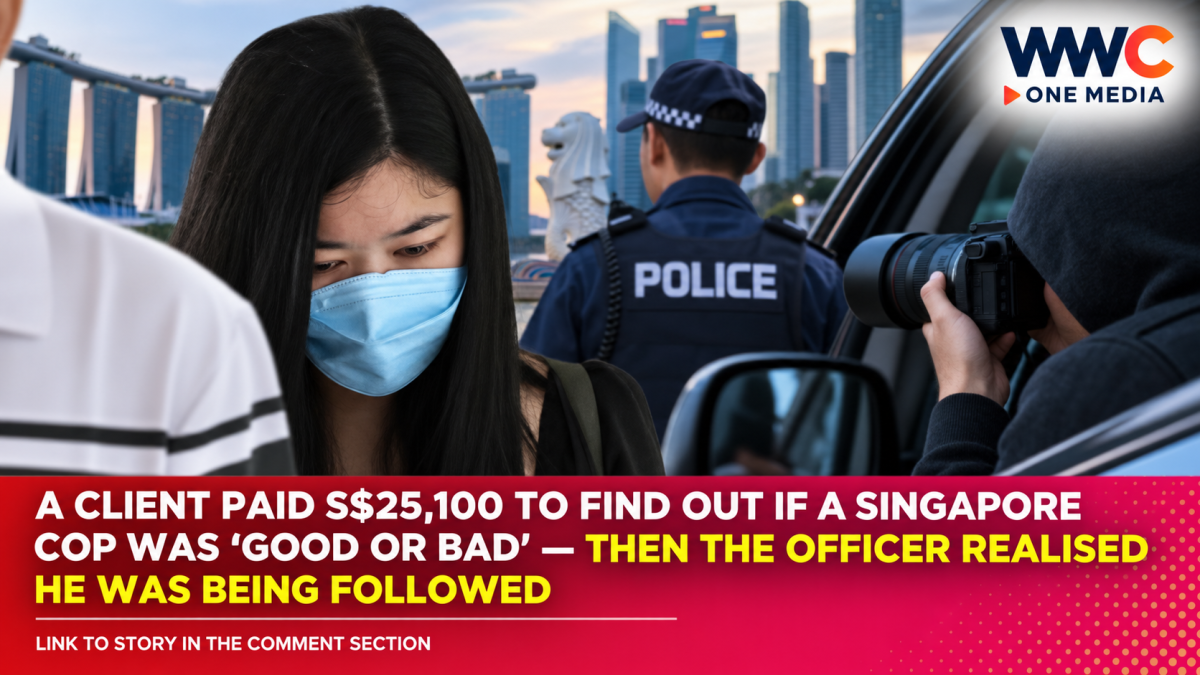
SINGAPORE — A Singapore man unhappy with how a police officer was handling a case involving his father wanted an answer to a deceptively simple question:
Was the investigator a “good or bad policeman”?
He hired a private investigation firm to find out.
What followed was a weeks-long surveillance operation that tracked the police officer between his home and workplace, photographed him inside his residence, monitored people he met and at times kept him under observation for more than 12 hours.
The assignment ultimately earned the private investigation company S$25,100.
It also ended in criminal prosecutions.
On Tuesday, September 15, 33-year-old Tan Hui Ting, who was a partner at private investigation and security firm CDiC Consultants, was fined S$24,000 after pleading guilty to consenting to her company supplying a private investigator for the operation without the legally required approval. She paid the fine in full.
Another charge was taken into consideration during sentencing.
The case is striking not simply because a police officer was followed.
It shows where Singapore draws a legal line around private surveillance when an investigation touches sensitive government premises and public-security interests.
The assignment began with a dissatisfied client
According to court proceedings, Pai Hong Yao approached CDiC in November 2021 because he was dissatisfied with the way Deputy Superintendent of Police Lee Tien Huat was handling a matter involving Pai’s father.
Pai met Tan Hui Ting and fellow CDiC partner Tan Kok Boon on November 29.
During that meeting, both were told that the surveillance target was a police officer.
Pai wanted the company to investigate whether Lee was a “good or bad policeman”.
Despite knowing who the target was and where he worked, the pair agreed to take the assignment.
Tan Hui Ting sent Pai a formal engagement letter the same day, which he signed and returned.
The company began investigating the officer around November 30 after receiving information including his photograph, mobile-phone number and workplace.
That workplace would later become legally crucial.
Lee was based at the Police Cantonment Complex.
The surveillance grew increasingly detailed
From December 16, 2021 to January 9, 2022, CDiC deployed private investigators around the officer’s residence and workplace.
They followed his movements during the day and took photographs.
Some operations stretched from early morning until midnight.
CNA reported one surveillance session beginning at 7.35am and ending at midnight, while earlier court coverage described several days of near-continuous observation.
The investigators also photographed Lee at home.
Among the images were two pictures showing him topless in his kitchen, according to Tuesday’s court report.
They gathered information on his vehicles and residence and sent regular updates back through the investigation company.
The operation became detailed enough that the private investigators even called the Police Cantonment Complex to check whether Lee was inside the building.
Pai also supplied information about people Lee might have been dealing with in connection with the investigation of his father.
That included the name and photograph of the lead prosecutor in the matter.
By the time the assignment ended, CDiC had received S$25,100 from the client.
The officer eventually spotted his watchers
The surveillance did not end because the private investigation firm voluntarily stopped.
It ended because the target noticed.
At about 4.15pm on January 9, 2022, Lee realised a group of people appeared to be following him.
He made a police report the next day.
Police later said investigators from Clementi Police Division used footage from police cameras and other CCTV systems to establish the identities of the private investigation firm’s partners and the investigators involved.
The four private investigators who physically carried out the surveillance were subsequently issued stern warnings, according to the police’s October 2025 statement.
Why did the firm need special permission?
This is the part of the case most likely to be misunderstood.
Singapore law does not say that every private investigation involving a police officer is automatically criminal.
The Private Security Industry Act 2007 instead requires prior written approval from the licensing officer for certain sensitive assignments.
These include surveillance or information gathering involving people working in particular protected or government premises.
The legislation specifically covers activity involving a protected area or protected place under the Infrastructure Protection Act, government buildings and several other designated security-sensitive locations.
Because Lee worked at the Police Cantonment Complex — itself a protected place — CDiC was required to seek approval from the Police Regulatory Department before accepting and carrying out the assignment.
It did not do so.
That distinction matters editorially.
The offence was not simply “hiring a PI to check a policeman”.
It was accepting and supplying investigators for a security-sensitive assignment without the prior approval required by law.
Police said it was the first known case of its kind
When Tan Hui Ting and Tan Kok Boon were charged in October 2025, the Singapore Police Force said this was the first case it was aware of in which a private investigation agency had been engaged to surveil a police officer investigating a case involving the client’s family member.
That made the prosecution more than an ordinary licensing dispute.
Prosecutors argued that the location and function of the target heightened the public-interest concerns.
Deputy public prosecutors noted on Tuesday that the Police Cantonment Complex is not simply an office building but a major operational centre for the Singapore Police Force and other law-enforcement departments.
They cited the security of government premises as well as broader national-security and public-order considerations in seeking a S$25,000 fine for Tan Hui Ting.
She ultimately received S$24,000.
For the offence, the law allowed a maximum penalty of two years in jail, a S$50,000 fine, or both.
Her lawyer argued her role was smaller
The defence sought a lower fine of no more than S$18,000.
Lawyer Aristotle Eng argued that Tan Kok Boon had played the larger supervisory role as managing director, while Tan Hui Ting was primarily client-facing.
Her role included coordinating a group chat through which surveillance information was relayed to the client, the defence said.
Eng also pointed out that investigators did not capture Lee carrying out confidential or secret operations and said all surveillance occurred outside the Police Cantonment Complex itself.
But under the relevant law, the restriction can extend to surveillance of a person working at a protected place — not merely filming inside the restricted premises.
Her former business partner was already sentenced
Tan Hui Ting is not the first person from CDiC sentenced over the assignment.
In July, Tan Kok Boon, then 58, was fined S$25,000, while CDiC Consultants was fined S$20,000.
District Judge Lim Tse Haw described the surveillance as “rather extensive”, noting that it continued until Lee himself realised he was being followed.
CDiC had also voluntarily disgorged the S$25,100 it received from the client shortly before the earlier sentencing.
Prosecutors argued that returning the money should not significantly mitigate the offence because it amounted to surrendering profits obtained from the unauthorised assignment.
Taken together, the sentences mean the firm and two key individuals involved in accepting the assignment have now faced substantial financial penalties.
There was also an allegation about deleted messages
When the pair were originally charged in October 2025, Tan Hui Ting faced a separate allegation that she had deleted a list and WhatsApp messages involving the client while police investigations were under way.
Tan Kok Boon was accused of approving the deletion.
The obstruction-related allegation against Kok Boon was later taken into consideration when he was sentenced after pleading guilty to the private-investigation offence, according to July court reporting.
CNA’s September 15 sentencing report states that one additional charge against Tan Hui Ting was also taken into consideration, while her conviction and S$24,000 fine were for the Private Security Industry Act offence.
That distinction is important: her sentencing should not be described as a conviction on multiple charges when the report states she pleaded guilty to one.
Private investigators in Singapore operate inside a licensed industry
The case also reveals how tightly regulated professional investigation work is in Singapore.
Agencies that supply investigators for payment need a Private Investigation Agency licence, while investigators themselves generally need the appropriate licensing and training qualifications.
Current Police Regulatory Department licence conditions require agencies to ensure deployed investigators comply with Singapore law and the Private Security Industry Act.
They also restrict potential conflicts of interest — for example, agencies cannot employ serving police officers or certain public servants where that employment creates a conflict with clients.
The industry therefore has legal authority to perform surveillance and information-gathering work, but that authority is not unlimited.
Assignments touching politically sensitive people, government locations or protected premises can trigger additional safeguards.
The S$25,100 question is what makes the story unusual
At its core, the case began not with corporate espionage or a national-security plot but with dissatisfaction over a police investigation involving a family member.
A client wanted someone to assess whether the investigating officer was “good or bad”.
The private investigation company accepted.
Then the job expanded into weeks of surveillance:
His home.
His workplace.
His daily movements.
The people he met.
His vehicles.
Photographs of him inside his kitchen.
And even telephone calls to his workplace to determine whether he was there.
The firm was paid S$25,100.
But the fact that the officer worked at one of Singapore’s most sensitive police facilities meant the investigators were operating in a category where ordinary commercial consent between client and detective was not enough.
They needed the government’s approval too.
They never got it.
The case leaves a clear warning for Singapore’s PI industry
There is nothing inherently unlawful about a private investigator gathering information for a client.
But the profession operates within boundaries designed to prevent commercial surveillance from colliding with government security, protected locations and public-order concerns.
Section 11 of the Private Security Industry Act effectively forces agencies to stop and ask for permission when an assignment crosses into those sensitive areas.
That check may have seemed bureaucratic when the assignment was offered in November 2021.
By September 2026, it had resulted in convictions and fines for both partners and the company.
And the most remarkable part is how the case ended.
A client spent S$25,100 trying to learn whether a police officer was a “good or bad policeman”.
Instead, the officer noticed the people watching him — and the investigation ultimately turned around on the private investigators themselves.




Leave a Reply