
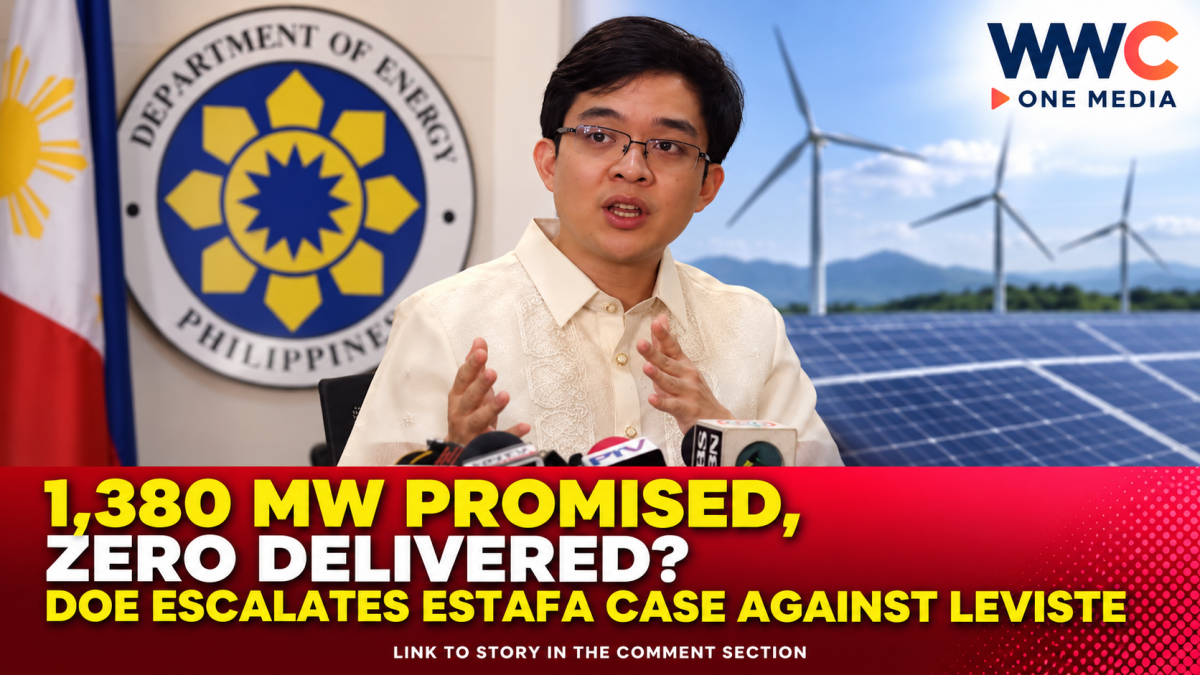
MANILA — The Department of Energy (DOE) has filed a supplemental estafa complaint against Batangas Rep. Leandro Leviste and two former Solar Philippines executives, accusing them of allegedly making false representations to secure renewable-energy awards totaling 1,380 megawatts (MW).
The complaint, filed before the Taguig City Prosecutor’s Office, covers 1,350 MW of solar capacity and 30 MW of wind capacity awarded under the government’s first Green Energy Auction Program (GEA-1).
The respondents named alongside Leviste are Hazel Iris Lafuente and Irma Flaminiano, both former officials associated with Solar Philippines entities.
WHAT THE DOE IS ALLEGING
According to reports on the supplemental complaint, the DOE alleges that the respondents represented their project companies as financially, technically and operationally qualified to participate in the government’s renewable-energy auction.
Energy Secretary Sharon Garin reportedly alleged that the DOE later discovered issues with the financial qualifications of several companies involved.
Among the allegations: Solar Philippines Commercial Rooftop Projects Inc. and Solar Philippines Visayas Corp. had negative equity when they registered for the auction, while SP New Energy Corp.’s equity was allegedly below the 30% contribution cited by the DOE as a standard for financing utility-scale solar projects of comparable size.
The DOE alleges that these circumstances were not properly disclosed when the companies participated in the auction.
THE 1,380-MW PROBLEM
The most striking issue in the complaint is the amount of renewable-energy capacity involved.
Solar Philippines companies won awards covering 1,380 MW — 1,350 MW of solar and 30 MW of wind. That figure represented roughly 70% of the total renewable capacity awarded in the first auction, according to earlier company disclosures and reporting.
But according to the DOE’s latest allegations, none of that awarded capacity was delivered by the December 25, 2025 deadline.
The department also alleges that project work programs were repeatedly missed and that required performance security was allowed to lapse.
DOE QUESTIONS WHAT HAPPENED TO THE ENERGY RIGHTS
The DOE has also raised allegations involving the subsequent handling of the renewable-energy rights.
According to Garin’s allegations, some of the rights were assigned, restructured or sold, leading the department to question whether the awards were obtained for actual project development or for eventual transfer and monetization.
Garin characterized the alleged conduct as an effort to “land-bank” public energy concessions.
Those claims, however, are allegations contained in a complaint and have not been established as facts by a court.
WHY THIS MATTERS TO ELECTRICITY CONSUMERS
The controversy goes beyond a dispute between the government and a renewable-energy developer.
The DOE has alleged that the failure to deliver the awarded capacity had consequences for the electricity market, including potentially higher clearing prices and additional reserve-procurement costs.
If proven, such allegations could raise broader questions about how renewable-energy capacity is awarded, monitored and enforced under the government’s Green Energy Auction Program.
The case could therefore become an important test of how strictly developers must comply with commitments made when competing for government-awarded renewable-energy contracts.
THIS IS NOT LEVISTE’S FIRST DOE LEGAL BATTLE
The latest estafa complaint comes months after the DOE filed another complaint involving Leviste and officials of Solar Para sa Bayan Corp. (SPBC).
That earlier case concerned alleged violations of the Public Service Act and the company’s obligations under its legislative franchise to provide electricity in remote, unserved and underserved areas.
Leviste previously dismissed those allegations, calling the complaint “super duper hina” or very weak, and argued that the case could set a problematic precedent for officers of public utilities.
WHAT HAPPENS NEXT?
The latest supplemental complaint is now before the Taguig City Prosecutor’s Office, which will determine whether the evidence supports the filing of criminal charges.
That means Leviste and the other respondents have not been found guilty of estafa.
The allegations remain subject to the prosecutorial process, and the respondents will have the opportunity to answer the accusations.
The case nevertheless puts a major spotlight on the Philippines’ renewable-energy auction system — particularly the question of what happens when awarded power capacity fails to materialize.
The bigger question now: Were the 1,380 MW awards simply delayed — or does the evidence support the DOE’s much more serious allegations?




Leave a Reply