
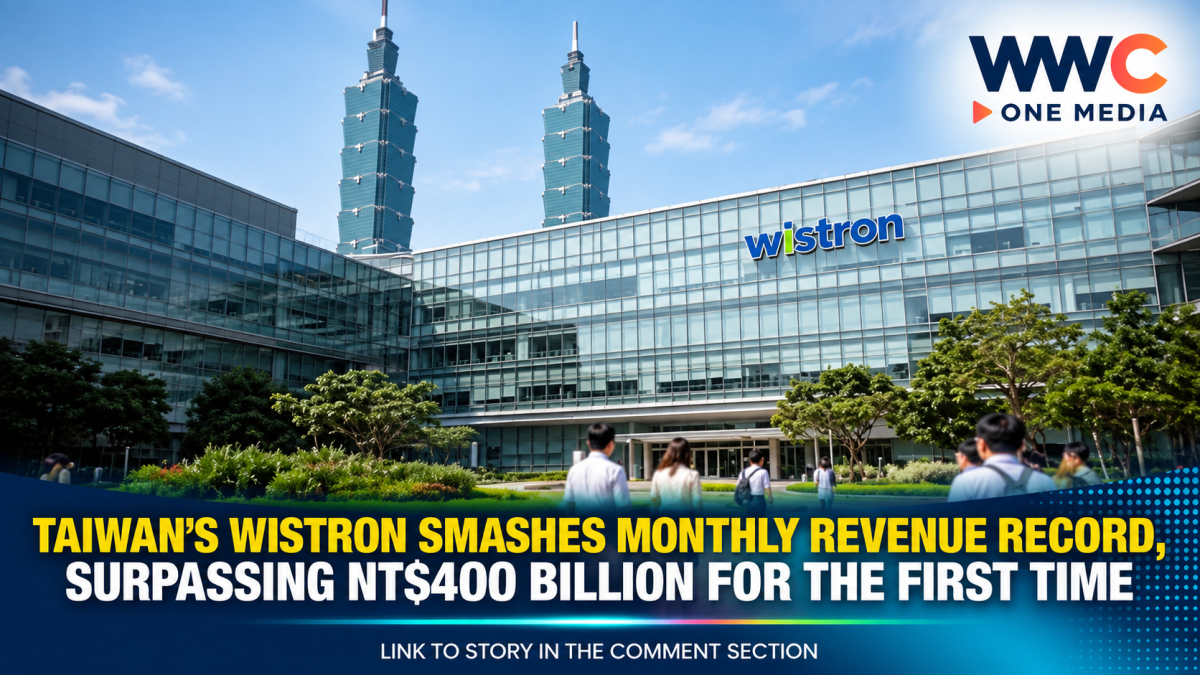
Taiwanese electronics manufacturer Wistron Corp. has crossed a major financial milestone as booming demand for artificial-intelligence infrastructure pushes its monthly revenue to an unprecedented level.
Wistron reported NT$460.065 billion (about US$14.6 billion) in revenue for August 2026, making it the first month in the company’s history that revenue has surpassed NT$400 billion.
The result highlights how Taiwan’s technology manufacturers continue to benefit from the global race to build AI computing infrastructure.
AI servers are driving the surge
Wistron is one of the Taiwanese manufacturers benefiting from rapidly rising demand for AI servers used by cloud-computing companies and other major technology customers.
The company said earlier in August that AI-server demand from cloud providers and business customers continued to exceed supply. Its second-quarter revenue rose 64% year over year to NT$895.44 billion, while net profit jumped 128%.
That momentum has now translated into an extraordinary monthly revenue figure.
The August result represents a significant acceleration from Wistron’s already strong first-half performance. The company reported NT$1.742 trillion in consolidated revenue for the first half of 2026, according to its financial announcement.
The numbers show how quickly the AI boom is reshaping Taiwan’s tech sector
Wistron’s record comes as Taiwan’s major electronics manufacturers increasingly shift production capacity toward AI-related infrastructure.
The broader industry is experiencing a similar surge.
Rival Taiwanese electronics giant Foxconn, formally known as Hon Hai Precision Industry, reported NT$921.8 billion in August revenue, up 51.98% from a year earlier. Foxconn said continued AI demand and the seasonal pickup in information and communications technology products should support third-quarter performance.
Together, the results illustrate the scale of the AI hardware boom—and the enormous amount of manufacturing capacity required to support it.
Wistron is expanding to keep up
Wistron is not simply benefiting from higher demand; it is also investing heavily to expand its ability to meet that demand.
The company opened a US$700 million smart factory in Texas in July, with production focused on Nvidia’s advanced AI systems.
Wistron has also approved additional spending to expand production capacity in Taiwan.
That expansion comes as customers increasingly seek larger quantities of AI computing infrastructure, putting pressure on manufacturers to secure components, production space and supply-chain capacity.
A huge new funding move
Wistron’s record revenue comes at an especially important moment for the company.
In September, Wistron raised approximately US$1.47 billion through a global share offering, with the proceeds earmarked for purchases of raw materials in foreign currencies and to support its expanding production needs.
The company issued 25 million global depositary receipts, equivalent to 250 million common shares. The new shares represent roughly 7.29% dilution for existing shareholders, although Wistron said it did not expect a material impact on shareholder interests.
The fundraising underscores an important reality behind the AI boom: producing the servers needed for next-generation computing requires enormous amounts of capital and materials.
Nvidia connection puts Wistron in the AI spotlight
Wistron’s growing role in AI infrastructure has also placed it closer to the center of Nvidia’s global supply chain.
Reuters reported that Wistron is a supplier of Nvidia systems and that its Texas facility is designed to manufacture Nvidia’s latest AI systems.
That positioning gives Wistron exposure to one of the fastest-growing segments of the technology industry.
But it also creates challenges.
As demand accelerates, manufacturers must balance aggressive expansion with supply-chain risks, capital requirements and the possibility that technology demand could eventually become less predictable.
Taiwan’s AI manufacturing boom shows no sign of slowing
Wistron’s latest result is more than an individual company record.
It is another sign of how dramatically artificial intelligence is reshaping Taiwan’s technology manufacturing industry.
Taiwan already plays a critical role in the global semiconductor and electronics supply chain. The explosion in AI computing has expanded that role beyond chips to include servers, networking equipment, power systems and other infrastructure needed to operate increasingly powerful AI models.
Wistron’s August milestone shows just how much money is now flowing through that ecosystem.
NT$460 billion in a single month is a remarkable figure—but the bigger story may be what it says about the AI infrastructure race still unfolding around the world.
If demand continues at anything close to its current pace, Taiwan’s AI-server manufacturers could be entering a new era of scale.
The question now is whether Wistron’s record August will become an extraordinary one-off—or the new baseline for a company riding one of the biggest technology investment cycles in decades.
WWC ONE MEDIA G.A




Leave a Reply