
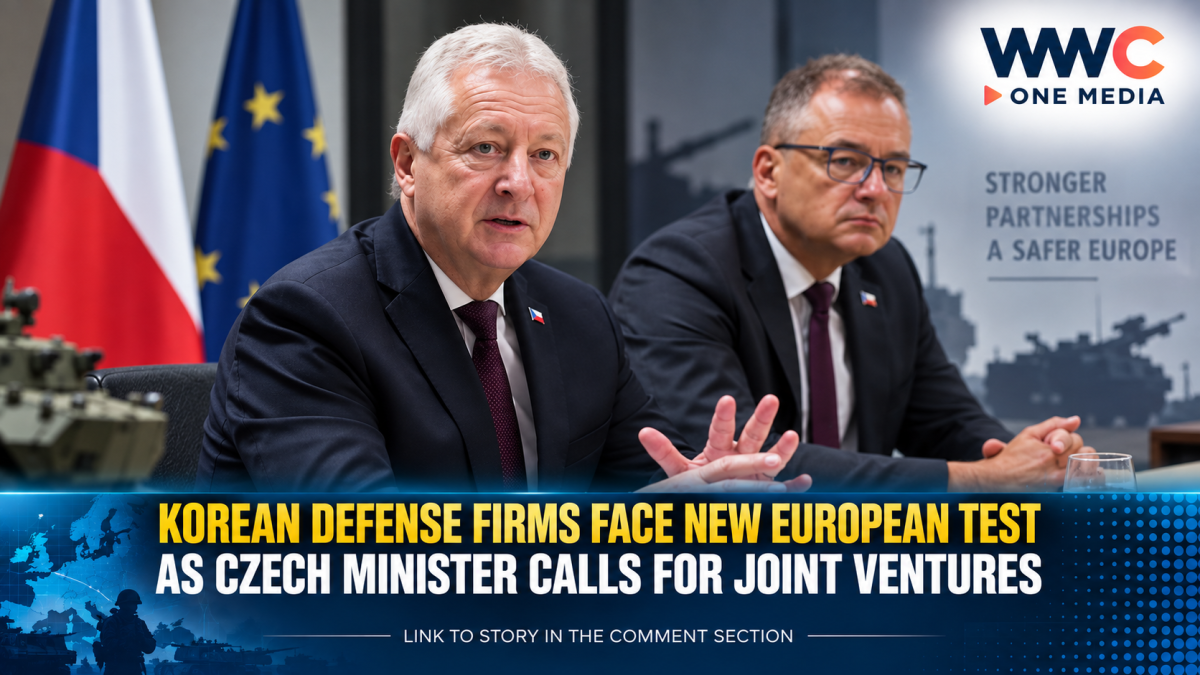
SEOUL, South Korea — South Korea’s rapidly expanding defense industry is facing a new challenge in Europe: selling products may no longer be enough.
Czech Deputy Prime Minister and Defense Minister Jaromír Zůna says South Korean defense companies seeking deeper relationships with NATO members should increasingly consider joint ventures, local manufacturing and technology partnerships inside Europe.
Speaking to The Korea Times during a visit to Seoul, Zůna pointed to Poland as an example of how Korean companies can build longer-term industrial relationships with European partners rather than simply exporting finished products.
“Poland is not only buying” Korean defense equipment, Zůna said, emphasizing that Warsaw is also building an industrial ecosystem with South Korean companies.
According to the Czech minister, the Polish model demonstrates how technology cooperation and European-based production could help Korean companies strengthen their position across the continent.
Why Europe wants more than imports
The shift reflects a broader change in Europe’s defense-industrial priorities.
Since Russia’s full-scale invasion of Ukraine, European governments have placed greater emphasis on expanding domestic production capacity, securing supply chains and reducing dependence on individual foreign suppliers.
For South Korean companies, that creates both an opportunity and a new requirement.
European governments may welcome Korean technology, manufacturing expertise and competitive industrial capacity, but increasingly want those capabilities connected to local companies, workers and production networks.
A 2024 study by the Central European Institute of Asian Studies noted that Central and Eastern Europe has become an increasingly important market for South Korean defense exports, with Poland playing a particularly significant role. The study also highlighted local manufacturing as an important component of major Korean-European defense agreements.
Czech Republic could become the next major test
The Czech Republic is particularly important because Prague is looking to strengthen its defense-industrial capabilities while remaining closely integrated with NATO and the wider European security architecture.
Zůna suggested that the same industrial model developed between South Korea and Poland could potentially help Korean companies expand their presence in the Czech market.
That could mean partnerships in areas such as manufacturing, research, maintenance, technology development and broader industrial cooperation—creating relationships that extend beyond individual procurement agreements.
The Czech minister’s comments also come as European governments increasingly examine how foreign defense suppliers can contribute to the continent’s own industrial base.
South Korea’s European strategy is already changing
South Korean defense companies have already moved toward greater European industrial participation.
Rather than relying exclusively on shipments from South Korea, companies have increasingly pursued local production facilities and partnerships with European businesses.
This approach can give Korean firms closer access to European customers while allowing European partners to gain manufacturing experience, technology and jobs.
It also potentially makes Korean companies more deeply embedded in European supply chains.
A recent analysis of the evolving European defense industry described this broader trend as a shift toward international industrial networks, with European companies increasingly forming partnerships with outside suppliers and technology firms.
NATO access is becoming an industrial question
Zůna’s message is significant because it suggests that expanding South Korea’s defense relationships with NATO countries is not simply about winning more contracts.
It is increasingly about where companies build, whom they partner with and how much industrial capability they establish inside Europe.
For Seoul, this could become an important part of its strategy to transform South Korea from a major defense exporter into a long-term industrial partner for European countries.
For European governments, meanwhile, Korean companies offer another potential source of investment and production capacity as countries seek to strengthen their defense-industrial base.
The result could be a new phase in South Korea-Europe relations—one in which factories, joint ventures and technology partnerships become just as important as export agreements.
The bigger picture
South Korea’s defense industry has expanded rapidly into European markets over the past several years, particularly in Central and Eastern Europe.
But the next stage may be considerably more complicated.
European governments increasingly want foreign companies to build locally, cooperate with domestic industry and contribute to Europe’s long-term manufacturing capacity.
That means South Korean firms could face a choice: continue primarily as exporters, or become more deeply embedded in Europe’s industrial ecosystem.
Zůna’s comments suggest that, at least from Prague’s perspective, the second path could be the key to unlocking broader relationships with NATO members.
And as Europe accelerates efforts to strengthen its industrial base, the question may no longer be whether Korean companies can enter the European market—but how deeply they are prepared to become part of it.
WWC ONE MEDIA G.A




Leave a Reply