
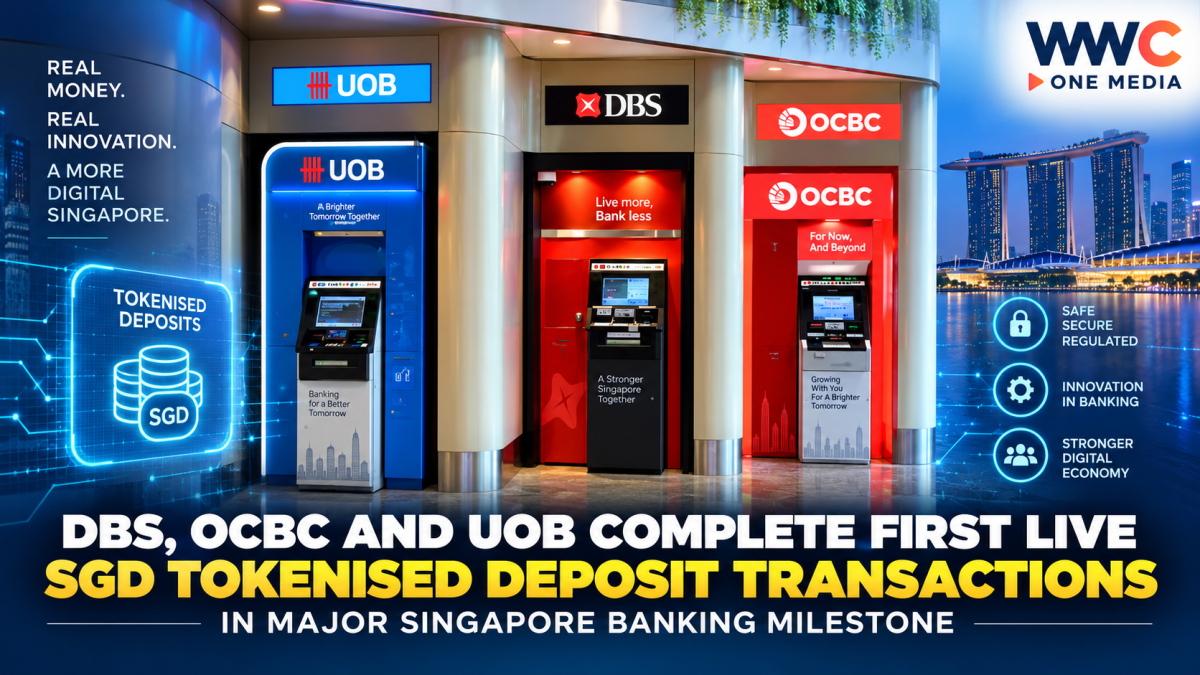
SINGAPORE — Singapore’s three biggest local banks are pushing the country’s financial system deeper into the digital age after DBS, OCBC and UOB completed landmark live transactions involving tokenised Singapore dollar deposits.
The milestone marks another major step in Singapore’s rapidly expanding push to bring blockchain and tokenisation technology into mainstream banking, with the country’s biggest lenders testing how digital representations of bank deposits could make payments and settlements faster, more efficient and potentially available around the clock.
The development builds on Singapore’s broader efforts to modernise financial infrastructure through shared digital ledgers and tokenised forms of money and assets. In November 2025, the Monetary Authority of Singapore announced a successful live trial involving DBS, OCBC and UOB for the settlement of interbank overnight lending using wholesale central bank digital currency on the Singapore Dollar Test Network.
Singapore’s Biggest Banks Move Tokenisation Into Live Banking
Unlike cryptocurrencies such as Bitcoin, tokenised deposits are digital representations of traditional bank deposits.
The money remains a liability of a regulated bank, but tokenisation can allow value and payment obligations to be represented and managed using digital ledger technology.
The goal is to make transactions more programmable, efficient and interoperable while keeping them within the existing regulated banking system.
Singapore has been steadily building the infrastructure needed for such transactions. The MAS-backed SGD Testnet was designed to help financial institutions test the settlement of tokenised financial assets using wholesale central bank digital currency and shared-ledger technology.
Why This Is a Big Deal for Singapore
The latest development puts DBS, OCBC and UOB at the center of a global race among major banks to modernise how money moves between financial institutions.
Traditional banking systems can involve multiple intermediaries, different operating hours and separate systems for payment messaging and settlement.
Tokenised deposits and shared ledgers could help reduce some of those barriers by allowing banks to coordinate transactions digitally and in near real time.
Singapore’s banks have already been moving rapidly in this direction.
UOB recently completed live cross-border tokenised deposit transactions with HSBC using Hong Kong dollars on Swift’s blockchain-based ledger, becoming the first Singapore-headquartered bank to execute live transactions on the platform. UOB also said it was preparing Singapore dollar and US dollar transactions involving additional banking partners.
The Race Toward 24/7 Banking
The potential prize is huge.
Businesses increasingly operate across time zones and expect money to move outside traditional banking hours.
Tokenised deposits could eventually allow companies to manage liquidity and make payments more efficiently on a 24/7 basis.
DBS recently demonstrated that potential in a separate transaction with Citi, completing a cross-border US dollar payment over a weekend using tokenised deposits via the Swift Digital Ledger. The banks said the transaction was completed in minutes, compared with conventional cross-border payments that can take up to two business days.
That momentum shows that tokenisation is rapidly moving beyond laboratory experiments.
Singapore’s Digital Finance Push Is Accelerating
The Monetary Authority of Singapore has made asset tokenisation a major part of its financial innovation strategy.
The central bank’s previous live trial involving DBS, OCBC and UOB featured the first live issuance of Singapore dollar wholesale CBDC, with transactions recorded in the banks’ official books and regulatory filings.
The SGD Testnet is designed to support several major functions, including a common settlement asset, programmable transactions and multi-asset settlement.
That means the technology could eventually support more than payments alone.
Potential applications include securities transactions, collateral management, lending and other complex financial arrangements.
What Tokenised Deposits Could Change
For ordinary customers, the shift may not immediately look dramatic.
A bank deposit will still be a bank deposit.
But behind the scenes, tokenisation could transform how quickly and efficiently financial institutions move money.
Potential benefits include:
- Faster settlement between banks
- More efficient liquidity management
- Round-the-clock transaction capabilities
- Programmable payments and automated conditions
- Reduced complexity in multi-bank transactions
- Improved interoperability between different financial systems
UOB has said shared-ledger infrastructure could help support seamless movement of value across domestic and cross-border payment networks while complementing existing banking systems.
The Bigger Battle Is About Interoperability
One of the biggest challenges facing digital finance is that banks and institutions are developing their own systems.
For tokenisation to reach its full potential, those systems need to communicate with one another.
DBS has been working on interoperability across different blockchain environments, including a partnership with Kinexys by J.P. Morgan to explore frameworks for transferring tokenised deposits between banking ecosystems and multiple blockchains.
The emergence of shared platforms and ledger-based infrastructure could help solve that problem by connecting banks without requiring every institution to operate on exactly the same technology.
Singapore Banks Are Moving Fast
The new milestone also shows how quickly Singapore’s financial sector is moving.
In recent weeks alone, Singapore banks have been involved in a series of live tokenised deposit transactions involving international partners.
OCBC recently worked with Citi on live transactions through Swift’s blockchain-based ledger, while Citi said it expected to conduct similar transactions with DBS and UOB later in September.
Meanwhile, UOB’s live transaction with HSBC and DBS’ weekend payment with Citi have added to the growing list of real-world tests involving major global banks.
The technology is no longer being discussed only as a future possibility.
It is increasingly being tested with live transactions.
The Bottom Line
DBS, OCBC and UOB have taken another major step toward the future of Singapore banking with live SGD tokenisation transactions.
The milestone strengthens Singapore’s position as one of the world’s leading financial centres for digital assets and tokenised finance.
The technology could eventually allow banks and businesses to move money faster, operate around the clock and manage payments across multiple institutions with far greater efficiency.
For now, traditional money is not disappearing.
But behind the scenes, Singapore’s biggest banks are quietly rebuilding the rails on which it moves.
The future of banking may still look familiar to customers — but underneath, the technology powering every dollar could be changing fast.DBS, OCBC and UOB Complete First Live SGD Tokenised Deposit Transactions in Major Singapore Banking Milestone
SINGAPORE — Singapore’s three biggest local banks are pushing the country’s financial system deeper into the digital age after DBS, OCBC and UOB completed landmark live transactions involving tokenised Singapore dollar deposits.
The milestone marks another major step in Singapore’s rapidly expanding push to bring blockchain and tokenisation technology into mainstream banking, with the country’s biggest lenders testing how digital representations of bank deposits could make payments and settlements faster, more efficient and potentially available around the clock.
The development builds on Singapore’s broader efforts to modernise financial infrastructure through shared digital ledgers and tokenised forms of money and assets. In November 2025, the Monetary Authority of Singapore announced a successful live trial involving DBS, OCBC and UOB for the settlement of interbank overnight lending using wholesale central bank digital currency on the Singapore Dollar Test Network.
Singapore’s Biggest Banks Move Tokenisation Into Live Banking
Unlike cryptocurrencies such as Bitcoin, tokenised deposits are digital representations of traditional bank deposits.
The money remains a liability of a regulated bank, but tokenisation can allow value and payment obligations to be represented and managed using digital ledger technology.
The goal is to make transactions more programmable, efficient and interoperable while keeping them within the existing regulated banking system.
Singapore has been steadily building the infrastructure needed for such transactions. The MAS-backed SGD Testnet was designed to help financial institutions test the settlement of tokenised financial assets using wholesale central bank digital currency and shared-ledger technology.
Why This Is a Big Deal for Singapore
The latest development puts DBS, OCBC and UOB at the center of a global race among major banks to modernise how money moves between financial institutions.
Traditional banking systems can involve multiple intermediaries, different operating hours and separate systems for payment messaging and settlement.
Tokenised deposits and shared ledgers could help reduce some of those barriers by allowing banks to coordinate transactions digitally and in near real time.
Singapore’s banks have already been moving rapidly in this direction.
UOB recently completed live cross-border tokenised deposit transactions with HSBC using Hong Kong dollars on Swift’s blockchain-based ledger, becoming the first Singapore-headquartered bank to execute live transactions on the platform. UOB also said it was preparing Singapore dollar and US dollar transactions involving additional banking partners.
The Race Toward 24/7 Banking
The potential prize is huge.
Businesses increasingly operate across time zones and expect money to move outside traditional banking hours.
Tokenised deposits could eventually allow companies to manage liquidity and make payments more efficiently on a 24/7 basis.
DBS recently demonstrated that potential in a separate transaction with Citi, completing a cross-border US dollar payment over a weekend using tokenised deposits via the Swift Digital Ledger. The banks said the transaction was completed in minutes, compared with conventional cross-border payments that can take up to two business days.
That momentum shows that tokenisation is rapidly moving beyond laboratory experiments.
Singapore’s Digital Finance Push Is Accelerating
The Monetary Authority of Singapore has made asset tokenisation a major part of its financial innovation strategy.
The central bank’s previous live trial involving DBS, OCBC and UOB featured the first live issuance of Singapore dollar wholesale CBDC, with transactions recorded in the banks’ official books and regulatory filings.
The SGD Testnet is designed to support several major functions, including a common settlement asset, programmable transactions and multi-asset settlement.
That means the technology could eventually support more than payments alone.
Potential applications include securities transactions, collateral management, lending and other complex financial arrangements.
What Tokenised Deposits Could Change
For ordinary customers, the shift may not immediately look dramatic.
A bank deposit will still be a bank deposit.
But behind the scenes, tokenisation could transform how quickly and efficiently financial institutions move money.
Potential benefits include:
- Faster settlement between banks
- More efficient liquidity management
- Round-the-clock transaction capabilities
- Programmable payments and automated conditions
- Reduced complexity in multi-bank transactions
- Improved interoperability between different financial systems
UOB has said shared-ledger infrastructure could help support seamless movement of value across domestic and cross-border payment networks while complementing existing banking systems.
The Bigger Battle Is About Interoperability
One of the biggest challenges facing digital finance is that banks and institutions are developing their own systems.
For tokenisation to reach its full potential, those systems need to communicate with one another.
DBS has been working on interoperability across different blockchain environments, including a partnership with Kinexys by J.P. Morgan to explore frameworks for transferring tokenised deposits between banking ecosystems and multiple blockchains.
The emergence of shared platforms and ledger-based infrastructure could help solve that problem by connecting banks without requiring every institution to operate on exactly the same technology.
Singapore Banks Are Moving Fast
The new milestone also shows how quickly Singapore’s financial sector is moving.
In recent weeks alone, Singapore banks have been involved in a series of live tokenised deposit transactions involving international partners.
OCBC recently worked with Citi on live transactions through Swift’s blockchain-based ledger, while Citi said it expected to conduct similar transactions with DBS and UOB later in September.
Meanwhile, UOB’s live transaction with HSBC and DBS’ weekend payment with Citi have added to the growing list of real-world tests involving major global banks.
The technology is no longer being discussed only as a future possibility.
It is increasingly being tested with live transactions.
The Bottom Line
DBS, OCBC and UOB have taken another major step toward the future of Singapore banking with live SGD tokenisation transactions.
The milestone strengthens Singapore’s position as one of the world’s leading financial centres for digital assets and tokenised finance.
The technology could eventually allow banks and businesses to move money faster, operate around the clock and manage payments across multiple institutions with far greater efficiency.
For now, traditional money is not disappearing.
But behind the scenes, Singapore’s biggest banks are quietly rebuilding the rails on which it moves.
The future of banking may still look familiar to customers — but underneath, the technology powering every dollar could be changing fast.
WWC ONE MEDIA J.M.D




Leave a Reply