
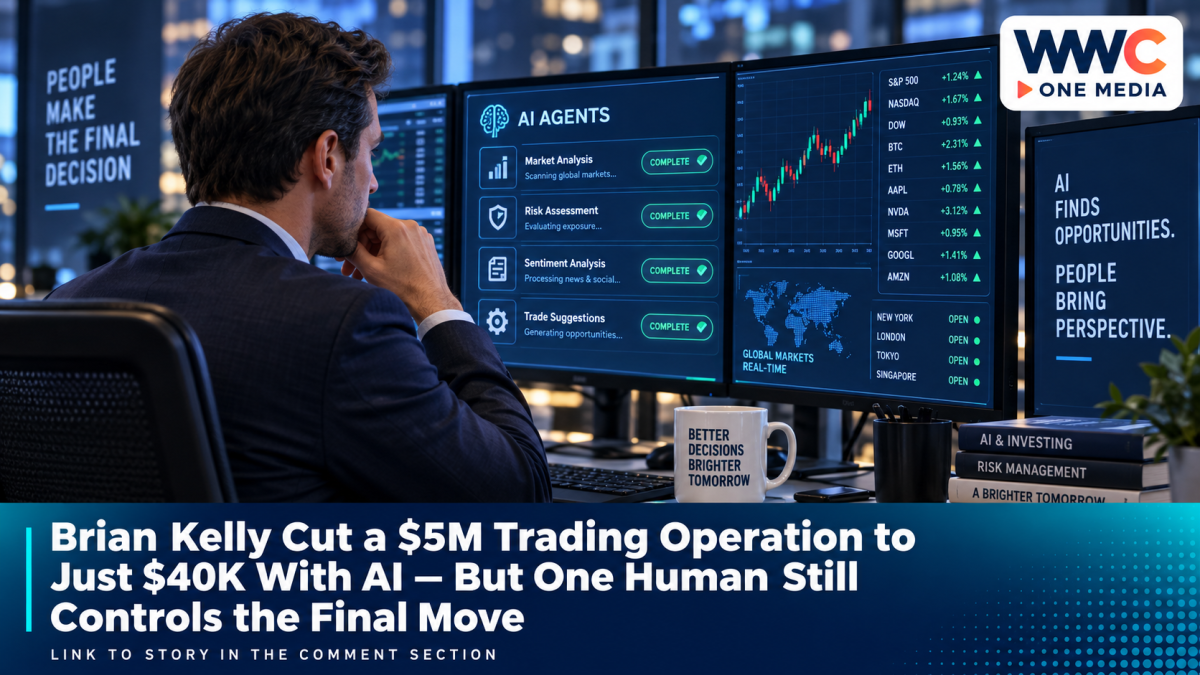
NEW YORK — Former cryptocurrency hedge-fund manager Brian Kelly has built a trading operation that offers one of Wall Street’s most dramatic examples yet of what an AI-powered workplace could look like.
His new firm, Bracket22, has no conventional team of analysts, quantitative researchers or operations employees working alongside him.
Instead, Kelly says much of that work is being handled around the clock by specialized artificial intelligence agents.
The result, according to Kelly: an operation that once carried roughly $5 million a year in labor-related and associated costs now costs him about $30,000 to $40,000 annually for AI agents, computing and the infrastructure needed to run them.
That represents a roughly 99% reduction based on Kelly’s own estimates.
But the number comes with an important qualification.
Bracket22 is not simply the old hedge fund with every employee swapped for software. Kelly closed his previous cryptocurrency hedge fund in early 2025, began experimenting with artificial intelligence later that year and subsequently created Bracket22 as a new trading business.
And unlike a traditional hedge fund managing outside investors’ money, Bracket22 trades Kelly’s own capital across cryptocurrencies, equities and commodities.
That distinction matters when assessing just how revolutionary his experiment really is.
Meet the AI “employees” running Bracket22
Kelly has divided the work among AI agents with distinct responsibilities rather than asking one model to handle everything.
An agent named “Steffi” focuses on technical analysis.
“Desmond” handles quantitative strategies.
And “Houston” functions as what Kelly describes as mission control, assembling information from the other systems and helping coordinate the overall workflow.
The architecture is designed to make individual agents behave more like specialists than general-purpose chatbots.
Kelly told CNBC he deliberately keeps their functions separated so that each can produce its own analysis rather than simply echoing another model’s conclusion.
But there is still one job he has not handed over.
Kelly says he makes the final investment decision himself.
That may be the most important detail in the entire experiment.
Bracket22 is powered by AI, but it is not operating as a completely autonomous investment manager with software independently deciding where all the money goes.
Human judgment remains at the end of the chain.
From seven or eight employees to AI agents
Kelly said his previous operation employed around seven or eight people around the world, including employees in New York.
Once salaries, healthcare, computing, office space, bonuses and related expenses were included, he estimates the annual cost associated with running that organization reached approximately $5 million.
He now puts the annual cost of his AI-based setup at roughly $30,000 to $40,000.
Kelly also estimates that he is at least 10 times more productive using the agents.
That figure, however, should be treated as Kelly’s assessment rather than an independently established industry benchmark.
The cost comparison needs similar context: the old and new businesses are structurally different, and Bracket22 now manages Kelly’s money rather than operating the same outside-capital hedge-fund model he previously ran.
Still, even with those caveats, the scale of the claimed cost reduction illustrates why agentic AI has become such a major issue for finance.
Wall Street is already moving in the same direction
Bracket22 may represent the extreme end of the experiment, but Kelly is hardly alone in trying to shift financial work to AI.
Reuters reported in July that major institutions including JPMorgan Chase, Morgan Stanley, Goldman Sachs, UBS, Citi and BNY were deploying or experimenting with agentic AI systems capable of carrying out multistep tasks with limited supervision.
BNY has gone as far as treating some AI systems like “digital employees,” while Morgan Stanley has been testing assistants capable of interacting with clients around the clock.
More than half of banks covered by a KPMG survey cited by Reuters were already testing agentic AI.
The major banks, however, are generally taking a more controlled approach than Kelly.
Executives repeatedly emphasize that humans remain responsible for high-stakes decisions, particularly when AI interacts with customers or handles regulated financial activity.
JPMorgan says AI has already displaced some workers
The employment consequences are no longer entirely theoretical.
JPMorgan CEO Jamie Dimon said earlier this year that the bank had already experienced worker displacement caused by AI and was developing extensive plans to move affected employees into other jobs.
“We already have huge redeployment plans” for employees, Dimon said during an investor meeting.
JPMorgan’s overall workforce was roughly flat at the time, but jobs were shifting internally as automation changed how work was performed.
In his annual shareholder letter, Dimon was even more explicit about the broader trend, writing that AI “will definitely eliminate some jobs” while improving and creating others.
He also warned that AI deployment could potentially move faster than workers and economies are able to adapt.
That makes Kelly’s one-person-plus-agents model particularly significant.
It demonstrates what becomes technologically possible when a business owner chooses not merely to give workers AI tools, but to redesign the business around software from the beginning.
Goldman Sachs is warning about a different danger
Cost savings are only one side of Wall Street’s AI debate.
Goldman Sachs partner Chris Churchman, who leads the bank’s Marquee platform and works on its AI initiatives, has warned that excessive automation could eventually weaken the very skills financial institutions depend on.
His concern is that young bankers may stop developing first-principles reasoning if increasingly complicated analytical work is delegated to machines.
Churchman described the potential result as “cognitive atrophy.”
The issue goes beyond whether an AI system can produce an investment model or price an asset correctly.
Finance has traditionally trained junior employees by making them perform repetitive analytical work under the supervision of more experienced professionals.
Automate enough of that apprenticeship process and Wall Street could eventually confront an uncomfortable question:
Where will tomorrow’s experienced decision-makers come from if machines perform much of the work that once trained them?
AI skills are also becoming a hiring requirement
Other banks are responding differently.
Rather than eliminating entry-level workers outright, some are increasingly expecting new recruits to know how to work alongside AI.
The Financial Times reported this week that UBS will require junior investment-banking candidates entering in 2027 to demonstrate AI proficiency, including during recruitment interviews.
The move reflects how tasks traditionally assigned to junior bankers — research, financial analysis and preparing client materials — are increasingly being assisted by artificial intelligence.
The same FT report cited Morgan Stanley analysts projecting that AI-driven efficiencies could contribute to the elimination of more than 200,000 European banking jobs over five years.
That forecast is not a certainty, but it shows how seriously financial institutions are considering the labor implications of automation.
What Bracket22 does — and does not — prove
Kelly’s experiment makes for an extraordinary number: roughly $5 million becoming $30,000 to $40,000.
But it would be premature to conclude that every hedge fund can now eliminate its workforce and achieve similar economics.
A large institutional investment manager has responsibilities that a personal trading operation may not face at the same scale, including compliance, investor relations, cybersecurity, operations, legal oversight, risk management and regulatory reporting.
And cheaper analysis does not automatically mean better investment performance.
The crucial test for any trading system remains whether it generates attractive risk-adjusted returns consistently over time, not simply whether it produces research at lower cost.
Kelly’s own approach acknowledges that limitation.
After his AI specialists perform their individual jobs and Houston brings the pieces together, a human still decides whether to make the trade.
That may make Bracket22 less a story about AI eliminating humans entirely and more a preview of something potentially much bigger:
one skilled human being gaining access to analytical capacity that once required an entire team.
Kelly himself argues that this is where the larger opportunity lies.
Instead of thinking only about replacing employees, he believes companies could use AI to multiply what their existing workers can accomplish.
And that distinction may decide whether the next stage of artificial intelligence becomes primarily a story about mass job replacement — or about dramatically smaller teams accomplishing what once required entire organizations.



Leave a Reply