
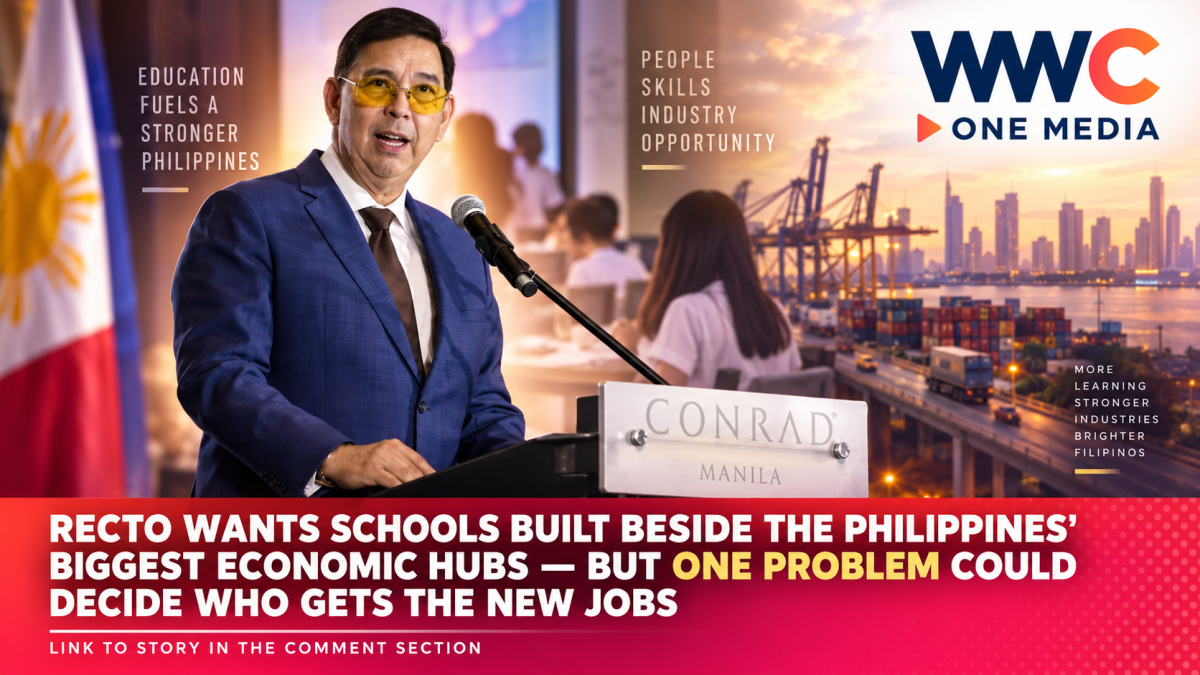
MANILA, Philippines — What if Filipino students did not have to wait until graduation to see the industries they are preparing to enter?
Executive Secretary Ralph Recto is pushing for schools, universities and training institutions to be located closer to the country’s economic and industrial hubs, a strategy aimed at producing workers whose skills match the jobs being created by factories, technology firms and other major employers.
The idea addresses one of the Philippine labor market’s longest-running problems: companies say they need skilled workers, while thousands of graduates struggle to find jobs aligned with what they studied.
Rather than keeping classrooms and factories separated by geography and, often, by completely different expectations, the emerging model places education directly alongside industry.
A working example can already be seen at the Batangas State University LIMA Campus, inside the sprawling LIMA Estate in Batangas.
The campus places engineering and technology students within an industrial environment where multinational and local companies operate, giving them greater exposure to actual workplace systems and allowing universities and employers to coordinate more closely on the competencies companies require. President Ferdinand Marcos Jr. highlighted the campus during his September 7 visit to LIMA Estate as an example of stronger industry-academe cooperation.
The problem is bigger than finding graduates
The government’s concern is not simply whether Filipinos earn diplomas.
It is whether what they learn can actually lead to sustainable employment.
Marcos cited a 2021 Asian Development Bank study indicating that roughly one-third of college graduates were employed in occupations generally intended for workers without college education, while about two-thirds of technical-vocational education and training graduates were working in occupations unrelated to the expected outcomes of their training programs.
That is the gap Recto’s proposed education-and-economic-hub model is trying to narrow.
Putting students closer to employers could allow schools to react faster when industries start demanding new skills—from mechatronics and automation to artificial intelligence, advanced electronics, power systems and data-driven manufacturing.
It could also turn internships and workplace immersion from short graduation requirements into a deeper part of a student’s education.
At the BatStateU LIMA Campus, programs have been designed around industry-based learning, including curriculum cooperation, practical exposure and training connected to companies operating within the estate. Aboitiz Economic Estates allocated 10 hectares inside LIMA Estate for the university’s long-term expansion.
The school’s partners describe it as the country’s first public-university campus fully embedded in an industrial estate.
Why LIMA could become a national template
LIMA Estate provides an unusually large testing ground for the concept.
Aboitiz Economic Estates says the roughly 1,000-hectare development is home to nearly 200 local and global companies and more than 75,000 professionals, with more employment projected as the estate expands.
That means students can theoretically learn only minutes away from manufacturers, engineering operations, technology businesses and other employers that could eventually recruit them.
The campus opened its pioneer batch of engineering and technology students in August, according to PNA.
Marcos also visited the nearby JERA-AboitizPower Global Technical Center of Excellence, which provides specialized instruction for power-sector professionals in areas including plant operations, maintenance, safety and emerging energy technologies.
Together, the facilities illustrate a different approach to workforce development: instead of asking employers to retrain graduates after hiring them, schools and industry begin coordinating before students enter the labor market.
Philippines is creating thousands of jobs—but workers must be ready
Recto’s proposal becomes more significant as the government rapidly expands economic zones outside Metro Manila.
The Marcos administration has created or expanded 46 economic zones, which Recto said could generate around P141.2 billion in investments and nearly 189,000 jobs.
Twenty-nine are in Luzon, 12 in the Visayas and five in Mindanao, with only three located in Metro Manila.
Four of the newest ecozone projects in Cavite, Batangas and Negros Oriental alone are expected to bring nearly P9.7 billion in investments.
Their projected employment includes about 2,200 additional jobs from the expansion of Suntrust Ecotown Tanza, 200 from the expanded Light Industry & Science Park IV in Malvar, about 1,500 at Robinsons Dumaguete IT Park and around 110 from a prospective locator at the newly designated Biz Hub at LIMA Estate.
Recto has said the goal is to allow businesses to go where Filipino talent already lives rather than forcing workers to relocate to expensive and congested metropolitan areas.
But bringing factories to the provinces solves only half of the equation.
The people living around those investment hubs must also have the qualifications those companies are looking for.
That is where putting universities, technical schools and training centers close to economic zones could become crucial.
New labor numbers make the challenge more urgent
The proposal also comes as the Philippine labor market shows signs of strain.
Official Philippine Statistics Authority figures show unemployment rose to 6 percent in July 2026, equivalent to approximately 3.14 million unemployed Filipinos, from 5.3 percent a year earlier.
Employment nevertheless reached 49.21 million, while underemployment improved to 12.9 percent.
CALABARZON—the region containing major industrial centers in Cavite, Laguna, Batangas, Rizal and Quezon—posted a July unemployment rate of about 6.07 percent, slightly above the national average.
Those numbers do not prove that skills mismatch alone caused the increase. But they underline why policymakers are under pressure to ensure that investment pledges and newly created economic zones translate into jobs Filipinos can actually qualify for.
Government expands micro-credentials and workplace training
The administration is also attempting to shorten the distance between education and employment through smaller, highly targeted credentials.
Marcos said 703 micro-credential competency programs were registered between July 2022 and May 2026, while nearly 4.9 million TVET graduates underwent competency assessment.
The number of TVET assessors increased from 13,535 in July 2022 to 16,640 by May 2026.
As of April, another 3,819 Filipinos had enrolled in the Enterprise-Based Education and Training Program, which allows participants to acquire skills through actual workplace experience.
The President has called on schools, government agencies and private companies to make training more accessible and responsive to changing industry demand.
Taiwan offers a clue—and a warning
There is also an international precedent for putting universities beside industrial centers.
A recent University of the Philippines study examining the Philippines’ semiconductor strategy pointed to Taiwan’s Hsinchu Science Park, which was developed beside major engineering universities and government research institutions.
That close geographic relationship helped create an ecosystem where universities, scientists, companies and government researchers could exchange knowledge and develop technology.
By comparison, researchers said some Philippine economic zones historically operated as isolated manufacturing enclaves with relatively weak connections to universities, research institutions and domestic suppliers.
That distinction could be critical as the Philippines attempts to move beyond assembly and testing into higher-value industries such as semiconductor design, advanced packaging, artificial intelligence and research and development.
Simply building another industrial park may create jobs.
Building an industrial park connected to universities, laboratories and training centers could potentially create something more valuable: an ecosystem capable of producing technology—and the Filipino engineers and technicians needed to sustain it.
The real test comes after the schools are built
Recto’s idea therefore sounds straightforward: bring classrooms to where future jobs are being created.
The difficult part will be execution.
A university located beside a factory will accomplish little if its curriculum remains disconnected from that factory’s technology. Industry partnerships will have to influence course design without reducing education merely to company-specific training.
Students will need laboratories and modern equipment. Teachers will need continuing industry exposure. Companies will have to provide meaningful apprenticeships rather than symbolic internships.
And government will need reliable information on which occupations will actually be in demand several years from now—not simply which jobs are difficult to fill today.
There is also a question of scale.
One industry-linked campus in Batangas can demonstrate that the concept works. Replicating it across Clark, Subic, Cavite, Laguna, Cebu, Iloilo, Davao and other emerging investment centers would require sustained coordination among the Department of Education, Commission on Higher Education, TESDA, PEZA, local governments, state universities and private industry.
The concept, however, represents a potentially important shift in Philippine economic policy.
For decades, the country has built economic zones to attract companies.
The next phase may be about building the schools, laboratories and talent pipelines beside them so Filipinos are not merely watching new factories rise in their hometowns—but are prepared to take the jobs inside them.
And that could ultimately determine whether the government’s billions in promised investments become Filipino careers—or another generation of jobs employers struggle to fill.




Leave a Reply