
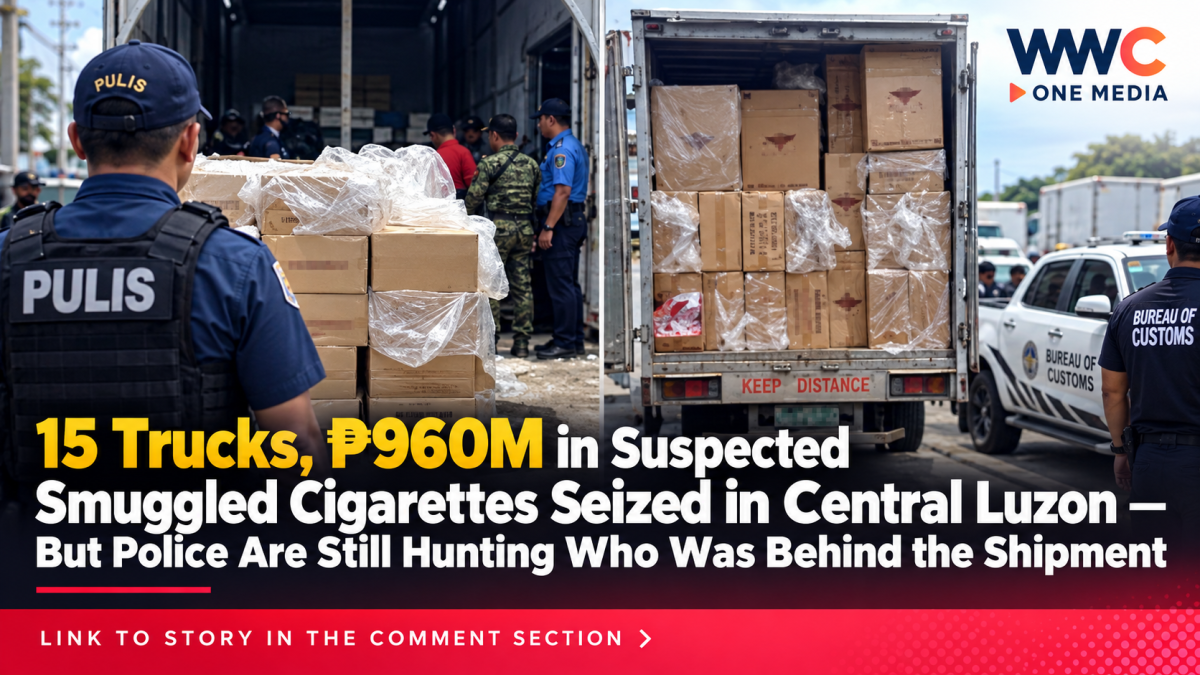
CENTRAL LUZON, Philippines — What began with the interception of a single wing van carrying almost ₱49 million worth of suspected illicit cigarettes rapidly expanded into one of Central Luzon’s biggest cigarette seizures this year, as police stopped 15 trailer trucks carrying an estimated ₱960 million in suspected smuggled tobacco products across Bataan and Pampanga.
But authorities say the operation is far from over.
Investigators are now trying to determine who owned, financed and organized the massive shipment, after information obtained from an earlier police operation pointed them toward a private seaport in Mariveles, Bataan.
It started with one van in Mabalacat
The chain of events began shortly after midnight on September 7, 2026, when personnel from the Police Regional Office 3 and the Criminal Investigation and Detection Group intercepted an Isuzu GIGA wing van along MacArthur Highway in Barangay Cacutud, Mabalacat City, Pampanga.
Authorities had reportedly been monitoring the vehicle for more than a week.
Inside, police discovered 759 master cases of “Modern” cigarettes—329 cases containing red packs and 430 containing blue packs. Police said the cigarettes appeared to lack Bureau of Internal Revenue tax stamps.
The shipment was initially valued at ₱48,955,500.
Four people aboard the van were arrested, while officers also recovered the vehicle and three mobile phones, according to separate reports from SunStar, Daily Tribune and Punto Central Luzon.
But investigators did not stop at the van.
The trail reportedly pointed to Mariveles
Information developed after the Mabalacat interception indicated that the shipment may have originated from a private seaport in Mariveles, Bataan, prompting operatives from PRO-3’s Regional Special Operations Group–Regional Intelligence Division to conduct surveillance in the area.
Police subsequently monitored several trailer trucks carrying 40-foot container vans.
At around 8:30 p.m., officers reportedly saw the trucks leaving the area one after another.
Law-enforcement units positioned themselves along routes in Bataan and Pampanga—and began intercepting the vehicles.
Fifteen trucks stopped across Bataan and Pampanga
Police eventually intercepted:
- Seven trailer trucks in Abucay, Bataan
- Two in Limay, Bataan
- One in Orion, Bataan
- Five in Lubao, Pampanga
The 15 trucks were carrying what police described as substantial quantities of suspected smuggled or illicit cigarettes.
Their initial estimated value: ₱960 million.
Authorities stressed that the figure remains subject to final inventory and verification by the appropriate government agencies.
When the earlier ₱48.955-million Mabalacat shipment is considered separately, the two linked operations involved cigarette cargo with preliminary police valuations totaling just over ₱1 billion.
The Philippine News Agency similarly reported that police had seized close to ₱1 billion worth of cigarettes in the operations and that 14 individuals were arrested, most of them drivers.
Police say the people behind the shipment remain the bigger target
PRO-3 director Brig. Gen. Jess Mendez said authorities are continuing their investigation to identify the owners and operators behind the shipments.
Mendez told reporters that the scale of the operation suggested investigators could be dealing with a substantial group, noting the sheer number of containers involved.
The 14 people arrested so far, however, should not automatically be treated as the masterminds of the alleged operation. Police said most were drivers, while investigators are still determining who controlled the cargo and its movement.
That distinction could become crucial as prosecutors determine who knew what—and what charges should ultimately be filed.
Why the case could become much more serious
Police said evidence gathered from the operation could support cases under the Philippines’ Anti-Agricultural Economic Sabotage Act, or Republic Act No. 12022.
The law, enacted in 2024, specifically defines tobacco to include manufactured products such as cigarettes, cigars and heated tobacco products.
It considers agricultural smuggling economic sabotage when covered products reach the statutory threshold of at least ₱10 million, subject to the requirements of the law. The statute also covers knowingly transporting or storing smuggled agricultural products.
Penalties vary depending on a person’s role and what prosecutors can prove. Principal perpetrators of qualifying economic-sabotage offenses can face extremely severe punishment under the law, while separate penalties apply to vehicle owners, facility operators, drivers and other personnel who knowingly participate.
That means the final legal exposure of those arrested will depend on evidence of ownership, participation and knowledge, not merely presence near the seized cargo.
Cigarette smuggling crackdown is getting bigger
The Central Luzon seizure comes amid a much broader government campaign against illicit tobacco.
In June 2026, the Bureau of Customs, National Bureau of Investigation, Bureau of Internal Revenue and Philippine Coast Guard intercepted 23 containers of illicit cigarettes valued at about ₱1.7 billion in another major operation.
A separate June operation in Cebu uncovered 11 40-foot containers containing an estimated ₱860 million worth of illicit cigarettes.
And in May, Customs reported finding 54 container vans containing cigarettes and raw tobacco in Agusan del Norte, with an estimated value of about ₱3.3 billion.
Earlier in Central Luzon itself, police seized around ₱150 million worth of illicit cigarettes in Baliwag, Bulacan, in April, arresting 19 suspects and recovering six vehicles.
The numbers show why enforcement agencies increasingly view illicit tobacco not simply as a street-level contraband problem, but as a potentially large-scale logistics and revenue issue involving trucks, container yards, ports and distribution networks.
The ₱960-million question
Stopping 15 trucks is a major enforcement win.
But it may also be only the visible end of a much bigger operation.
Police have the vehicles. They have the cigarettes. They have several suspects and potentially valuable evidence obtained from the first intercepted van.
What investigators still need to establish is who paid for the shipment, who arranged its movement from the suspected point of origin, where the cigarettes were ultimately headed—and who expected to profit once nearly ₱1 billion worth of tobacco entered the market.
Those answers could determine whether the Central Luzon seizure ends as another massive confiscation—or becomes the case that exposes the organization behind it.




Leave a Reply