
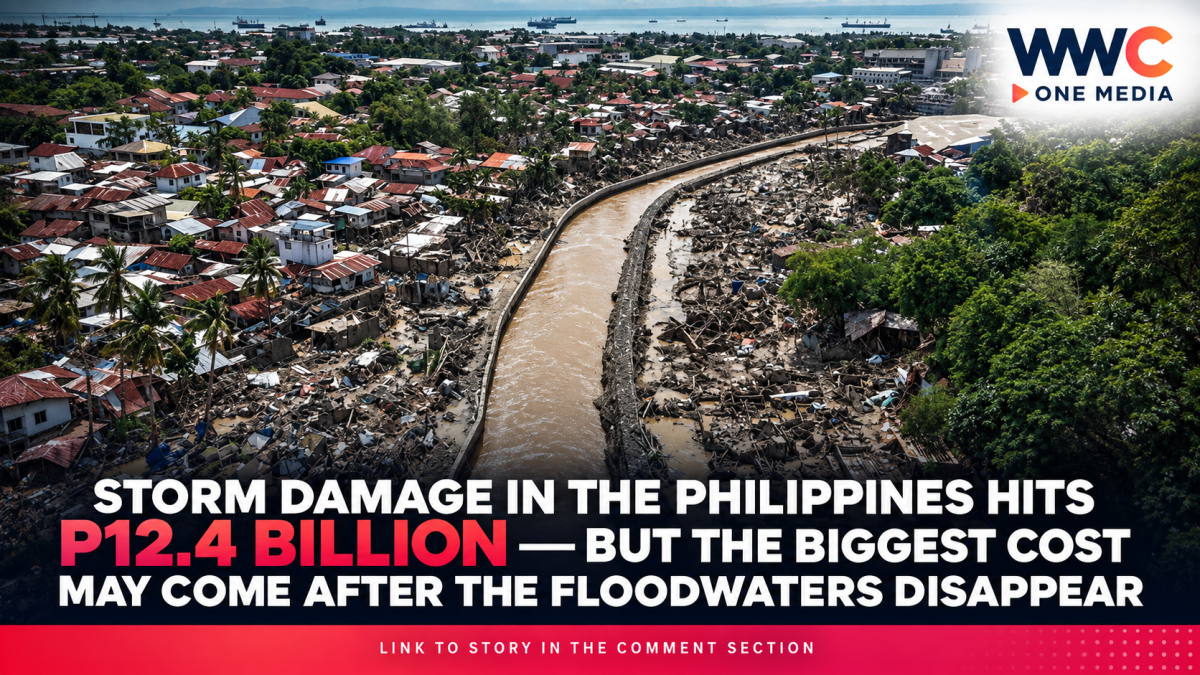
MANILA, Philippines — The economic toll from weeks of relentless rains and successive tropical cyclones has climbed to roughly P12.4 billion, with roads, bridges, flood-control facilities, farms and thousands of homes damaged across large parts of the Philippines.
The latest National Disaster Risk Reduction and Management Council assessment puts infrastructure damage at about P8.30 billion and agricultural losses at roughly P4.12 billion, following the combined effects of the enhanced southwest monsoon, or habagat, and tropical cyclones Luis, Maymay, Neneng and Pilandok.
But the peso figure tells only part of the story.
More than 9.6 million people, representing over 2.78 million families, have been affected across 10 regions, while tens of thousands remain displaced as communities deal with flooding, damaged homes and disrupted livelihoods.
P8.3 billion infrastructure bill spreads across six regions
Infrastructure accounts for the biggest share of the NDRRMC’s current damage estimate.
The council placed infrastructure losses at approximately P8.30 billion, involving 1,383 damaged facilities. These include roads, bridges, flood-control structures, schools, health facilities and other government infrastructure.
Damage was reported across the Ilocos Region, Cordillera Administrative Region, Central Luzon, Calabarzon, Mimaropa and Western Visayas.
The scale of the damage illustrates why the recovery bill could remain substantial even after floodwaters recede. Reopening roads is only the first step; damaged bridges, public buildings, drainage systems and flood-control structures can require months of engineering work and billions of pesos in rehabilitation funding.
Schools have been hit particularly hard.
Separate Department of Education figures reported earlier showed 11,167 classrooms across 2,243 schools damaged by the habagat and recent cyclones. DepEd estimated that about P7.783 billion would be needed for cleanup, repairs and reconstruction.
That DepEd estimate should not be added directly to the NDRRMC’s P8.3-billion infrastructure tally because the datasets may overlap.
Nearly 100,000 farmers and fisherfolk face losses
Agriculture has suffered another major setback.
The NDRRMC’s Sept. 9 situation report placed agricultural damage at approximately P4.12 billion, affecting roughly 80,274 hectares and more than 92,900 farmers and fisherfolk.
A separate and more detailed final assessment from the Department of Agriculture put agricultural and fisheries damage slightly higher at P4.38 billion, affecting 99,663 farmers and fisherfolk, 81,511 hectares and approximately 102,791 metric tons of production.
Rice took the biggest hit in the DA assessment.
Rice losses were valued at around P2.05 billion, accounting for nearly 47 percent of the total agricultural damage. High-value crops followed at roughly P1.38 billion, while fisheries sustained approximately P647.79 million in losses. Corn, cassava, livestock, poultry and agricultural equipment were also affected.
The impact could eventually reach consumers as well.
The Department of Agriculture has warned that vegetable prices could rise by around 15 to 20 percent, particularly for some lowland vegetables, following damage in major production areas such as Central Luzon and Southern Tagalog.
That creates a second layer of economic pressure: storms do not only destroy crops already in the field—they can also tighten supplies and push food prices higher weeks after the weather itself has improved.
More than 9.6 million people affected
NDRRMC figures show 9,614,020 people or 2,781,245 families have been affected across 39 provinces, 468 cities and municipalities, and 6,551 barangays.
At the time of the report, more than 162,000 people were staying in 820 evacuation centers. Authorities had also recorded 1,830 flooded areas and dozens of other incidents involving landslides, damaged structures and destructive winds.
Housing losses have also mounted.
A total of 4,361 houses were reported damaged, including 3,758 partially damaged homes and 603 destroyed homes.
Death toll requires an important distinction
The NDRRMC listed 44 reported deaths, along with 18 injured people and five missing.
However, it is important not to describe all 44 fatalities as definitively caused by the storms.
As of the Sept. 9 report, only 12 deaths had been confirmed as related to the severe weather, while 32 were still undergoing validation. Twelve of the 18 reported injuries had also been confirmed, with six still being validated.
That distinction matters in accurate disaster reporting, particularly while local and national authorities continue verifying reports from affected areas.
Government relief bill is also rising
The government has continued deploying food, emergency supplies and financial assistance as the disaster response shifts gradually toward recovery.
The Department of Social Welfare and Development said by Sept. 7 it had provided more than P2.1 billion in assistance to communities affected by the four tropical cyclones and the enhanced habagat.
DSWD also said it had distributed more than 3 million family food packs, while maintaining a nationwide stockpile of over 3.2 million food packs for further emergency response.
Meanwhile, the Philippine Crop Insurance Corp. set aside around P187 million in insurance payments for nearly 25,000 insured farmers affected by flooding and other weather-related losses.
From P6.6 billion to P12.4 billion in just over two weeks
The rapid increase in reported damage shows how prolonged weather events can compound losses.
On Aug. 23, NDRRMC estimated combined agriculture and infrastructure damage at about P6.61 billion. By Sept. 3, it had climbed to nearly P10.8 billion. On Sept. 7, the figure reached around P11.7 billion, before rising to the current P12.4-billion estimate.
Those numbers may still change as damaged areas are inspected and local reports are validated.
What is already clear is that the Philippines is confronting more than a short-term disaster response problem.
Farmers need to replant. Families need homes repaired. Schools need classrooms rebuilt. Roads and bridges must be restored. Flood-control structures damaged during the same weather events they were meant to withstand will require close scrutiny and rehabilitation.
And as the government calculates the billions needed for reconstruction, the larger question is no longer simply how much the storms destroyed.
It is whether the next round of extreme weather will arrive before the country has finished rebuilding from this one.




Leave a Reply