
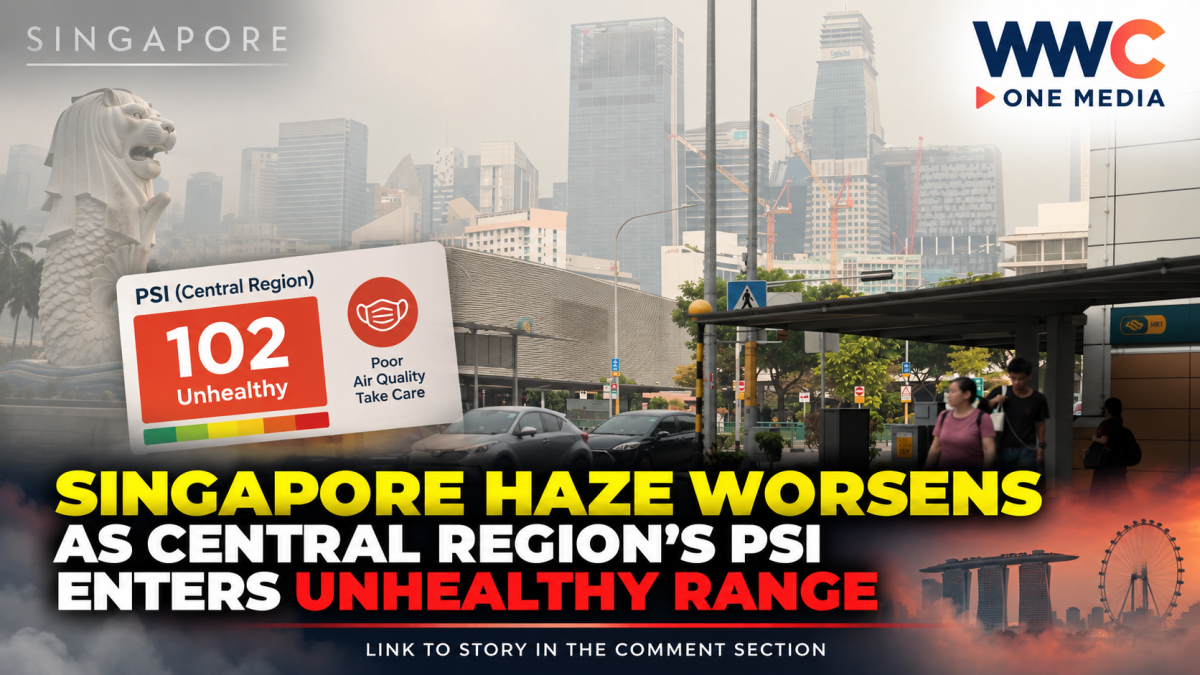
SINGAPORE — Air quality in Singapore’s central region entered the unhealthy range as haze blanketed parts of the city-state, prompting health advisories and renewed concerns over transboundary smoke from Indonesia.
The 24-hour Pollutant Standards Index (PSI) in Singapore’s central region reached 103, crossing into the unhealthy range of 101 to 200. It marked the first time since October 2023 that haze pushed Singapore’s PSI into the unhealthy category.
Other parts of Singapore remained in the moderate range at the time, but authorities warned that conditions could change as smoke haze continued to drift across the region.
Central Singapore Records Unhealthy Air Quality
According to data from Singapore’s National Environment Agency (NEA), the central region recorded the highest 24-hour PSI reading at 103.
The western and eastern regions followed with readings of 88 and 87, while the northern and southern regions recorded readings of 77 and 75 respectively.
The haze also affected shorter-term air quality readings. One-hour PM2.5 levels in the central and eastern regions entered the elevated range, signalling increased concentrations of fine particulate matter in the air.
Smoke From Indonesia Raises Fresh Concerns
Singapore’s haze situation has been linked to ongoing hotspot and wildfire activity in Indonesia, particularly in southern and central Sumatra and parts of Kalimantan.
Meteorological authorities have observed moderate to dense smoke plumes drifting toward Singapore under prevailing south-easterly and southerly winds.
NEA has warned that Singapore could continue to experience transboundary haze if the fires remain active.
The wider regional crisis has also affected other Southeast Asian countries, with reports of severe haze and worsening air quality linked to extensive Indonesian wildfires.
Government Starts Daily Haze Advisories
Following the unhealthy PSI reading, Singapore authorities began providing daily haze advisories to help residents plan outdoor activities.
The advisories include forecasts for the 24-hour PSI and guidance on how different groups should respond to changing air quality conditions.
Government agencies also activated measures to reduce the impact of haze, with plans in place to provide additional support should air quality deteriorate further.
What Does an Unhealthy PSI Mean?
A 24-hour PSI reading between 101 and 200 is classified as unhealthy.
For healthy individuals, authorities advise reducing prolonged or strenuous outdoor physical exertion when PSI enters the unhealthy range.
Children, elderly people and pregnant women are advised to minimise prolonged or strenuous outdoor activities.
People with chronic lung or heart conditions should take extra precautions and avoid prolonged or strenuous physical exertion when air quality worsens.
For immediate outdoor activities, NEA advises residents to check the one-hour PM2.5 readings, while those planning activities for the following day should refer to the 24-hour PSI forecast and health advisory.
Air Quality Has Been Fluctuating
Singapore’s haze conditions have fluctuated significantly in recent days.
After the central region entered the unhealthy range on September 4, air quality later improved and returned to the moderate range.
However, the haze threat did not disappear.
By September 9, the central region’s 24-hour PSI had climbed to 98, edging close once again to the unhealthy threshold, while one-hour PM2.5 readings in the central and eastern regions were elevated. NEA forecast that Singapore’s PSI could remain in the high moderate to low unhealthy range.
The situation shows how quickly haze conditions can change depending on wind direction, weather conditions and the intensity of fires in the region.
The Bottom Line
Singapore’s central region recorded a 24-hour PSI reading of 103, pushing air quality into the unhealthy range as transboundary haze affected the city-state.
The development marked Singapore’s first unhealthy PSI reading caused by haze since October 2023.
Although air quality later improved, the threat remains. Smoke from ongoing fires in Sumatra and Kalimantan continues to pose a risk, and authorities have warned that Singapore could experience further haze episodes if the fires persist.
For residents, the message is clear: keep an eye on PSI and PM2.5 readings, adjust outdoor activities when necessary, and take extra precautions if you or your family members are vulnerable to poor air quality.
WWC ONE MEDIA J.M.D




Leave a Reply