
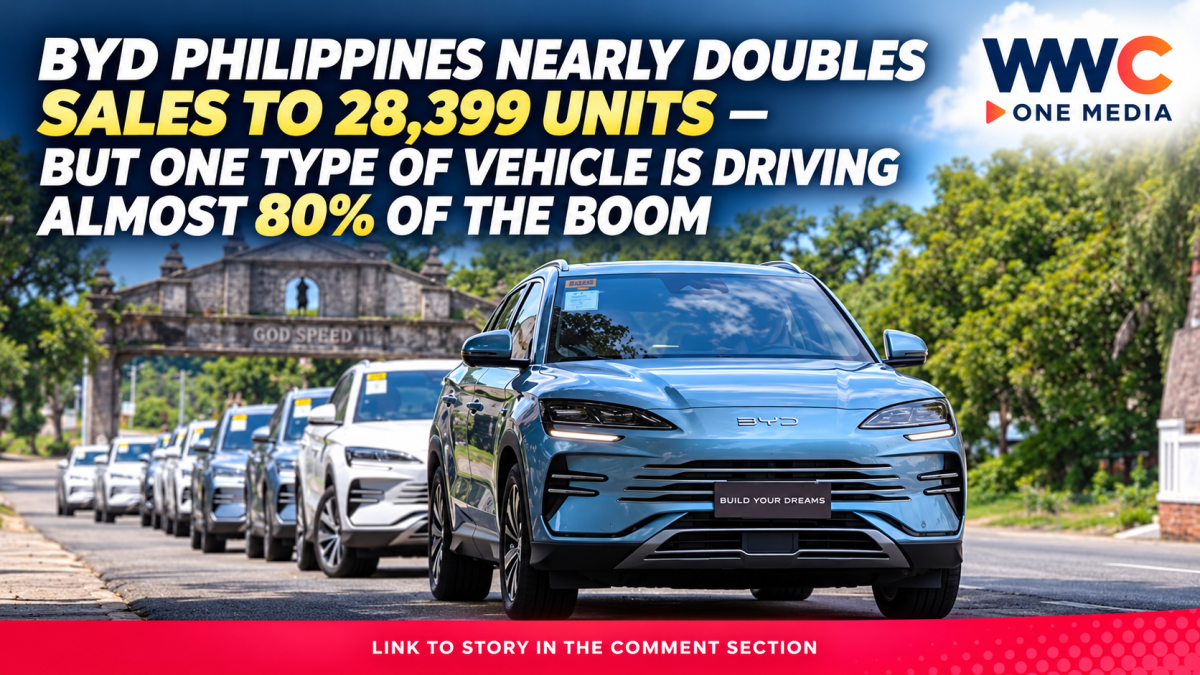
MANILA, Philippines — BYD Cars Philippines has nearly doubled its vehicle sales in the first eight months of 2026, underscoring how quickly electrified vehicles—particularly plug-in hybrids—are gaining ground in the Philippine automotive market.
The Chinese new-energy vehicle maker sold 28,399 vehicles from January through August 2026, up 99% from the same period a year earlier, according to figures released by BYD Cars Philippines and reported by several local news organizations.
That means BYD has already surpassed the 26,122 vehicles it sold during the entire 12 months of 2025, accomplishing the feat with four months still remaining in the year.
BYD sold another 4,682 units in August alone, keeping the brand close to the pace established during its record-breaking April, when it delivered 5,730 vehicles. April sales were 258% higher than in the same month in 2025.
But behind the headline numbers is an important detail: the Philippine market’s appetite for BYD is being driven overwhelmingly by vehicles that can still run on gasoline.
Plug-in hybrids power BYD’s Philippine surge
Of BYD’s 28,399 vehicles sold from January to August, 22,555 were DM-i plug-in hybrid models.
That represents approximately 79% of the company’s Philippine sales during the period.
DM-i sales were up 95% from 11,542 vehicles a year earlier, showing that many Filipino buyers appear to be gravitating toward vehicles that provide electric driving capability without requiring them to depend exclusively on charging infrastructure.
Leading BYD’s lineup is the Sealion 6 DM-i, which recorded 7,759 sales through August. The crossover alone represented about 27% of all BYD vehicles sold in the Philippines during the eight-month period.
Another plug-in hybrid, the BYD eMAX 9 DM-i, contributed 2,512 units.
The numbers offer a clearer picture of how electrification may be unfolding in the Philippines.
Instead of Filipino motorists moving directly from gasoline-powered cars to fully battery-electric vehicles, plug-in hybrids are emerging as an important bridge—offering electric-assisted driving while retaining an internal-combustion engine for longer trips or areas where public charging remains limited.
Pure electric BYDs are growing even faster
Battery-electric vehicles remain the smaller part of BYD’s Philippine business, but that category is expanding rapidly.
BYD sold 5,844 fully electric vehicles from January through August, a 115% increase from 2,720 units during the same period in 2025.
The BYD eMAX 7 was the company’s bestselling fully electric vehicle, reaching 1,975 units, or roughly 34% of BYD’s Philippine BEV sales during the period.
Combined, BYD’s 22,555 plug-in hybrids and 5,844 battery-electric vehicles account for the company’s entire reported 28,399-unit total.
The mix suggests that while demand for pure EVs is accelerating, Filipino buyers are currently purchasing plug-in hybrids at nearly four times the volume of BYD’s fully electric models.
BYD challenges the traditional Philippine auto hierarchy
BYD’s rapid growth has also pushed the company toward the top of the country’s overall automotive sales rankings.
Zigwheels Philippines reported that BYD remains in a strong position for third place among Philippine automotive brands, behind Toyota and Mitsubishi. The publication cautioned, however, that comparisons with some rival brands were based on the latest available CAMPI-TMA figures, which covered January through July at the time of comparison.
That distinction matters because BYD is not a member of the Chamber of Automotive Manufacturers of the Philippines, meaning industry rankings can involve figures reported through different automotive organizations and reporting periods. Philstar earlier noted BYD’s position among the country’s leading electrified-vehicle brands.
Still, selling more than 28,000 vehicles in eight months places BYD firmly among the fastest-growing major automotive brands in the country.
Its rise is especially striking against a Philippine vehicle market that has experienced softer overall sales in parts of 2026 even as electrified-vehicle demand has expanded sharply.
CAMPI-TMA data showed sales of electrified vehicles reaching 38,286 units from January through July, up about 136% year on year. Battery EV and plug-in hybrid sales were among the fastest-growing categories.
Bigger dealership network supports growth
BYD is also rapidly building the physical network needed to support those sales.
The company now has 81 dealerships nationwide, expanding access not just to vehicles but to maintenance, warranty and after-sales services—areas that can strongly influence consumer confidence in relatively new automotive technologies.
BYD Cars Philippines Managing Director Bob Palanca said the company’s performance indicates electrified vehicles are becoming increasingly mainstream among Filipino motorists.
The company’s Philippine expansion forms part of a much broader international push by BYD.
Globally, BYD recorded 440,293 new-energy vehicle sales in August 2026, while Chinese automakers have increasingly looked overseas for growth amid weaker domestic demand in China. Reuters reported this week that Chinese passenger-vehicle exports surged in August, with companies including BYD posting strong export performances.
The next milestone may come quickly
BYD now needs to sell just 1,601 additional vehicles to cross the 30,000-unit mark in the Philippines for 2026.
Given that it sold 4,682 vehicles in August alone, passing that threshold could come quickly if demand remains close to recent levels.
But the more consequential question is no longer simply whether BYD can break another company sales record.
Its eight-month performance suggests the competitive structure of the Philippine automobile market itself may be changing.
For decades, Japanese automakers have dominated local roads and sales rankings. Now a Chinese manufacturer selling nothing but electrified vehicles has already exceeded its previous full-year record before the final quarter has even begun.
And with nearly four out of every five BYDs being sold locally powered by plug-in hybrid technology, the Philippine transition toward electric mobility may be happening in a very different way than many expected.




Leave a Reply