
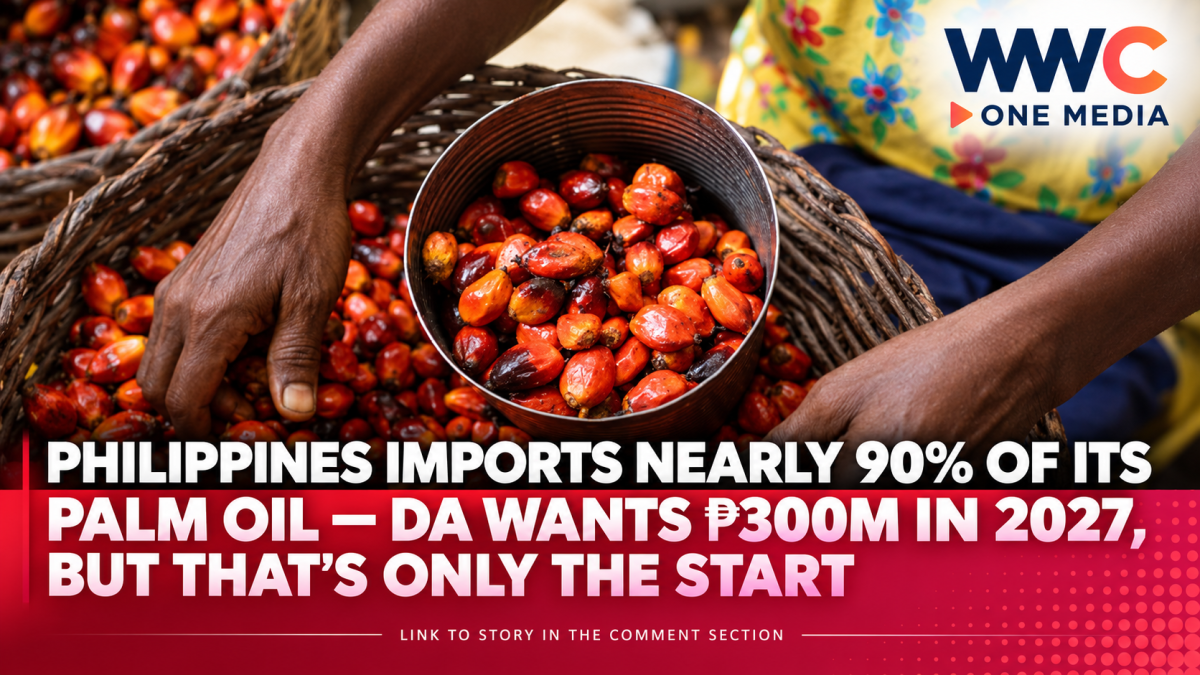
The Philippines wants to dramatically expand its homegrown palm oil industry, and the Department of Agriculture is asking Congress for at least ₱300 million in 2027 to begin closing a supply gap that has left the country heavily dependent on imports.
Agriculture Secretary Francisco Tiu Laurel Jr. said the Philippines currently imports nearly 90 percent of its palm oil requirements, making the industry a prime target for import substitution and new agricultural investment.
The latest proposal, however, may only represent the opening phase of a much larger government push.
Tiu Laurel said the DA could seek funding of as much as ₱1 billion annually for five years if Congress approves legislation designed to accelerate development of the domestic palm oil industry. That would potentially translate into a multibillion-peso government commitment aimed at plantations, productivity, planting materials and industry infrastructure.
Why the Philippines is betting bigger on palm oil
Palm oil is widely used in cooking, processed food, cosmetics, soaps and other industrial products. The government also sees the crop as a possible future feedstock for alternative fuels, although any such use would depend on energy policy, economics and sustainability requirements.
The scale of the Philippines’ dependence on foreign supply is evident in projections from the USDA Foreign Agricultural Service in Manila.
For marketing year 2026-2027, USDA analysts forecast Philippine palm oil production at only about 125,000 metric tons, while imports are projected to reach roughly 1.465 million metric tons. The same forecast places planted area at about 70,000 hectares.
Indonesia and Malaysia dominate Philippine supply. Trade figures cited by USDA show the two countries accounted for virtually all Philippine palm oil imports in 2025, with Indonesia supplying about 708,747 metric tons and Malaysia about 697,480 metric tons.
That dependence is precisely what the DA hopes to reduce.
A 300,000-hectare ambition
The Agriculture Department said the government has identified a roadmap that could eventually develop as much as 300,000 hectares of oil palm plantations.
Tiu Laurel acknowledged that the target will take time. For now, he said reaching 100,000 hectares by 2028 would already represent a major achievement.
Most existing Philippine oil palm production is concentrated in Mindanao. USDA data identify Soccsksargen and Caraga as the biggest production areas, alongside plantations in the Zamboanga Peninsula, BARMM, Northern Mindanao and Davao. Smaller areas are also found in Mimaropa and Central Visayas.
The DA has also been supporting the development of local planting materials and nurseries. Earlier this year, the department said the Philippine Coconut Authority was working on nurseries in Caraga while a government-backed nursery at the University of Southern Mindanao in Kabacan, North Cotabato, would use disease-free planting materials sourced from Malaysia.
Why did the budget figure change?
The latest ₱300-million request deserves some context because the amount being discussed by officials has changed during 2026.
In February, the DA said it was eyeing as much as ₱1.2 billion for palm oil development in 2027, after a proposed ₱1-billion allocation for 2026 was reduced to about ₱79 million.
During a House briefing on September 1, GMA News reported Tiu Laurel asking for a special provision providing an additional ₱500 million for palm oil next year.
The department’s September 9 official statement subsequently described its request as “at least ₱300 million” in 2027 budgetary support.
That means the figures should not necessarily be treated as contradictory final appropriations. Rather, they reflect an evolving funding proposal as the DA and Congress work on the 2027 national budget. No final allocation has yet been guaranteed simply because an amount has been requested.
Palm oil expansion also brings a warning
The economic case for greater local production is significant, but expansion has also attracted concerns over land use, biodiversity and its possible impact on the Philippines’ established coconut industry.
BusinessWorld reported earlier this year that former Agriculture Secretary William Dar supported agricultural development but cautioned that new plantations should not encroach on forested areas.
Other agriculture-sector representatives have argued that the government should be careful not to divert attention and resources from coconut farmers, while critics of large monoculture plantations have raised concerns about biodiversity, land rights and working conditions.
Those issues could become increasingly important if the government moves from tens of thousands of hectares of oil palm today toward its far more ambitious long-term plantation target.
Congress could determine how big the industry becomes
Tiu Laurel said the DA supports having proposed palm oil legislation certified as urgent and intends to make that recommendation to President Ferdinand Marcos Jr. The Agriculture Department is also proposing a more specialized structure inside the Philippine Coconut Authority, including officials and teams specifically focused on palm oil development.
Separately, House Bill No. 7462, filed in January 2026, proposes creating a Philippine Palm Oil Development Authority tasked with promoting and developing the industry. House records currently list the measure as pending before the Committee on Agriculture and Food.
For the Philippines, the bigger question is therefore no longer simply whether palm oil production should expand.
It is how fast the country can build a competitive domestic industry without creating new environmental, land-use and agricultural problems—and whether Congress is prepared to provide the billions of pesos that a full-scale expansion could eventually require




Leave a Reply