
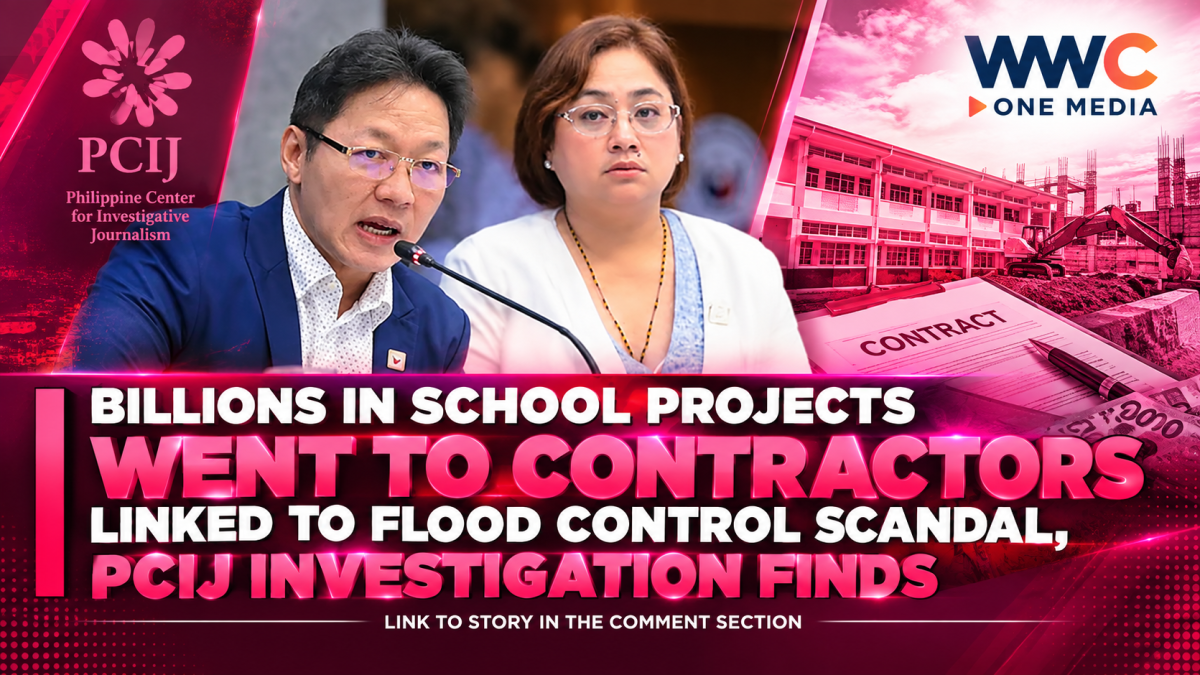
MANILA, Philippines — Billions of pesos meant to build classrooms, laboratories and other school facilities were awarded to contractors now linked to the Philippines’ massive flood-control scandal, raising fresh questions about whether the same weaknesses that plagued public works projects also affected the government’s education infrastructure program.
An investigation by the Philippine Center for Investigative Journalism (PCIJ) found that companies associated with contractors implicated in flood-control controversies secured a significant share of Department of Public Works and Highways (DPWH) school infrastructure contracts over the past decade.
Among the biggest recipients were firms linked to construction tycoons Pacifico “Curlee” Discaya II and Sarah Discaya, which collectively received about P13.4 billion worth of school building and facility contracts, according to PCIJ’s analysis of DPWH records.
The findings come at a critical time for Philippine education.
The government is pouring tens of billions more pesos into classrooms as schools across the country continue to struggle with overcrowding, unfinished buildings and a massive infrastructure backlog.
But the latest investigation raises an uncomfortable question:
If corruption and poor planning allegedly infected flood-control projects, did the same system also put the country’s classrooms at risk?
P13.4 Billion in School Contracts
PCIJ analyzed more than 30,000 school infrastructure contracts awarded through the DPWH over roughly a decade.
Its investigation found that companies linked to the Discaya family secured approximately P13.4 billion in school building and facility projects, making them the largest recipients among contractors identified in the analysis.
Two Discaya-linked firms were particularly prominent during the Duterte administration:
- Alpha & Omega — about P5.6 billion
- St. Timothy — about P4.2 billion
The investigation found that the same broader contractor network later became associated with allegations and cases involving irregular flood-control projects.
However, it is important to distinguish between the allegations involving flood-control projects and the separate school infrastructure contracts.
A contractor’s involvement in an investigation or case does not automatically prove that every school project it handled was anomalous.
That distinction is crucial as authorities, journalists and the public examine the contracts.
Nine Discaya-Linked Firms Lose Licenses
The scrutiny surrounding the Discaya network has intensified following allegations involving flood-control projects.
PCIJ reported that nine Discaya-linked companies had their licenses revoked by the Philippine Contractors Accreditation Board amid multiple graft and malversation cases connected to alleged irregularities in flood-control projects.
The broader flood-control scandal has already triggered major investigations and criminal cases involving government officials, contractors and politically connected figures.
Recent national reporting has described the scandal as involving thousands of flood-control projects worth hundreds of billions of pesos, with authorities examining allegations involving substandard, overpriced or nonexistent projects.
Now, PCIJ’s school infrastructure investigation is drawing attention to another potentially troubling overlap:
Some of the same names that benefited from public works contracts also secured billions intended for the country’s schools.
Students Still Waiting as Buildings Sit Unfinished
The investigation begins with a powerful example of what can happen when infrastructure projects become trapped in planning and bureaucratic failures.
At Mabuhay City Elementary School in Dasmariñas, Cavite, around 1,500 students have been forced to share limited classroom space.
The school operates in shifts, with students squeezed into overcrowded classrooms.
Just steps away, however, stands another school building that has reportedly remained unfinished and unused for nearly two years.
The approximately P32-million project was funded through the government’s Basic Education Facilities Fund and contracted to L.A. Clamor Construction, according to PCIJ.
The project reportedly encountered structural adjustments because of the site’s location near a waterway.
But an error involving a request for additional funding reportedly placed the project in bureaucratic limbo.
The result is a painful contradiction:
Students need classrooms now, but a taxpayer-funded building remains unfinished nearby.
1,000 Classrooms Reportedly Unusable
The Mabuhay school is far from an isolated case.
PCIJ reported that Education Secretary Sonny Angara said in 2025 that around 1,000 classrooms built through DPWH projects were unusable.
At the same time, the country still faced a shortage of approximately 166,000 classrooms, according to the investigation.
The situation has created enormous pressure on the government to accelerate construction.
In Central Visayas, the challenge has also been severe.
SunStar Cebu reported in June that no new classroom projects had yet broken ground in Central Visayas six months into 2026, despite urgent needs in schools affected by the 2025 earthquake and Typhoon Tino.
That means the national debate over school infrastructure is not just about contracts and corruption.
It is about students studying in overcrowded, damaged or temporary learning spaces.
P80 Billion for School Infrastructure — But Can the System Deliver?
The government has significantly increased funding for education infrastructure.
PCIJ reported that following the wider flood-control controversy, a substantial portion of funding was redirected toward education, with about P80 billion allocated for school infrastructure in 2026.
That makes 2026 one of the most important years for the country’s school construction program.
But the huge budget has also intensified concerns.
More money alone does not guarantee more classrooms.
The system still faces problems involving:
- Poor project planning
- Procurement delays
- Failed bidding
- Design revisions
- Site ownership disputes
- Contract cancellations
- Limited construction space
- Delayed project identification
According to PCIJ, these weaknesses have contributed to years of delays in delivering urgently needed school facilities.
Same Problems Seen in Flood Control Projects?
PCIJ’s investigation found similarities between the problems surrounding school infrastructure and those that have drawn attention to flood-control projects.
These include allegations and concerns involving:
Politically Connected Contractors
The investigation found that contractors with political connections or controversial track records were among those receiving substantial government contracts.
Uneven Distribution of Projects
Funding decisions raised questions about whether projects were always distributed according to the most urgent educational needs.
Delayed Planning
Schools and project locations were sometimes finalized too late in the budget cycle, leaving little time for construction.
Procurement Problems
Failed bids, contract cancellations and other administrative problems delayed projects.
Performance Concerns
PCIJ also examined contractor performance records and cases involving poor or unsatisfactory project ratings.
The findings suggest a deeper structural problem:
The Philippines may not simply have a shortage of money for classrooms. It may also have a system struggling to turn public money into finished, usable schools.
P934 Million in Special Funding Under Scrutiny
PCIJ also examined school infrastructure contracts supported by unprogrammed funds.
The investigation found that the DPWH awarded approximately P934 million in school infrastructure contracts funded through this source from 2023 to 2024.
Nearly half of that amount — about P412 million — reportedly went to six projects in Lipa City, Batangas.
The concentration of projects drew attention because Lipa is associated with Executive Secretary Ralph Recto’s political base.
PCIJ sought comment from Recto regarding the findings, according to its report.
The investigation does not establish that the contracts were illegal solely because of their location.
But the concentration raises questions about how projects are selected and whether infrastructure money is consistently directed toward areas with the greatest need.
How School Projects Are Awarded
The system itself involves several government agencies.
Most school infrastructure funds are allocated through the Department of Education (DepEd).
But the DPWH has historically played a major role in procurement and implementation.
That arrangement has created coordination challenges.
According to PCIJ, project recipients may only be finalized and validated after agreements are completed between DepEd and DPWH.
By that time, much of the year may have already passed.
Contracts can then be delayed until late in the year.
ACT Teachers Rep. Antonio Tinio argued that classroom requirements should already be validated when the National Expenditure Program is prepared so construction can begin much earlier.
The criticism highlights one of the biggest problems:
A classroom shortage cannot be solved efficiently if the government spends most of the year deciding where to build.
The Contractor “Report Card” Problem
Government contractors are evaluated through the Contractor’s Performance Evaluation System, or CPES.
PCIJ noted that poor or unsatisfactory performance ratings resulting from negligence can potentially affect a contractor’s eligibility for future government projects under blacklisting guidelines.
Blacklisted firms can face temporary disqualification.
In serious cases, contractors can face longer or permanent restrictions.
But the investigation suggests that performance records alone may not always tell the full story.
A contractor can receive generally favorable ratings while still facing separate allegations, complaints or cases involving other projects.
That creates another difficult challenge for the government:
How do you identify potentially problematic contractors before billions more pesos are awarded?
The Flood-Control Scandal Changes Everything
The wider flood-control controversy has changed how the public looks at government infrastructure spending.
Authorities are now examining allegations involving projects that were reportedly:
- Overpriced
- Substandard
- Poorly implemented
- Or allegedly never completed
Recent criminal investigations have also extended to Cebu.
The Department of Justice is conducting a preliminary investigation involving 20 individuals in connection with two allegedly anomalous flood-control projects in Balamban, Cebu. Authorities have stressed that the respondents have the right to submit counter-affidavits and evidence and that no final findings have been made at the preliminary investigation stage.
The overlap between contractors, public works systems and infrastructure budgets has therefore become a major national concern.
And PCIJ’s latest findings suggest the public should look beyond flood control.
Classrooms, laboratories and school facilities also deserve scrutiny.
P400 Billion Needed to Fix the Classroom Backlog
The scale of the problem remains enormous.
PCIJ reported that approximately P400 billion may be needed to address the country’s school infrastructure backlog.
That raises a critical question for taxpayers:
If the government is preparing to spend hundreds of billions more, how can it ensure the money produces actual classrooms?
Experts and education advocates are likely to focus on several areas:
Better Planning
Project sites and requirements should be identified before funds are released.
Stronger Contractor Screening
Past performance, project history and legal records should be carefully examined.
Faster Procurement
Construction should begin earlier in the fiscal year.
Greater Transparency
The public should be able to track project costs, contractors and completion status.
Independent Inspections
Buildings should be checked before being accepted and turned over to schools.
Accountability
Officials and contractors found responsible for proven violations should face appropriate sanctions under the law.
The Real Victims Are the Students
Behind the billions of pesos, contractor names and government investigations are millions of students.
Students studying in overcrowded classrooms.
Students attending schools in shifts.
Students using temporary learning spaces.
Teachers trying to educate children without enough rooms, laboratories or facilities.
That is what makes the issue so urgent.
Every delayed or unfinished school project has consequences beyond government paperwork.
It affects a child’s daily education.
A Warning as Education Spending Grows
The government’s decision to increase school infrastructure spending could help address one of the country’s biggest education problems.
But the PCIJ investigation serves as a warning.
If the underlying system is not fixed, a larger budget could simply mean larger opportunities for waste, delays and abuse.
The lesson from the flood-control scandal may be simple:
Infrastructure is not just about allocating money.
It is about ensuring the project is necessary.
Ensuring the contractor is qualified.
Ensuring the work is completed.
And ensuring the public actually gets what it paid for.
The Bottom Line
A major investigation by the Philippine Center for Investigative Journalism has found that contractors linked to the country’s flood-control scandal received billions of pesos in school infrastructure contracts over the past decade.
Companies linked to Curlee and Sarah Discaya alone secured approximately P13.4 billion in school building and facility projects, according to PCIJ’s analysis of DPWH contract data.
The findings do not automatically prove that all of those school projects were fraudulent or defective.
But they raise serious questions about contractor selection, government oversight and whether warning signs were ignored while billions of pesos continued flowing into public infrastructure.
The stakes are now higher than ever.
With tens of billions of pesos being allocated to new classrooms — and an estimated P400 billion still needed to address the infrastructure backlog — the government faces a defining test.
Can it build the classrooms Filipino students desperately need?
Or will the same problems that haunted flood-control projects follow the money into education?
For millions of students still waiting for a proper classroom, the answer cannot come soon enough.
WWC ONE MEDIA J.M.D




Leave a Reply