
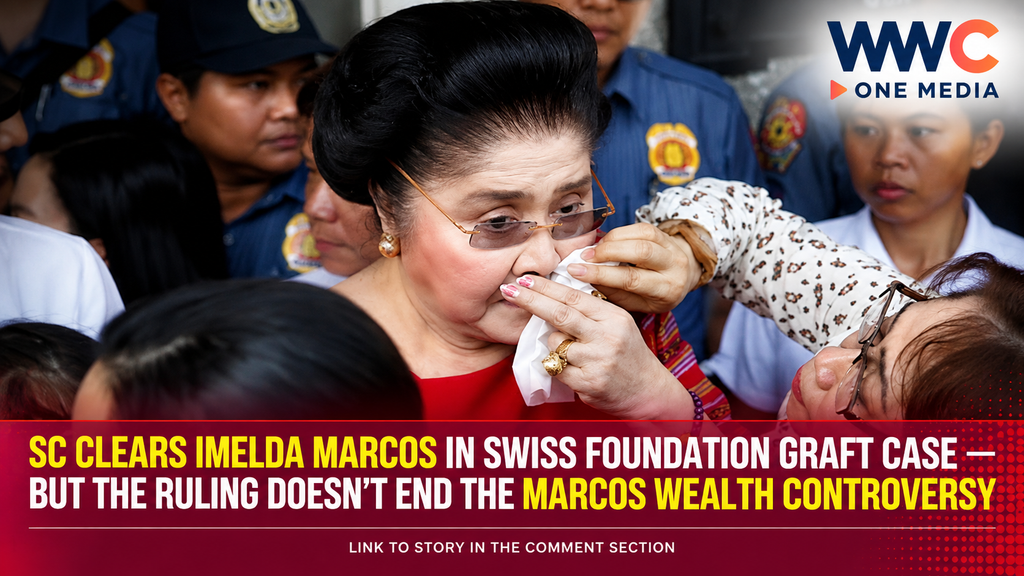
The Supreme Court First Division reversed the Sandiganbayan’s November 2018 decision, which had found Marcos guilty on seven counts of violating the country’s anti-graft law.
The seven entities involved were Maler Establishment, Trinidad Foundation, Rayby Foundation, Palmy Foundation, Vibur Foundation, Aguamina Foundation and Avertina Foundation.
The Sandiganbayan had previously concluded that the foundations were established primarily for the benefit of the Marcos family and were used for activities including opening bank accounts, transferring funds, earning interest and making investments.
But the Supreme Court reached a different conclusion after reviewing the evidence presented by the prosecution.
Why did the Supreme Court acquit her?
The decisive issue was evidence.
According to the Supreme Court ruling summarized by GMA News, the prosecution’s testimonial and documentary evidence was found to be inadmissible and lacking sufficient probative value.
The Court specifically found problems with the authentication of the Swiss documents.
“The relevant Swiss documents were not properly authenticated.”
The Court also noted that the prosecution failed to present a credible witness who could attest to the genuineness and due execution of the documents.
That evidentiary problem became critical because the case was criminal in nature. The prosecution had to establish Marcos’ guilt under the applicable anti-graft law to the required standard.
The other legal issue: were the foundations actually “businesses”?
The Supreme Court also addressed whether Marcos’ alleged financial or pecuniary interests in the foundations fell within Section 3(h) of Republic Act No. 3019, the Anti-Graft and Corrupt Practices Act, as well as the relevant provision of the 1973 Constitution.
The Court concluded that the prosecution failed to establish that the foundations were “businesses” in the ordinary meaning of the term.
Because of that uncertainty, the Court said doubts about whether the foundations fell within the law should be resolved in favor of the accused.
This is an important distinction: the Supreme Court’s ruling was based on the prosecution’s failure to prove the criminal case under the applicable legal and evidentiary requirements.
It should not automatically be interpreted as a blanket judicial declaration that every allegation involving Marcos family wealth was proven false.
Why the 2018 conviction was such a major case
The case dates back decades.
In 1991, Imelda Marcos was charged with 10 counts of graft involving alleged financial interests and participation in the management of organizations in Switzerland during her time as a government official.
Seven of those charges eventually resulted in the 2018 Sandiganbayan conviction.
At that time, prosecutors alleged that the seven Swiss foundations were connected to the Marcos family and that foreign currencies and other assets had been moved through the entities.
The anti-graft court’s 2018 findings described the foundations as being established primarily for the family’s private benefit.
The Sandiganbayan also acquitted Marcos on three other graft counts in 2018 involving alleged financial interests in local corporations.
So the Supreme Court’s latest ruling effectively overturns the seven-count Swiss-foundation graft conviction that had remained under appeal.
What happened to the alleged Swiss wealth?
This is where the story becomes more complicated.
The Supreme Court has previously issued separate rulings involving the Marcos family’s Swiss deposits and alleged ill-gotten wealth.
In a landmark 2003 decision involving a civil forfeiture case, the Supreme Court dealt with Swiss accounts totaling approximately $356 million at the time, held through groups of foreign foundations. The Court’s ruling addressed the government’s effort to recover those assets as ill-gotten wealth.
That case was separate from the criminal graft prosecution against Imelda Marcos.
This distinction is crucial for readers.
The latest Supreme Court acquittal does not mean that every previous Supreme Court ruling concerning Marcos family assets, Swiss deposits or ill-gotten wealth has suddenly been erased.
The cases involved different legal actions, evidence and questions.
Why the evidence issue matters
The latest decision highlights one of the most difficult aspects of decades-old corruption cases: proving historical transactions with admissible evidence many years after they allegedly occurred.
The 2018 prosecution relied heavily on documents connected to the Swiss foundations.
But the Supreme Court found that the relevant Swiss documents had not been properly authenticated and that the prosecution did not produce a credible witness capable of establishing their authenticity and execution.
This does not necessarily mean the allegations never existed.
Rather, it means the Court found that the prosecution did not establish the criminal case with evidence that could properly be considered and relied upon under the rules of evidence.
That distinction is particularly important when reporting the case because an acquittal is not the same thing as a factual declaration that every historical allegation was fabricated.
A legal reversal with major political significance
The decision comes at a politically sensitive moment for the Marcos family.
It also arrives as debates over the family’s historical wealth remain highly contentious.
In August, the August Twenty-One Movement criticized President Ferdinand Marcos Jr. over his comments concerning his family’s wealth and cited Imelda Marcos’ 2018 graft conviction. The group argued that the conviction remained part of the historical record at that time.
The latest Supreme Court ruling now changes the legal status of that particular conviction.
That makes the September 9 decision significant not only as a legal development but also as another chapter in the decades-long battle over the Marcos family’s wealth and accountability.
What this ruling does — and does not — mean
What it does:
- Overturns Imelda Marcos’ 2018 Sandiganbayan conviction on seven graft counts involving Swiss foundations.
- Finds the prosecution’s relevant Swiss documents improperly authenticated.
- Finds insufficient proof that the foundations qualified as “businesses” covered by the cited anti-graft provision.
- Results in her acquittal in this particular criminal case.
What it does not automatically mean:
- It does not erase every previous court ruling involving Marcos family assets.
- It does not automatically invalidate separate civil forfeiture proceedings.
- It does not establish that all allegations concerning Marcos family wealth were false.
- It should not be reported as a blanket Supreme Court declaration that the Marcos family’s entire wealth was legitimate.
The Philippine Supreme Court has previously made separate rulings concerning Swiss deposits and alleged ill-gotten wealth, including a 2003 decision involving approximately $356 million in Swiss accounts.
The bigger picture
For Imelda Marcos, the decision represents a major legal victory after decades of litigation.
For Philippine history, however, the ruling is unlikely to close the debate.
The latest case was ultimately decided on the sufficiency, admissibility and legal relevance of the prosecution’s evidence, rather than serving as a comprehensive judicial review of every allegation involving the Marcos family’s wealth.
And that is the key point readers need to understand:
Imelda Marcos has been acquitted in this specific Swiss-foundation graft case — but the decades-old legal and political story surrounding Marcos wealth is far from being reduced to a single Supreme Court ruling.
Leave a Reply