
SEO keywords: Citi Japan, Citi blockchain payments, cross-border payments Japan, instant payments Japan, Citi Token Services, blockchain banking, tokenized deposits, Japan fintech, corporate payments, digital finance
SEO meta description: Citi is expanding blockchain-powered payment infrastructure that could enable faster cross-border transactions for corporate clients, as Japan accelerates its move toward digital financial infrastructure.
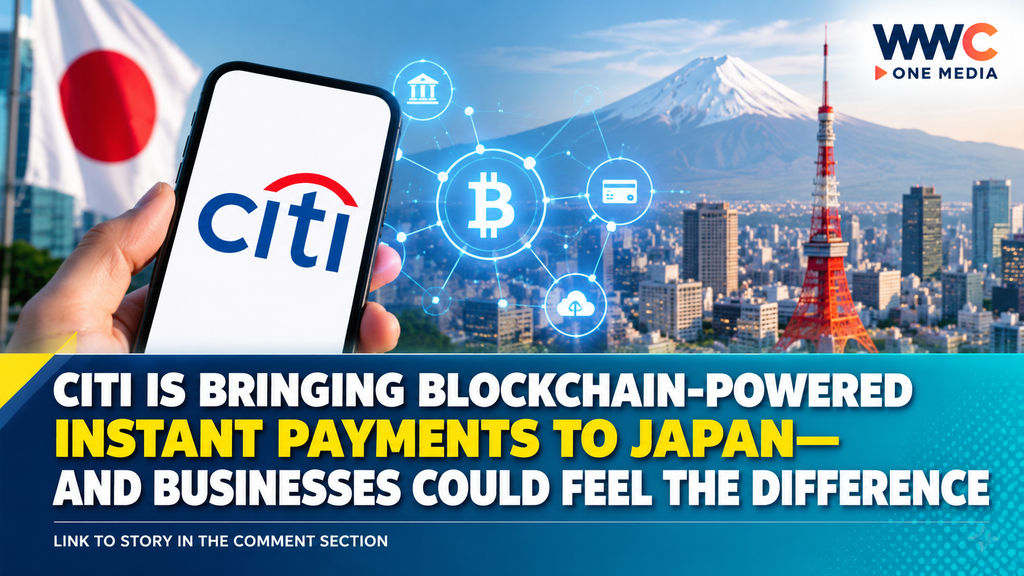
TOKYO — Cross-border payments are entering a new phase, and Citigroup is betting that blockchain technology can help Japanese companies move money internationally with far less waiting.
Citi has been expanding its Citi Token Services platform, which uses a private, permissioned blockchain and tokenized bank deposits to support near-real-time payments and liquidity transfers. The system is designed to operate around the clock, reducing the delays caused by traditional banking cut-off times, weekends and time-zone differences.
While Citi’s existing announcements do not establish that a Japan-specific rollout is already live, the bank’s global expansion of the technology puts Japanese corporations among the potential beneficiaries of a rapidly changing cross-border payments environment.
Why blockchain could change corporate payments
Traditional international payments can be slowed by banking hours, intermediary institutions and different settlement systems across countries.
Citi’s blockchain-based approach attempts to address those bottlenecks by digitizing deposits and moving them through a permissioned ledger.
Citi says its Token Services platform can support 24/7 near-instant cross-border payments and liquidity movements, while clients do not need to hold cryptocurrency or manage their own blockchain wallets.
That distinction is important.
This is not a cryptocurrency payment system in the conventional sense.
Instead, Citi uses blockchain infrastructure inside a regulated banking environment, with tokenized representations of deposits used to facilitate transfers.
Citi is already moving beyond the pilot stage
The technology is no longer merely a theoretical experiment.
In July 2026, Citi announced that Thailand’s Siam Commercial Bank had become the first financial-institution client globally to go live with an integrated 24/7 USD Clearing and Citi Token Services solution.
The system enables corporate and institutional clients to initiate and receive U.S.-dollar payments around the clock, with near-instant settlement. Citi said the infrastructure connects more than 300 financial institutions across over 50 markets.
That represents an important step toward Citi’s goal of creating an always-on global payments network.
A major September development strengthens the case
Citi has also taken another significant step in the blockchain-payments race.
On September 2, the bank announced that it had successfully processed live transactions on Swift’s blockchain-based ledger, working with First Abu Dhabi Bank and Singapore’s OCBC.
The transactions demonstrated how shared-ledger infrastructure could support always-on, cross-border payments without relying entirely on traditional banking cut-off times. Citi said additional transactions involving DBS and UOB were expected later in September.
The development is particularly significant because Swift’s network connects financial institutions around the world.
Rather than creating an isolated blockchain payment network, the industry is increasingly looking at ways to connect blockchain-based systems with existing financial infrastructure.
Japanese companies stand to benefit from the shift
Japan has a large population of globally active companies that regularly send and receive payments across borders.
For exporters, importers and multinational corporations, faster settlement could potentially improve cash-flow management and reduce the amount of money that needs to remain parked in accounts ahead of transactions.
Citi’s own description of Token Services emphasizes precisely those advantages: faster movement of liquidity, real-time payment visibility and reduced dependence on traditional cut-off times.
That could be particularly relevant for companies operating across Asian, U.S. and European time zones.
A payment that can be initiated on a weekend or outside normal banking hours does not necessarily have to wait until the next business day.
Japan is also exploring blockchain for financial markets
Citi’s move comes as Japan itself is examining blockchain-based infrastructure.
Reuters reported in August that Japanese authorities and financial institutions were preparing to study blockchain infrastructure for instantaneous settlement of stocks and Japanese government bonds.
The proposed study involves the Financial Services Agency, Ministry of Finance, Bank of Japan and private financial institutions, with a plan to develop a detailed implementation roadmap by early 2027. Potential deployment could come in the early 2030s.
The initiative shows that blockchain is increasingly being examined not simply as a cryptocurrency technology, but as potential infrastructure for mainstream financial markets.
Citi wants blockchain to connect—not replace—the banking system
One of the most significant aspects of Citi’s strategy is its emphasis on interoperability.
Citi’s digital-assets strategy includes connecting traditional fiat money with tokenized deposits, stablecoins and other blockchain-based assets.
The bank says its Citi Integrated Digital Assets Platform is designed to support the issuance, transfer and custody of tokenized assets, as well as foreign-exchange settlement and cross-border payments.
The strategy suggests Citi is not betting that blockchain will simply replace today’s banking system.
Instead, the bank is trying to make blockchain another layer of infrastructure that can work with existing financial networks.
The latest DBS-Citi transaction shows where this could lead
The momentum accelerated again in September.
DBS and Citi announced that they had completed a cross-border U.S.-dollar payment between Singapore and the United States over a weekend using tokenized deposits through the Swift Digital Ledger.
According to DBS, the transaction took minutes rather than the industry norm of up to two business days.
That demonstration offers a glimpse of what always-on corporate payments could eventually look like.
Instead of companies waiting for banks to reopen after a weekend or for transactions to pass through multiple time-zone windows, payment infrastructure could operate continuously.
But Japan’s rollout should not be overstated
There is an important distinction between Citi’s global blockchain-payment capabilities and a confirmed Japan-specific product launch.
Citi has clearly stated that it intends to expand its blockchain-based payment capabilities into additional markets. Its Token Services platform is already operating across multiple markets and currencies.
However, the available Citi announcements do not establish that Japanese companies already have universal access to an instant, blockchain-based cross-border payment corridor.
That means headlines suggesting that all Japanese companies can now instantly send money overseas through Citi would go beyond the evidence.
The more accurate takeaway is that Citi is building the infrastructure that could make such services increasingly practical for Japanese corporate clients.
The bigger race is underway
Citi isn’t alone in pursuing faster international payments.
Banks, central banks, payment networks and technology companies around the world are experimenting with tokenized deposits, shared ledgers and instant-payment links.
The objective is increasingly clear: make cross-border transactions operate more like domestic digital payments—fast, transparent and available around the clock.
Japan’s own exploration of blockchain settlement adds another layer to that transformation.
For Citi, meanwhile, blockchain is becoming part of a much broader digital-assets strategy.
The bottom line
Citi isn’t simply experimenting with blockchain anymore—it is putting the technology into live financial infrastructure.
Its Token Services platform, 24/7 USD Clearing and participation in Swift’s blockchain-ledger initiative point toward a financial system in which corporate money can move across borders at virtually any hour.
For Japanese companies, that could eventually mean faster international payments and more efficient treasury management.
But the next major question is no longer whether blockchain can move money.
It is whether banks, regulators and companies can connect these new systems into one truly global, always-on payment network.
WWC ONE MEDIA G.A




Leave a Reply