
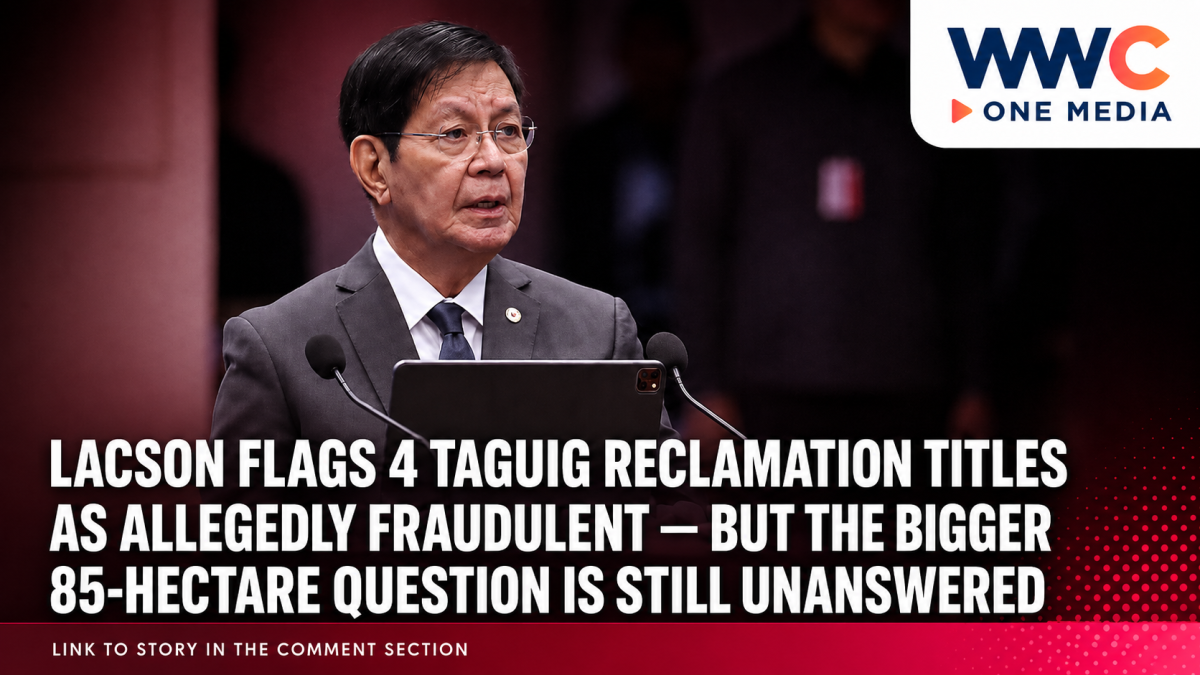
MANILA, Philippines — The controversy surrounding reclamation and flood-control projects along the Taguig side of Laguna Lake has taken another turn after Sen. Panfilo “Ping” Lacson disclosed that four parcels of reclaimed land covering nearly 38.83 hectares are tied to land titles he alleges were fraudulently issued.
The disclosure raises a potentially bigger question than the infrastructure projects themselves: How did portions of reclaimed lake area obtain land titles, and who ultimately has the legal right to own them?
Lacson said Saturday, August 29, that investigators had initially identified four parcels of allegedly illegally reclaimed land carrying questionable titles. At least four additional parcels, he said, did not have corresponding plotted titled lots in the Land Registration Authority’s digital records.
Four parcels, nearly 39 hectares
According to information released by Lacson, one parcel covers 9,204 square meters and is under an Original Certificate of Title linked to an administrative patent.
A second covers 5,000 square meters under an Original Certificate of Title processed through judicial or ordinary land registration.
The third—and considerably larger—parcel covers 181,077 square meters under a Transfer Certificate of Title that Lacson said originated from a homestead patent.
The fourth covers 193,027 square meters under another Transfer Certificate of Title.
Together, the four parcels cover 388,308 square meters, or approximately 38.83 hectares.
Lacson has not publicly identified the people whose names appear on the titles, nor has he released the OCT and TCT numbers. He said those details are being withheld while authorities continue examining the records.
The documents are expected to be submitted to the Office of the Ombudsman, which is already conducting a fact-finding investigation into alleged irregularities involving infrastructure and reclamation projects in Taguig.
Important distinction: fraud has not yet been legally established
While Lacson has described the titles as having been “fraudulently” issued, there is currently no final finding from the LRA, Office of the Ombudsman or a court declaring those titles fraudulent.
That distinction is important.
The ongoing investigation will have to establish how the titles were created, whether the land could legally have been titled in the first place, who participated in the process and whether any criminal or administrative violations occurred.
Lacson said he asked the LRA to reconstruct the history of the Original Certificates of Title and other titling methods in an effort to determine how the properties ended up registered.
The LRA examination follows information and records supplied by the Philippine Reclamation Authority.
The investigation goes beyond 38.83 hectares
The parcels covered by the newly disclosed titles represent only part of the broader reclamation controversy.
Earlier this month, Lacson said authorities were examining around 85 hectares of allegedly unauthorized reclaimed land along the Taguig side of Laguna Lake.
That larger figure refers to the broader reclamation area under scrutiny and should not be confused with the roughly 38.83 hectares represented by the four titles currently being highlighted.
The issue emerged from a wider investigation into allegedly anomalous flood-control and slope-protection projects in Taguig.
Lacson previously claimed that some projects presented as slope-protection or flood-mitigation works were actually being used to facilitate reclamation.
His team has separately raised allegations involving ghost projects, duplicate appropriations and the reuse of photographs from previously completed projects for billing purposes. Those allegations have also been referred to the Ombudsman for investigation.
Ombudsman seeks records from multiple agencies
The controversy has progressed beyond competing political statements.
Lacson said the Ombudsman has sought records from agencies including the DPWH, Land Registration Authority, Philippine Reclamation Authority and Taguig Registry of Deeds as part of its fact-finding investigation.
The PRA has also provided drone images relating to reclamation sites, according to reports.
That document trail could become crucial because investigators would need to determine not only whether reclamation occurred without proper authorization but also how titles covering reclaimed areas were processed and transferred.
Why the titles could become a major legal issue
Philippine reclamation rules give the controversy potentially serious consequences.
PRA regulations state that reclamation projects undertaken without the required government authorization may be considered illegal and subject to forfeiture in favor of the State.
The PRA’s rules also provide that titles covering illegally reclaimed land that are registered in the names of persons or entities other than the Republic may be challenged in court for reversion to the government.
That means the case may eventually become about far more than allegedly irregular infrastructure spending.
Depending on what government investigators establish, it could develop into a dispute over land ownership, the validity of property titles, government assets and possible accountability for officials or private parties involved in the reclamation and titling process.
Any cancellation or reversion of individual titles, however, would still have to follow the appropriate legal process.
Cayetano has denied earlier reclamation allegations
The investigation has unfolded amid a highly public dispute between Lacson and Senate Minority Leader Alan Peter Cayetano, whose family has long been politically associated with Taguig.
Cayetano previously denied claims that the Taguig lakeshore involved private illegal reclamation, saying areas being questioned were government property developed into public parks and challenging Lacson to personally inspect infrastructure projects in the city.
GMA News reported that it again sought Cayetano’s comment regarding Lacson’s latest disclosure involving the four titles, but his camp had not responded as of the publication of its August 29 report.
What happens next could be more important than the allegations
For now, the biggest unanswered questions sit with the government agencies examining the paper trail.
Investigators will need to determine when the titles were issued, what land originally existed before reclamation, which government approvals were obtained, who benefited from the transactions and whether the titling process complied with Philippine land and reclamation laws.
If authorities eventually conclude that land was illegally reclaimed and subsequently titled to private parties, the government could move to challenge those titles and seek the return of the property to the State.
But until the LRA, PRA, Ombudsman or the courts complete their respective proceedings, allegations of fraud remain allegations.
What began as a controversy over flood-control spending in Taguig is now developing into something potentially much larger: a test of how dozens of hectares of newly created land entered the property-registration system—and whether those titles can survive government scrutiny.




Leave a Reply