
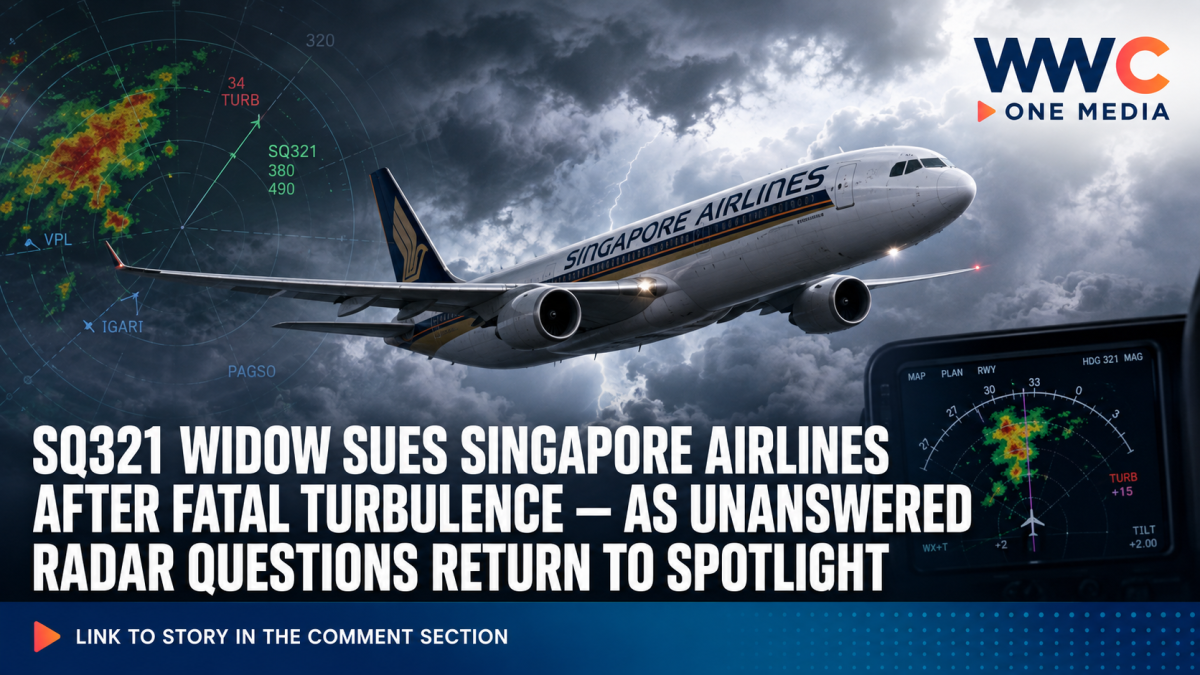
SINGAPORE — More than two years after one of the most serious turbulence incidents in Singapore Airlines’ history, the tragedy aboard Flight SQ321 is moving into a new arena: the courtroom.
Linda Kitchen, 74, whose husband Geoff Kitchen died after the London-to-Singapore flight encountered severe turbulence over Myanmar in May 2024, has begun legal proceedings against Singapore Airlines in Britain.
Kitchen herself suffered serious spinal injuries, including a broken back, and is seeking damages that her lawyers say will help pay for specialist support required for her recovery. Two claims involving the Kitchen family have reportedly been filed — one concerning Linda Kitchen’s injuries and another brought on behalf of her late husband’s estate.
But the court action could become about far more than compensation.
It comes just months after Singapore’s final investigation into SQ321 raised a question that remains difficult to resolve: Why did the aircraft apparently enter an area of dangerous convective weather without the pilots receiving a clear warning from their onboard weather radar?
A dream holiday that ended in disaster
Linda and Geoff Kitchen, from the Bristol area in England, had been married for more than five decades and were beginning a six-week trip through Singapore, Indonesia and Australia when they boarded Singapore Airlines Flight SQ321 at London Heathrow.
The Boeing 777-300ER was carrying 211 passengers and 18 crew members when it encountered severe turbulence over southern Myanmar on May 21, 2024.
What followed happened extraordinarily fast.
Singapore investigators found that the aircraft initially experienced an uncommanded climb amid an updraft. Then, at about 37,000 feet, vertical acceleration rapidly shifted from positive 1.35G to negative 1.5G in just 0.6 seconds.
Passengers and crew members who were not restrained were thrown upward.
Within the next four seconds, the forces reversed again, sending airborne occupants back down.
Flight data showed the aircraft lost approximately 178 feet — 54 metres — during the violent 4.6-second sequence.
The cabin was left badly damaged. Passengers suffered head, neck and spinal injuries, and the pilots diverted SQ321 to Bangkok’s Suvarnabhumi Airport for emergency medical assistance.
In total, investigators recorded 79 injured people. Fifty-six suffered serious injuries and 23 suffered minor injuries. Geoff Kitchen, 73, died aboard the aircraft. Singapore’s final investigation said he suffered heart failure and pulmonary oedema, a build-up of fluid in the lungs.
Linda Kitchen suffered a broken back
According to accounts she gave British media, Geoff Kitchen fell onto his wife during the violent movement, pinning her against a seat armrest as other passengers tried to help.
A doctor performed CPR on Geoff.
Linda was eventually taken to hospital in Bangkok, where she remained for about 10 days before being transported back to Britain. She then spent roughly another week in hospital and required substantial help after being discharged.
She later learned that her husband had died.
The widow has said she is not only pursuing compensation but also wants answers about what happened during the flight and whether anything could have been done differently.
The radar question investigators could not fully close
The lawsuit comes after Singapore’s Transport Safety Investigation Bureau released its final report into SQ321 in May 2026.
Investigators concluded that the turbulence was convectively induced, probably linked to a rapidly developing cloud capable of producing powerful upward and downward air movements.
Yet the pilots reported that their navigational weather displays did not show bad weather ahead, while visual observations appeared to show a clear flight path.
Investigators said it was likely the aircraft’s weather radar had not shown the true intensity of the weather conditions before SQ321 entered the affected area.
That finding, however, came with an important complication.
The radar manufacturer told investigators that post-flight testing found no evidence that the system had malfunctioned by failing to detect and display weather.
Adding another layer to the mystery, similar radar-related issues had reportedly been recorded on the aircraft on three occasions during the month before the SQ321 incident. Investigators also looked at other aircraft travelling through the broader region around the same period, some of which detected and avoided adverse weather, although their flight paths were not identical to SQ321’s.
The final safety investigation therefore did not establish that a specific hardware failure caused the accident.
That distinction could become important in court.
Just 17 seconds between the seat-belt sign and severe turbulence
The investigation also reconstructed how little warning time existed inside the aircraft.
As the initial turbulence began, the flight crew switched on the fasten-seat-belt sign.
But severe turbulence arrived only about 17 seconds later.
Investigators said there was not enough time for the crew to make a cabin announcement before the strongest forces struck.
That timeline illustrates one of aviation’s most difficult safety problems: some dangerous atmospheric conditions can develop or intensify rapidly, while airborne weather radar has inherent limitations.
Aviation specialists interviewed by CNA after the final report stressed that the evidence did not establish a straightforward pilot error or conclusively prove a radar hardware failure. Instead, the unanswered issue is why the overall warning system apparently failed to give the flight crew enough information to avoid the hazardous area.
Why the lawsuit could matter
International passenger claims involving Singapore Airlines are generally governed by the Montreal Convention, the global treaty governing airline liability for passenger injury and death on international flights.
Aviation-law experts told CNA that passengers can generally claim proven damages up to roughly S$235,000 (US$183,000) without having to establish airline fault under the current liability framework.
For damages above that level, questions about negligence, wrongful acts and whether another party was responsible can become significantly more important.
Serious spinal injuries, long-term medical treatment, loss of earnings and fatality claims can potentially produce damages well beyond the initial threshold, depending on the evidence and the law applied by the court.
Several other SQ321 passengers have also begun legal action against Singapore Airlines in Britain, according to British court records cited by The Independent and CNA.
Importantly, filing a lawsuit does not mean Singapore Airlines has been found negligent or legally liable. Those issues would have to be determined through the court process if the claims proceed to judgment rather than settlement.
The TSIB investigation itself was conducted for aviation-safety purposes and was not intended to assign civil or criminal blame. Singapore’s transport authorities explicitly state that safety investigations are designed to prevent future accidents rather than determine legal liability.
Singapore Airlines declines to comment on court case
Singapore Airlines told CNA and The Straits Times on August 29 that it was unable to comment because the matter is before the courts.
The airline previously apologised following the SQ321 incident and announced compensation for affected passengers.
In 2024, passengers classified as having minor injuries were offered US$10,000, while those with more serious injuries were invited to discuss compensation based on their individual circumstances and offered an advance payment of US$25,000 for immediate expenses.
Singapore Airlines also introduced additional turbulence-related safety measures following the accident, including enhanced turbulence-monitoring tools for crews, updated weather-radar guidance, refresher training and stronger reminders encouraging passengers to keep their seat belts fastened whenever seated.
The biggest question may now move from investigators to lawyers
Two years of technical investigation have established much of what happened aboard SQ321.
Investigators know how violently the gravitational forces changed. They know how rapidly passengers were thrown upward and back down. They know the seat-belt warning came only seconds before the worst turbulence. And they concluded that the aircraft flew into convectively generated turbulence that apparently was not clearly displayed to the pilots.
What remains unresolved is why.
For Linda Kitchen and potentially other injured passengers, that unanswered question is no longer only an aviation-safety issue.
It may now become one for a court to examine.
And depending on what emerges from the litigation, the SQ321 case could determine not just how one family is compensated for a devastating flight — but how responsibility is assessed when a modern airliner, sophisticated weather technology and an almost invisible atmospheric threat collide.


Leave a Reply