
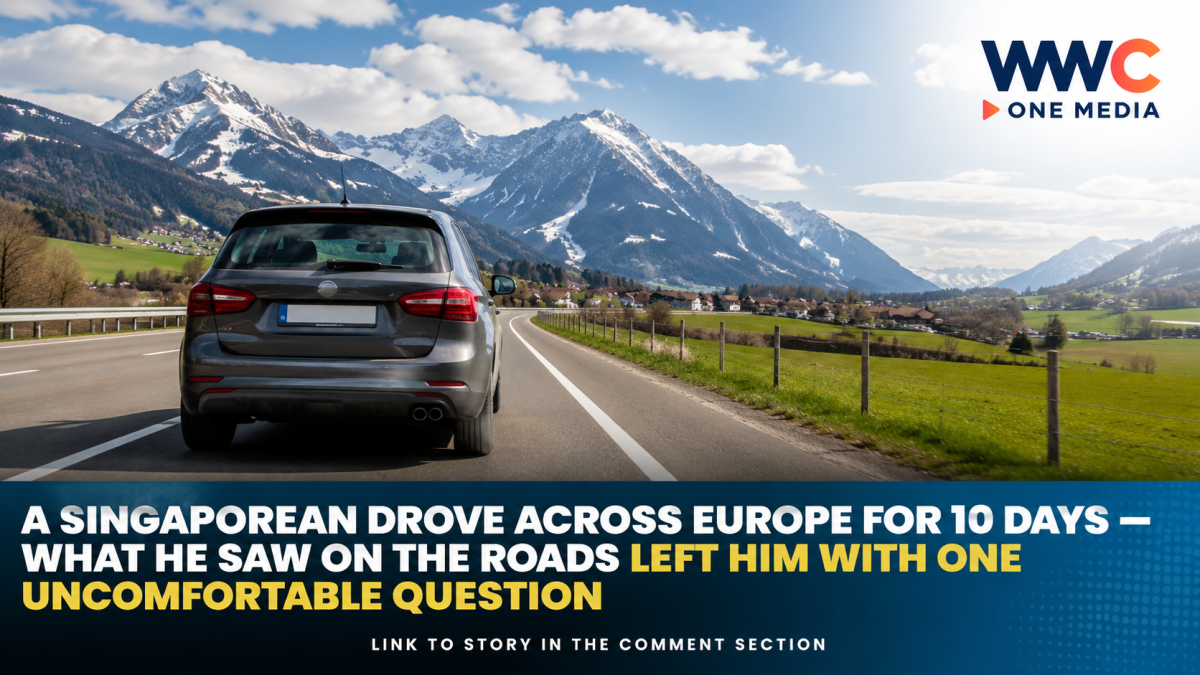
A road trip across Europe has reignited a familiar debate about Singapore drivers — but beyond the provocative headline lies a more serious question: are our roads being held back by infrastructure, or by the way we treat one another behind the wheel?
A 10-day road trip through Western and Central Europe was all it took for one Singapore-based motoring columnist to come home with a controversial conclusion: Singapore’s biggest driving problem may not be its roads, cars or speed limits — but its driving culture.
The opinion piece, originally published by Motorist and republished by AsiaOne, argues that European roads offered a striking contrast in areas such as lane discipline, giving way to emergency vehicles and general awareness of other road users.
It’s a sweeping claim, and one that should be treated as exactly what it is: a personal observation rather than a scientific study.
But the debate it has sparked touches on something far more difficult to dismiss.
The real issue isn’t whether Singaporeans are “bad drivers”
Singapore has no shortage of competent drivers. Nor is Europe some motoring utopia where every driver follows the rules perfectly.
Road safety standards and accident risks vary significantly across European countries, and recent reporting has highlighted substantial differences in road safety outcomes across the continent.
So perhaps the more useful question isn’t whether Singaporeans can drive.
It’s whether Singaporeans are consistently good at sharing the road.
That distinction matters.
A driver can be technically skilled yet still tailgate, block another vehicle unnecessarily, change lanes without consideration or fail to anticipate the needs of pedestrians and emergency responders. Safe driving is not simply about controlling a car — it is also about awareness, patience and cooperation.
And Singapore’s own road safety data suggests there is room for serious reflection.
Singapore’s road safety numbers tell a sobering story
The Government has been tightening enforcement as concerns over road safety grow.
According to the Singapore Police Force, road fatalities reached a 10-year high in 2025, while the number of people injured in road accidents also increased. From January 2027, the threshold at which non-probationary motorists face their first licence suspension will be lowered from 24 to 18 demerit points as part of tougher measures aimed at deterring unsafe behaviour.
Separate Traffic Police reporting found that common contributing factors in injury accidents included failing to keep a proper lookout, poor vehicle control and changing lanes without due care.
Meanwhile, the Ministry of Home Affairs has said Singapore recorded an annual average of about 190 dangerous-driving offences and nearly 18,000 careless-driving offences between 2021 and 2025.
Those numbers don’t prove that Singapore drivers are worse than drivers elsewhere. But they do show that the conversation about driving behaviour isn’t merely anecdotal.
The lane discipline debate isn’t just about the “fast lane”
One of the strongest points raised by the European road-trip article concerns lane discipline.
Anyone who has spent time on Singapore’s expressways has probably witnessed the familiar frustration: a slower vehicle occupying a lane while faster traffic builds up behind it, followed by tailgating, abrupt lane changes and sometimes risky overtaking.
Singapore’s Highway Code itself emphasises keeping left where appropriate rather than unnecessarily occupying the middle of the road, while official driving guidance also stresses signalling early, checking blind spots and avoiding dangerous lane changes.
But there is an important caveat: lane discipline should never become an excuse for aggressive driving or speeding.
A slower driver can create frustration, but the responsibility to drive safely remains with everyone. The answer to poor road etiquette isn’t more tailgating, intimidation or reckless manoeuvres.
It’s better anticipation — from both sides.
Europe offers one lesson Singapore could take seriously
Perhaps the most compelling observation from the road trip involves emergency vehicles.
In countries such as Germany, motorists are required in certain congested multi-lane situations to create a dedicated emergency corridor — known as a Rettungsgasse — so police, ambulances and rescue services can get through.
Singapore’s rules are clear too: motorists must give way to emergency vehicles and should not speed up to block them, overtake them or tailgate behind them.
The difference, therefore, may not always be about whether rules exist.
It may be about whether road users instinctively cooperate before they are forced to.
That is the heart of the debate.
We may have expensive cars — but courtesy is free
The original columnist made a tongue-in-cheek connection between Singapore’s Certificate of Entitlement and a sense of entitlement on the road.
It’s an attention-grabbing line, but the underlying point deserves consideration.
Singapore’s roads are a shared and limited space. Every driver, motorcyclist, cyclist and pedestrian is navigating the same environment, often under time pressure and in close proximity to one another.
That makes courtesy more than just good manners. It is a safety tool.
Giving someone space to merge. Slowing down when visibility is poor. Checking twice before changing lanes. Allowing an elderly pedestrian time to cross. Moving safely aside for an ambulance.
None of these actions makes someone a weaker driver.
In fact, they may be the clearest signs of a confident one.
So, can Singaporeans drive?
Of course they can.
But that isn’t the question we should be asking.
The better question is whether Singapore can build a driving culture where being skilled behind the wheel also means being patient, predictable and considerate of everyone else on the road.
With road fatalities rising and authorities introducing tougher penalties, this isn’t just another online argument about who belongs in which lane. Singapore’s own road safety trends suggest that driving behaviour deserves closer attention.
A 10-day European road trip cannot deliver a definitive verdict on an entire nation of drivers.
But sometimes an outsider’s perspective — or simply seeing how things are done elsewhere — can expose habits we have stopped noticing.
And perhaps that’s the uncomfortable takeaway from this viral road-trip debate:
The biggest upgrade Singapore’s roads may need isn’t necessarily a new lane, a faster speed limit or a more expensive car. It could simply be a little more consideration from the people holding the steering wheel.




Leave a Reply