
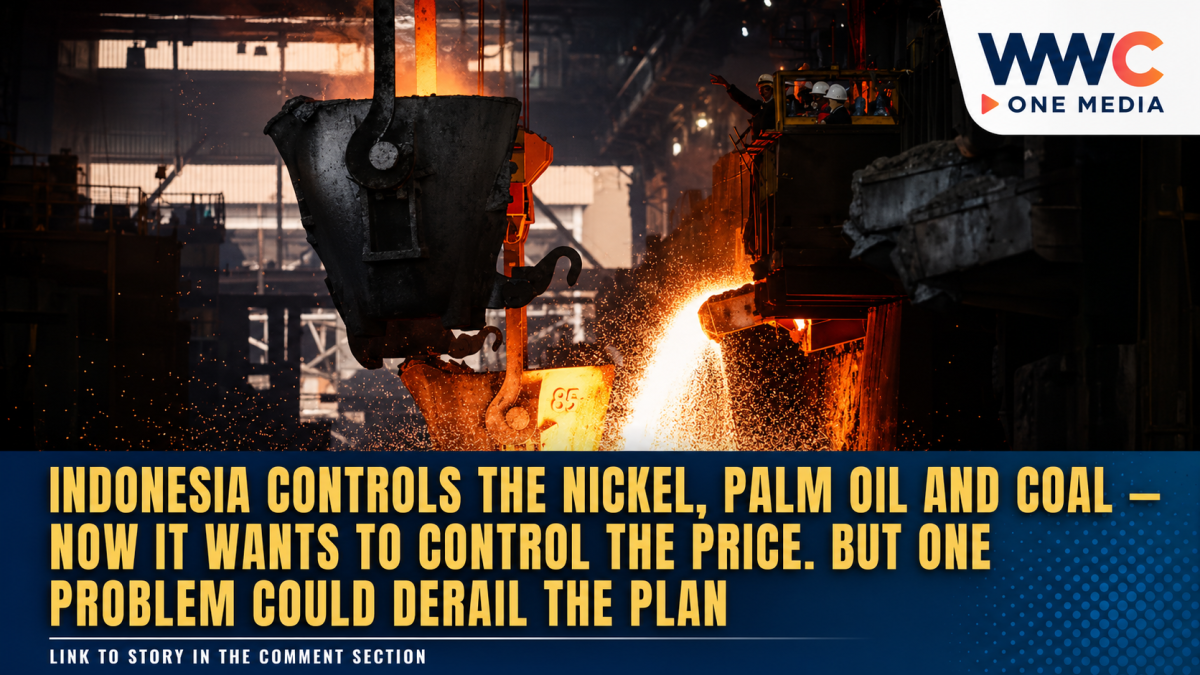
JAKARTA — Indonesia is preparing one of its boldest attempts yet to turn its natural-resource dominance into global pricing power, with President Prabowo Subianto targeting January 1, 2027 for the launch of a new mineral and strategic commodities exchange.
The ambition is straightforward: Indonesia does not want to remain merely one of the world’s biggest suppliers of nickel, palm oil and thermal coal while exchanges and trading hubs overseas continue to provide the benchmarks used to price much of that output. Prabowo formally announced the plan on August 14, saying Indonesia should have a stronger role in determining the value of resources produced within its borders.
But building an exchange is the easy part. Convincing miners, plantation companies, commodity traders, banks and foreign buyers that its prices are trustworthy enough to replace—or even seriously compete with—established international benchmarks could be far harder.
Indonesia has the commodities. Now it wants the pricing power.
The planned Bursa Mineral dan Komoditas Strategis, or Mineral and Strategic Commodities Exchange, is expected to cover major Indonesian exports including nickel, palm oil and coal, with other strategic commodities potentially following.
The exchange will be supervised by Indonesia’s Financial Services Authority, or OJK, and implementing rules are expected to be developed ahead of the January launch. S&P Global reported that the government wants the platform to establish Indonesian reference prices rather than depending so heavily on overseas benchmarks.
That objective has enormous economic implications.
Indonesia sits at the center of the global nickel industry, particularly after years of investment in processing and smelting driven heavily by demand for stainless steel and electric-vehicle batteries. It is also a dominant producer and exporter of palm oil and thermal coal. Yet benchmark pricing for these commodities remains concentrated elsewhere: nickel is heavily influenced by trading on the London Metal Exchange, while Malaysian derivatives markets play a major role in global palm-oil pricing.
Prabowo’s argument is that a country supplying such a large share of strategically important raw materials should have more influence over the price at which they are sold.
Nickel shows exactly why Jakarta wants more control
The nickel market provides perhaps the clearest demonstration of Indonesia’s growing influence—and the limits of that power.
Nickel prices plunged from an average of about US$21,474 per metric tonne in 2023 to US$15,349 in 2025, according to figures cited by CNA. Jakarta responded by signalling tighter mining quotas for 2026, with annual permits targeted at roughly 250 million to 260 million wet tonnes, well below the 379-million-tonne figure previously discussed for 2025.
The market reacted quickly. Benchmark nickel surged from around US$14,235 a tonne in December 2025 to almost US$19,000 in January, Reuters reported, demonstrating just how much Indonesia’s supply decisions can move international prices. Nickel later reached roughly US$19,350 in April before retreating toward US$17,000 by August.
That episode underlines Jakarta’s thinking: Indonesia already has enough production power to shake commodity markets. The government now wants an Indonesian trading platform capable of turning that physical dominance into lasting price-discovery power.
But Indonesia already has a warning sign
Indonesia does not have to look overseas to understand how difficult that will be.
The country already has commodity-trading infrastructure, including palm-oil trading through the Indonesia Commodity & Derivatives Exchange (ICDX). Yet industry participation remains limited.
CNA reported that only around 50 of Indonesia’s roughly 2,000 palm-oil companies are registered to trade through the exchange. Even more striking, of approximately 511 trillion rupiah worth of palm oil Indonesia exported in 2025, only about 2.69 trillion rupiah was transacted through ICDX—roughly 0.5% of total export value.
That is the central obstacle facing Prabowo’s new exchange.
A commodity benchmark becomes influential not because a government declares it important, but because enough producers, buyers, traders and financial institutions actually use it.
Without large and continuous trading volumes, there is not enough liquidity to produce a price that global participants trust.
The Jakarta Post has highlighted a similar concern, noting that Indonesia previously established domestic exchanges for crude palm oil and tin but struggled to turn them into internationally dominant reference prices because trading liquidity remained limited. Analysts warned that credible benchmarks require large transaction volumes, regular trading and confidence in the exchange’s mechanics.
Fees could become another make-or-break issue
Palm-oil producers have also raised a practical problem: trading through an exchange can cost more than dealing directly with established buyers.
GAPKI chairman Eddy Martono told Indonesian media that companies face membership, transaction and clearing fees when using an exchange. Direct bilateral deals can be cheaper and may include substantial advance payments, while prices can still be referenced against transparent international benchmarks.
For Jakarta, that creates a difficult equation.
If participation in the new exchange is optional, companies may simply continue using established trading arrangements.
If participation becomes mandatory, the government could generate volume quickly—but it risks increasing costs, interfering with existing long-term contracts and unsettling buyers.
Sarjito, selected to head supervision of the new mineral and strategic commodities exchange, has said the market does not need to be enormous immediately but must be trusted from its first transactions. He has outlined policies aimed at making the bourse liquid, credible and properly supervised.
CNA reported that Sarjito also indicated exchange trading would be mandatory, although it was not yet clear whether that requirement would apply to exports, domestic transactions or both. That detail could become one of the most closely watched parts of the final regulations.
This is bigger than commodity trading
The exchange is part of a much broader Prabowo strategy to tighten Indonesia’s control over the money generated by its natural resources.
Earlier this year, the government established Danantara Sumberdaya Indonesia, or DSI, to monitor strategic commodity exports and improve transparency around volumes, declared values and foreign-exchange earnings.
The initial announcement caused market concern that Jakarta intended to centralise commodity sales completely. Officials subsequently stressed that DSI would monitor rather than take control of commercial exports. Reuters reported this month that DSI had already monitored thousands of transactions as the government sought to detect under-invoicing and other practices believed to reduce state revenue.
The presidential office has similarly said the system is intended to reconcile how much commodity is loaded onto ships, how much exporters declare and how much ultimately reaches overseas destinations.
Together, DSI and the new commodity exchange represent a significant shift: Jakarta is attempting to gain greater oversight not only over what Indonesia exports, but also how those exports are priced and how much money returns to the country.
The biggest question is credibility
There is one complication Jakarta cannot solve simply through legislation.
International markets must believe the prices produced by the exchange reflect genuine supply and demand—not the price the government would prefer commodities to fetch.
That distinction will be crucial.
Indonesia’s financial markets have already faced heightened scrutiny this year. Reuters reported in January that MSCI raised concerns about ownership transparency and trading practices in Indonesian equities, triggering a severe stock-market selloff and fears Indonesia could eventually face a downgrade from emerging- to frontier-market classification if reforms prove insufficient.
Against that backdrop, transparency in the new commodity exchange—from transaction reporting and clearing to surveillance and prevention of manipulation—will matter almost as much as trading volume itself.
Indonesia has the resources to command attention. It has the world’s most powerful position in nickel supply and enormous influence across palm oil and coal.
But being the world’s dominant producer does not automatically make a country the world’s dominant price setter.
London and Malaysia built their commodity benchmarks through years of liquidity, reliable contracts, market infrastructure and international participation. Indonesia now wants to compress that journey into a much shorter timeframe.
The January 1 launch may therefore be only the beginning.
The real verdict will come when traders around the world decide whether an Indonesian price is one they are willing to trust—and put billions of dollars behind.


Leave a Reply