
HONG KONG — After years of trying to convince investors that it had become a truly global fashion powerhouse, Shein is finally heading to the public market.
But not in New York. Not in London. And nowhere near the valuation it once commanded.
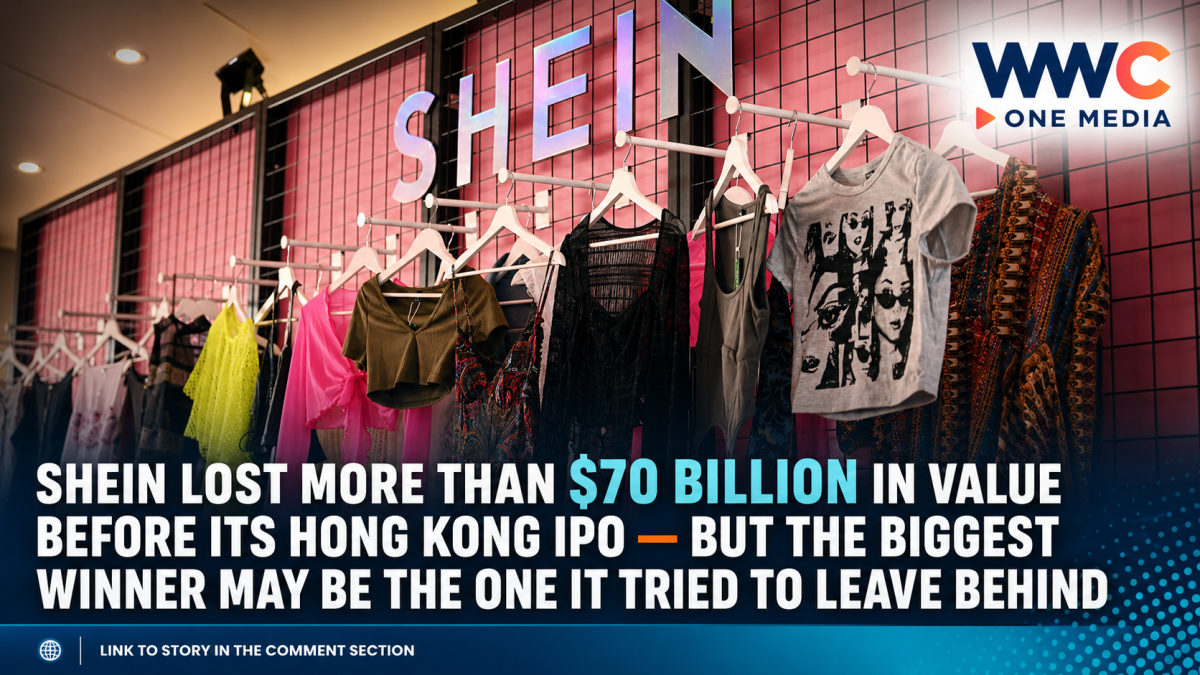
The China-founded, Singapore-headquartered fast-fashion giant priced its Hong Kong initial public offering at HK$48.56 per share, raising about US$1.7 billion and valuing the company at roughly US$26.5 billion ahead of its scheduled September 1 trading debut.
That number tells one of the biggest stories behind the IPO.
In 2022, private investors valued Shein at nearly US$100 billion. Its new valuation is more than 70% below that peak — effectively wiping tens of billions of dollars from the value investors once placed on one of the world’s fastest-growing fashion businesses.
And yet, despite the enormous markdown, one part of Shein’s business may emerge more important than ever: its deeply entrenched manufacturing network in southern China.
Shein Tried to Become Global — But China Never Really Left the Business
Shein moved its headquarters to Singapore in late 2021 and spent years building the image of an international company.
It expanded manufacturing initiatives into countries including Brazil and Turkey and initially pursued a blockbuster stock-market listing in New York before switching its attention to London.
Neither attempt succeeded.
Reuters reported that Shein struggled to obtain the necessary approval from Chinese authorities for an overseas listing while simultaneously facing growing political and regulatory scrutiny in Western countries.
Eventually, Shein returned closer to where its business model began.
Founder Sky Xu increased engagement with Chinese officials, while the company emphasised the economic importance of its operations in China. Xu also pledged US$1.5 billion in investment during a February 2026 appearance in Guangdong, the province at the heart of Shein’s manufacturing system.
Reuters reported that nearly 80% of Shein’s workforce is in mainland China, according to the company’s IPO prospectus.
That makes Shein’s identity more complicated than the Singapore headquarters might suggest.
Its corporate address may be international, but the production machine responsible for its extraordinary speed remains heavily Chinese.
Thousands of Factories Built Shein’s Real Competitive Advantage
The core of Shein’s model is concentrated around Guangzhou in southern China, where thousands of factories and suppliers form an unusually dense apparel-production ecosystem.
That network allows Shein to react quickly to online trends, place relatively small initial production orders and move successful designs into larger production runs at speeds traditional fashion retailers can struggle to match.
CNA’s Bloomberg Opinion commentary argues that this supplier network could ultimately be the biggest beneficiary of Shein’s IPO.
The argument is strengthened by Shein’s own investment plans.
According to the prospectus cited by CNA, about 40% of IPO proceeds are expected to go toward technology, including improvements connected to the manufacturing and supplier network.
That means the public listing could reinforce — rather than reduce — Shein’s dependence on the manufacturing ecosystem it once appeared eager to deemphasise.
Investors Aren’t Paying Anything Close to the Old Price
Perhaps the clearest warning sign is Shein’s valuation.
The company was worth approximately US$98.2 billion in 2022 and around US$64 billion in later fundraising rounds, according to company filings cited by Reuters and CNA. It is now entering the Hong Kong market at roughly US$26.5 billion.
Even more unusually, Shein has agreed to compensate some earlier private investors whose investments contained protection against a major valuation decline.
The company could pay up to approximately US$3.5 billion to certain earlier investors — about twice the US$1.7 billion being raised in the IPO itself.
The listing therefore looks very different from the triumphant mega-IPO once imagined when Shein was approaching a US$100 billion valuation.
Investor demand covered the institutional order book, but Reuters reported relatively weak enthusiasm among retail investors amid concerns about slowing growth, rising costs and Shein’s future profitability.
Shein’s Growth Engine Is Starting to Sputter
The valuation collapse isn’t simply the result of geopolitics.
Shein’s underlying growth has also slowed dramatically.
Its IPO prospectus indicated that first-half 2026 revenue growth was expected to remain broadly around the 1.1% year-on-year growth recorded in the first quarter. The company also expects its operating margin to be slightly weaker.
Shein reported a US$99 million quarterly loss, partly reflecting the impact of accounting charges and changes to the trade environment after the United States ended a tariff exemption for low-value imported packages.
That exemption — commonly known as the de minimis rule — had been particularly valuable to companies such as Shein because huge quantities of inexpensive products could previously be shipped directly to American consumers without standard import duties.
Europe has also tightened rules governing low-value e-commerce shipments.
For a business built around selling inexpensive clothing at enormous scale, even relatively small increases in shipping, customs and compliance costs can become significant.
Regulatory Pressure Isn’t Going Away
Shein’s challenges extend beyond tariffs.
Reuters reports that the company has faced regulatory investigations in both the United States and Europe, while previous European investigations have resulted in penalties involving allegations such as misleading discounts and greenwashing.
The company has said it maintains high standards of corporate governance, transparency and accountability.
Shein has also faced years of questions surrounding its supply chain and allegations involving forced labour risks. The company prohibits forced labour under its supplier code of conduct, while Beijing rejects allegations of forced labour in Xinjiang.
Those controversies helped complicate Shein’s attempts to achieve a Western stock-market listing.
Shein Now Wants to Turn Its Supply Chain Into a Product
The company’s next strategy could be even more important than selling Shein-branded dresses.
With growth slowing in mature Western markets, Shein wants to use its manufacturing capabilities to support other fashion brands.
The idea is straightforward: acquire or work with outside labels and connect them to the same highly responsive supplier ecosystem that helped Shein dominate ultra-fast fashion.
But the model has not yet proved transformational.
CNA’s Bloomberg Opinion commentary notes that Shein’s earlier designer-support and fulfilment initiatives contributed no more than about 1% of sales last year.
Acquisitions could accelerate the strategy, but they introduce another problem: brands with their own identity, quality standards or sustainability positioning may not fit naturally into Shein’s ultra-fast-fashion production machine.
That makes Shein’s next chapter much harder than simply producing more inexpensive clothing.
The Bigger Message Behind Shein’s IPO
Shein’s Hong Kong listing is still significant.
It is the largest Hong Kong IPO of 2026 so far, according to Reuters, and comes during a major rebound in fundraising in the city. Hong Kong IPOs had raised roughly US$41 billion this year by late August, more than double the comparable amount a year earlier.
The Hong Kong Stock Exchange also lists Shein under stock code 00625, with its global offering documents published on August 24.
But Shein’s journey contains an uncomfortable irony.
The company spent years attempting to present itself as increasingly global while seeking the prestige and capital of New York or London.
Instead, it is arriving in Hong Kong at barely one-quarter of its former valuation — and investors are being asked to bet heavily on the very Chinese production ecosystem the company once tried to make less central to its international story.
Shein’s IPO therefore isn’t just about whether investors believe a US$26.5 billion valuation is cheap.
The much bigger question is whether the manufacturing system that revolutionised fast fashion can produce another growth story now that the original one is slowing.
And if it can, the thousands of factories clustered around southern China may prove to be the most valuable part of Shein after all.




Leave a Reply