
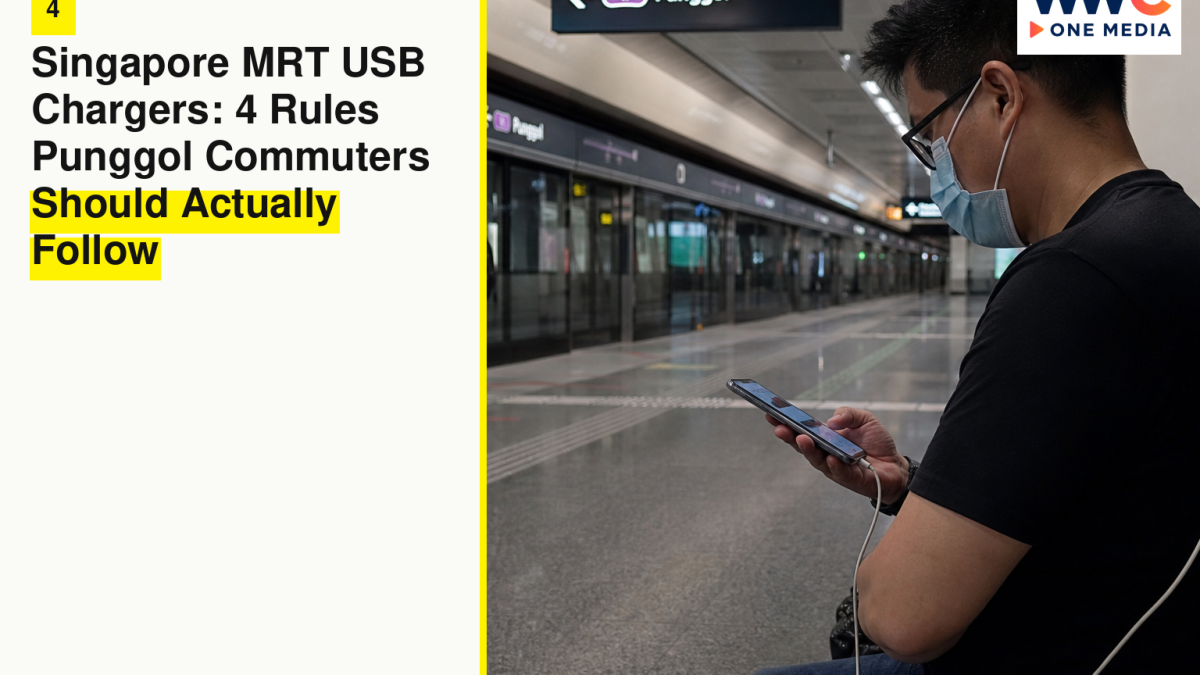
SINGAPORE — The North East Line out of Punggol can feel long enough to justify a plug. A seat with a USB port looks like infrastructure. It is someone else’s brick in a public place. Singapore MRT USB chargers are a convenience painted onto a commute, not a promise that the port is kind to a work phone. Punggol commuters who still have a laptop in the bag and a morning that starts at Waterway Point already know the cleaner rule, even if they ignore it when the battery hits red after a night of maps: your cable, your bank, or nothing.
This is not a scare poster. It is not a how-to for anyone who wants to mess with a port. It is four rules you can actually follow between Punggol and HarbourFront, plus the extra logistics people skip until a prompt appears that they did not expect. Juice jacking, in the boring sense, is a caution: a public USB port is a computer you do not control. You do not need the attack diagram. You need a habit.
Have the four rules in your head before the doors close at Punggol. After you plug a work phone into a seat, you are in a conversation with hardware you did not bring.
1. Singapore MRT USB chargers are not your charger — bring your own cable or do not plug in
A port in a seat is a hole with power behind it, maybe. Sometimes it is dead. Sometimes it is slow. Sometimes it is fine for a sip and you will never know what else it is willing to talk about. The first rule is not technical theatre. It is ownership.
If you insist on using a public USB port, the cable should be yours, from your bag, the one you already use at home. You plug your cable into the seat. You do not pick up a lead that was “helpfully” left on the fabric. You do not borrow from the person beside you because their braid looks expensive. Their cable is their problem. A stranger’s cable is a stranger’s hardware.
A charge-only cable is the minimum if you still want the seat. Many office people in Punggol already own one without thinking of it that way: a short lead that will not do data, used with a power bank. If your daily cable is a data cable — and most phone cables are — then the seat USB is a worse idea than it looks. Data-capable cables are how phones and computers have conversations. You do not owe a public seat a conversation.
Number the decision at the platform, not after you sit:
- Battery is fine until Raffles Place or the office. Do nothing. Ride.
- Battery is low, you have a power bank. Use the bank, your cable, your brick in miniature. Keep it in the bag or on your lap, not as a tripwire in the aisle.
- Battery is low, no bank, you are tempted by the seat USB. Ask whether this phone is a work phone. If yes, do not plug it into the seat. Ride ugly. Borrow a wall at Punggol MRT, at a mall, at the office, at a kopitiam near the interchange. A wall you can see is still not magic, but it is a different class of object from a port inside upholstery.
- Personal phone, no bank, you still want the seat. Own cable only. Watch the phone. If anything except a charge icon appears, unplug.
What not to do. Do not plug in “just to see if it works” with a work profile, company mail, and a bank app sitting on the same device. Do not use a cable that was on the seat as if the train had a lost-and-found of generosity. Do not daisy-chain a hub, a dongle, and a phone into a public port because you also wanted to charge earbuds. That pile is how you look busy and think less.
City logistics. Punggol station in the morning is a funnel from the LRT, from the bus interchange, from Waterway Point coffee that ran long. You will not have a calm minute to inspect a port. That is why the rule is binary. Own cable or no seat USB. Binary survives a crowd. A ten-step protocol does not.
Objection: “It’s just five percent, I have to.” Five percent is a planning failure from last night, not an emergency the train is required to solve. Charge at home. Charge at the office. Carry a small bank. The North East Line will not become your charger because you stayed on a phone at 1 a.m. in a Punggol flat.
2. A power bank in the bag beats a seat USB, and it still has manners
A power bank is the actual public-transport charger. It is yours. It charged in your kitchen. It connects with your cable. It does not live in a seat that thousands of commuters have already used as a table for packets of tissue and a wet umbrella.
Carry it. Use it. Do not perform it.
Manners on the North East Line, the Punggol LRT, and the walk through Waterway Point:
- Bank in the bag or on your lap, cable short, phone in your hand or a zipped pocket. A long cable across two seats is how you annoy a neighbour and snag a trolley bag.
- Do not leave the bank on an empty seat as a claim. It is a trip hazard and a theft with a waiting time.
- Do not block the doorway at Punggol while you rummage for a brick the size of a novel. If your bank is that big, it belongs in a backpack pocket you can reach without becoming architecture.
- If the bank or the phone runs hot, stop. Heat is the same information it is at home. Public transport is not a reason to ignore a hot battery.
- Keep it contained. A bank in a bag is ordinary. A bank deployed as a sprawl of wires is a mess. This desk is not your airline. For flights you follow the airline. For the MRT, keep it contained.
Work phones and personal phones should not share a “I will just top up on the train” philosophy. A work phone is a small office. Treat it like you would treat a staff laptop. You would not plug a staff laptop into a USB hole in a seat. Do not plug the phone that holds the same mail into that hole either.
A small Punggol kit that actually gets used:
- One short marked cable in the front pocket of the bag.
- One small bank that you actually recharge on a weeknight, not a brick that has been at 4 percent since January.
- A wall charger that stays at home and another that stays at the desk if you can. The train is not the third charger. It is the failure mode.
What not to do. Do not buy a bank at a kiosk in Waterway Point at 8:10 a.m. because the phone died and then immediately plug a mystery cable into a seat until the bank has some juice. You now have two unknown relationships. Do not charge the bank from the seat USB. That is the same public port with an extra device. Charge the bank at home.
Objection: “Power banks are bulky.” The small ones exist. The bulky ones are a choice. A dead phone on the way from Punggol to the CBD is also bulky, in the sense that it occupies the rest of your morning. Pick the bulk you prefer.
3. Juice jacking is a caution, not a campfire story — skip the how-to, keep the habit
You will hear the phrase. Juice jacking. It sounds like a movie. People use it to mean a public USB port that does more than give power: it tries to talk to the phone, prompt something, move something, install something. This desk will not draw the diagram. We will not list tools. We will not tell you how a port would be wired to misbehave. You do not need that. Attack steps are not a public service.
What you need is the caution in one sentence. A USB port is not only a power socket. USB is a data family. A wall outlet with a dumb adapter is a different object from a USB hole in a seat, a kiosk, an airport chair, or a mall charging station. If you did not bring the charger, you do not know what the hole is.
So the habit is boring:
- Prefer a wall plus your own brick and cable.
- Prefer your own power bank.
- If you use a public USB port anyway, use your own cable, prefer charge-only if you have it, and unplug at the first unexpected prompt.
- Work phones stay off public USB.
- Never tap through a popup you did not expect while a public cable is attached. Unlocking a phone to “just allow” is how a caution becomes a story.
You may never see a prompt. Most commutes will be uneventful. Uneventful is not the same as guaranteed. Habits are for the uneventful days so that the weird day is already handled.
What not to do. Do not test a port with a friend’s phone to see if it is safe. You have not made it safe. You have involved two people. Do not look up exploit steps on the train because a thread scared you. The thread will not charge your phone. It will give you a worse morning. Do not announce to a carriage that the port is a hacker trap. You do not know that. You know it is public.
If a prompt appears — a computer wants to access data, a file transfer, a trust question, anything that is not a charge icon — you unplug. You do not screenshot it for a group chat while it is still connected. Unplug first. Ride. Deal with the phone when it is only your hardware again.
This is the same family of caution as a public computer at a library. You can use it. You should not log into a bank on it. You should not treat it as yours. Singapore MRT USB chargers sit in that family. Public. Convenient. Not yours.
4. If the phone is hot, stop — heat plus a mystery port is a cue to ride ugly
Heat is the rule people skip because a percentage is climbing. A warm phone on a morning train can be ordinary: maps, a crowded car, Punggol sun through the window, a case that does not breathe. A phone that is hot while it is drinking from a seat USB is a different sentence. Unplug. Let it calm down. Use the bank later if you must, with your cable, after the temperature is ordinary.
Hot plus public port is a stop for three practical reasons, none of which require a lab:
- You cannot see the quality of the power. Tired charging makes heat. Heat is bad for batteries you still need to live with for years.
- You cannot see whether the phone is working harder than a charge, talking when you wanted a sip.
- You are in a packed car. A hot device in a pocket against a stranger is how you become a problem for more than yourself.
Ride ugly. Ugly is a phone at 8 percent that still does a fare in a wallet, or a card you still carry because you are not a person who bets the whole commute on a battery. Ugly is getting off at Serangoon or Dhoby Ghaut and using a wall in a mall if the morning can take ten minutes. Ugly is not plugging into the next port to see if this one is cooler.
What not to do. Do not put a hot phone under a thigh to hide the glow. Do not keep charging in a case that is already an oven, with wireless buds stacked on top, while the seat USB keeps pushing. Do not ignore a warning the phone already knows how to show. If the device says it is too hot to charge, believe it.
Battery anxiety is cheaper than a weird prompt. Battery anxiety is also cheaper than a swollen battery next year. The train will arrive. The office will have a wall.
Punggol to the CBD is shorter than your fear of 12 percent
Punggol, then Sengkang, then the long North East Line run toward HarbourFront. People get off for the Circle Line, the Downtown Line, the walk into the CBD. The ride is not nothing. It is also not a long-haul flight. A phone that left the flat at 40 percent will survive a normal morning of maps, music, and a few chats if you are not recording video the whole way.
Charge overnight. Charge while you make coffee. Charge at the office while you make the second coffee. The seat USB is what you reach for when those three did not happen. Fix the three.
If you are the person who navigates with maps the entire walk from Punggol MRT to a bus stop you already know, download the offline area. Maps that do not have to shout at a mast use less battery. Dark mode on a night ride is kindness to you and to the person opposite. Brightness is a battery setting before it is an aesthetic.
A numbered evening reset for Punggol flats:
- Bank on a plug, not in the bag at 4 percent.
- Phone on a plug while you shower, not while you sleep under a pillow.
- Cable that you will take tomorrow is the one on the bank, not a mystery from a kitchen mug.
- Fare card or phone-wallet situation known before you leave, so a dead phone is not a dead gate.
- Work laptop charged on its own brick. The train will not charge it. Do not even look at a seat USB with a laptop cable. That is how a commute becomes an incident.
If you use a watch or a phone as a fare, keep a physical card in the bag anyway for the week you get this wrong. Public transport in Singapore is not a good place to discover that your only fare is a battery.
What a public USB port actually is
It is a shared object. It has been used by school bags, by spilled drinks, by people who jammed a connector in at a slant. It may be dirty. It may be loose. It may be wired to a charger that is tired. It may be fine. You cannot tell which of those is true from the plastic.
So you do not put your only work device into a shared object for a 10 percent sip unless you have no other option and you accept the trade. Most Punggol commuters have another option. It is called last night.
Airport charging stations, mall chairs, coach seats, library tables — same family. The rule set travels. Own brick on a wall is best. Own bank is second. Public USB is last, own cable only, work phone excluded, heat is a stop.
Hotel desks in the CBD are not public USB. They are still not your living room. Use your brick. Hotel furniture has a hobby of hiding power strips behind beds.
Punggol LRT is a smaller car and a worse place for a cable performance. If you plug in on the LRT loop toward an estate station, you are doing it in a space where knees already fight. Prefer the bank. Prefer not charging for a six-minute ride. The LRT is not a lounge.
Waterway Point has walls and cafes and the particular temptation of “I’ll just sit.” Sitting is fine. A cafe wall with your brick is fine. A public charging table with a forest of USB holes is the same family as the seat. Own cable, or use the wall outlet the shop actually offered.
Seat etiquette so the rule does not turn you into a problem
The North East Line at 8.20 a.m. is a body problem before it is a battery problem. If you take a seat with a USB because you want the port, and someone who needs the seat more is standing, you have made a social mistake that no charge percent will fix. Charge standing with a bank. Give the seat away.
Cables on the floor are how people trip into other people. Short cable. Phone in hand. Bank in bag.
Do not unplug someone else to take the port. Do not ask a stranger whether their cable is safe. Do not lecture a carriage. Follow your own four rules quietly.
If a port is clearly broken — loose, sparking, wet — you do not use it and you do not keep poking it. Move. If you can tell staff without making a scene, do. You are not a technician. You are a commuter who can walk to another car.
Priority seats are not charging stations with better stickers. If you are in a priority seat because the car is empty, fine. If the car fills, you stand. The USB hole does not make the seat yours.
Work phone versus personal phone, written as a house rule
One sentence for people who carry two devices, which is a lot of Punggol office traffic:
The work phone never uses Singapore MRT USB chargers. The personal phone uses a power bank. Public USB is a last resort with my cable, and I unplug if the phone gets hot or talks.
If you only carry one phone, it is a work phone the moment it has company mail. Treat it as the work phone.
If IT already issued a policy, follow the policy. This desk is not a substitute for a staff handbook. If the handbook says no public USB, that is the whole article for that device.
Company laptops stay in the bag. There is no version of this commute where a notebook drinks from a seat USB. If the laptop is dying, you work on paper or you wait for a desk. You do not invent a docking station between Punggol and Little India.
The prompt you should never tap on a train
You may never see it. If you see a trust request, a file transfer, a computer name, a pairing, an install, anything that is not charging — unplug. Do not tap Allow. Do not tap Trust. Do not enter a passcode to just dismiss while the cable is still in. Unplug, then dismiss.
We are not describing how someone would cause that prompt. We are describing your hands. Unplug. Ride. If you are worried, do not use the phone for banking until you are on a network you trust and the cable is yours at a wall. If your company has a desk that collects weird device behaviour, that is their job. Yours is to stop feeding the port.
A library computer is the analogy that stays useful. You might check a catalogue. You would not key in a bank password. You would not insert a work USB stick into a machine whose history you cannot see. A seat USB is closer to that computer than it is to the wall outlet above a hawker table.
Night trains, weekend trains, and the false calm
A Sunday NEL with seats is when people get sloppy. The port is empty. The car is quiet. You think the risk went home with the office crowd. The port did not become yours because the commute is leisure. Same hole. Same rule.
Late trains toward Punggol after overtime in the CBD are when batteries are actually low. That is a real use case for the bank you should have charged. It is not a use case for a port you did not inspect, in a car where you might fall asleep on your own cable. If you are that tired, you hold the phone or you put it away. You do not build a charging nest and close your eyes.
Weekend trips from Punggol to HarbourFront for the mall, to Chinatown, to a beach with a long transfer — still a bank day. Tourist-density cars have more abandoned cables, not fewer. An abandoned cable is not a gift. Leave it.
What this desk is not telling you
We are not claiming a measured infection rate for seat USB in Singapore. We are not naming a train model as unsafe with a fake test. We are not walking you through tampering. We are not telling you to take a seat apart. We are not telling you that every public port is hostile. Most days, most ports, nothing cinematic happens. Habits are still worth more than a sip.
We are not telling you to fear USB as a shape. Your wall brick at home is USB. Your bank is USB. Ownership is the point. Public is the point.
If a colleague swears they have charged from the NEL for years, they may be telling the truth. They still cannot sell you their luck. You can still carry a bank.
Bottom line
Singapore MRT USB chargers look like a favour to Punggol commuters. They are a public USB hole in a seat. Four rules are enough: your own cable or you do not plug in; a power bank in the bag beats the seat; juice jacking stays a caution without a how-to, which means you do not give a work phone to a port you do not control; heat means stop, even if the percentage is climbing. Charge at home. Carry a card for the gate. Ride ugly when you have to. The NEL will get you to the CBD. It does not have to raise a battery to do it.




Leave a Reply